Do You Need to Wash Hydroponic Greens?
The appeal of growing leaves in water is partly that they arrive clean. No grit in the folds, no washing up a sink full of soil, nothing to pick out. That is true, and it is one of the better small pleasures of the whole business. It is also a claim about dirt, and somewhere along the way it gets read as a claim about safety. Those are not the same claim, and the second one deserves to be checked rather than assumed. One crop sits outside everything below, because washing watercress does not make it safe if it came out of a stream.
What this site has already said, and what it did not
Our article on when to harvest tells you to put leaves away dry and unwashed and to wash them at the moment you eat them. Our article on whether hydroponic food is as nutritious explains why that order and not the other one, because washing costs vitamin C and wet leaves in a fridge go slimy.
Both of those are arguments about crispness and about vitamin C. Neither one is an argument about safety. Sitting next to them is a sentence saying that hydroponic leaves are clean already, and that sentence has been doing more work than it was ever asked to do. This article is the check.
What washing is actually for
Leafy greens are the crop that food safety people worry about, because they are eaten raw and they are eaten in quantity. A Purdue study we will come back to counts 51 foodborne outbreaks linked to leafy greens reported to the Centers for Disease Control and Prevention between 2014 and 2018.
In a field, the same paper lists where contamination comes from: polluted irrigation water or wash water, the soil itself, animal faeces, and the people handling the crop at harvest and packing. A soilless system in a kitchen deletes most of that list outright. There is no soil, no manure, no run off from a neighbouring field, and nothing with four legs walking through the crop. That is a real advantage and it is the honest half of the clean leaves claim. Our comparison of hydroponics against soil makes the same point about plant disease, and it holds here too.
What it does not do is remove the whole list. It removes the routes that run through dirt and leaves the ones that run through people, animals and water.
Indoors is not the same as sealed
In July 2021 the United States Food and Drug Administration investigated an outbreak of Salmonella Typhimurium traced to packaged salad greens from a greenhouse farm in Rochelle, Illinois. Thirty one people were ill and four were taken to hospital. The recall started on 15 July and was widened twice.
The part worth sitting with is where the investigators found the organism. Samples taken inside the facility grew a different salmonella, not the one making people ill. The genetic match to the outbreak strain came from an outdoor storm water drainage pond next to the building. The agency’s own summary says that no clear route of contamination was readily identified.
That is a commercial operation that a federal agency visited and sampled, and the honest conclusion from it is not that indoor growing is dangerous. It is that a roof is a smaller set of doors rather than no doors, and that the route in can be something nobody thought to watch.
A reservoir is a comfortable place to live
The second thing worth knowing is what happens if something does get in. Researchers at Purdue ran paired hydroponic and aquaponic systems in a greenhouse for several years and looked for Shiga toxin producing E. coli in the water, the roots, the leaves and the fish.
They measured the conditions in their reservoirs and reported plainly that the dissolved oxygen, pH, temperature and strength they were running were sufficient to support the growth of these bacteria. Everything we do to make a reservoir good for roots makes it reasonable for them too. The same paper cites work finding this group of organisms surviving in water for twelve weeks at 77F (25C), which is a long time next to the two week reservoir change most home systems run on.
They also note that the quantities involved can sit below the level at which a test finds anything without enrichment, and still be enough to colonise roots. Nothing about a clear reservoir tells you it is sterile, in the same way that nothing about clear water tells you about what is happening on the roots.
The part washing cannot reach
That Purdue work was really about one question. If these organisms are in the water, can they get inside the plant, where no amount of rinsing will reach them.
They grew basil, cilantro, lettuce and kale, and gave some of the plants a specific injury: one third of the roots cut back by a centimetre with sterilised scissors. Some were cut as seedlings at the moment of transplanting. Others were cut three weeks later, seven days before harvest. A third group was left alone.
| Roots cut | Inside roots | In leaves |
|---|---|---|
| Not cut | No | No |
| At transplant | Yes | Yes |
| Before harvest | Yes | No |
From the Purdue study, and only from the systems where the organism was present. It was on the root surface of every plant in those systems. Getting inside the root took an injury, at any age, and getting as far as the leaves took that injury early enough to leave time to travel.
Two things follow. The first is that intact roots are a real barrier, which is worth knowing because it is doing a job you cannot see. The second is more awkward. The injury the study chose to simulate is not an exotic laboratory event. It is what happens when roots that have already grown out of the bottom of a plug are forced through the mesh of a net pot, and it was the one condition that put anything into the leaves.
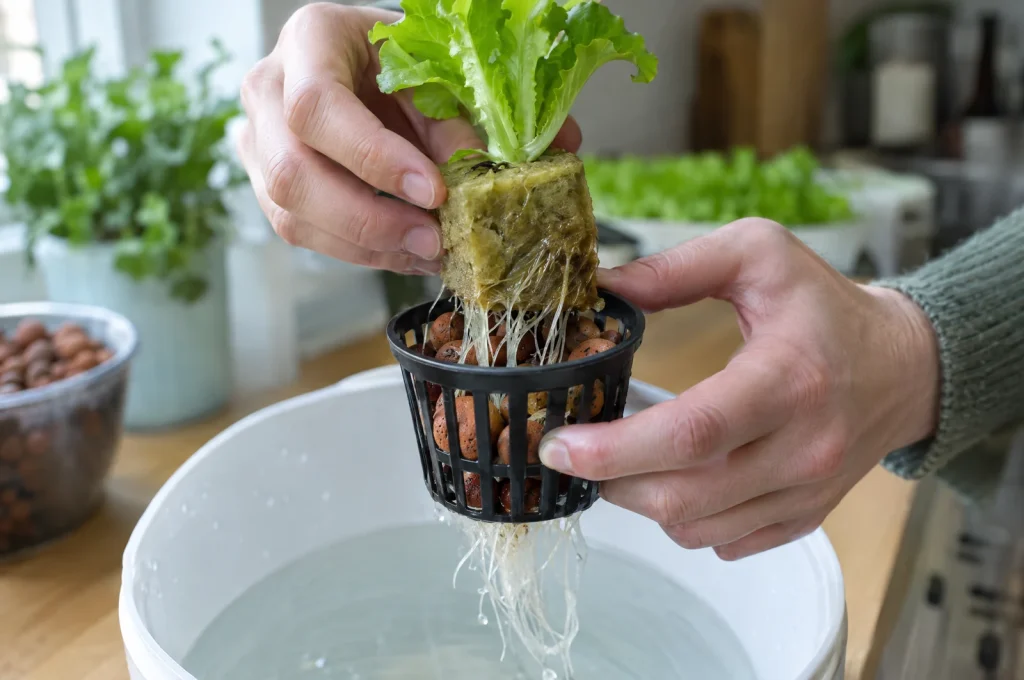
Our article on the seedling that stalls after transplanting argues that a hydroponic transplant done properly does not damage a single root, because the plug moves whole and nothing is ever pulled out of soil. It makes that point in order to rule transplant shock out as an explanation for slow growth. It turns out to be describing the barrier as well.
The result that matters most is the boring one
All of the above came from the contaminated half of that experiment, which was the aquaponic side, where fish that had not been changed since an earlier experiment are the likely route in.
On the hydroponic side, across all four crops, nothing was found in the solution, nothing on the roots and nothing in the leaves. The researchers attribute that to having sanitised the systems thoroughly beforehand and having kept the two sides from contaminating each other. Their conclusion is as plain as a conclusion gets: contamination of this kind can be eliminated in a hydroponic system if the whole system is sanitised properly before each use.
Which turns the scary part of this article into a maintenance job you already have. The changeover between crops is the point at which a system gets emptied and cleaned rather than rinsed, and biofilm either comes off with a brush or does not come off at all. It was already the job that protects your next crop from whatever the last one left behind. It is also the one that keeps this question theoretical.
So what do you do in a kitchen
Penn State Extension’s guidance for home gardens is blunt about where the risk sits at this scale. Animals, poultry, wildlife, contaminated tools and poor hygiene can all introduce pathogens, and hands transfer organisms from animals, tools and other surfaces straight onto produce. Their practical instructions are to wash your hands with soap and running water for at least twenty seconds, to discourage pets from the growing area, and to clean harvest containers before use.
Read that list against a kitchen rather than a garden and it is almost entirely about you. Your hands, the scissors, the bowl you cut the lettuce into, the cat on the worktop, the cloth you used on something else first. Those are the doors that are actually open, and none of them is closed by the fact that the plant never met soil. The water you top up with is another, and it is the one place where the usual advice runs backwards: the chloramine you are told to get rid of is there to keep that water clean all the way along the pipe. The weekly minute you already spend looking under leaves is a reasonable moment to notice whether anything else has been visiting.
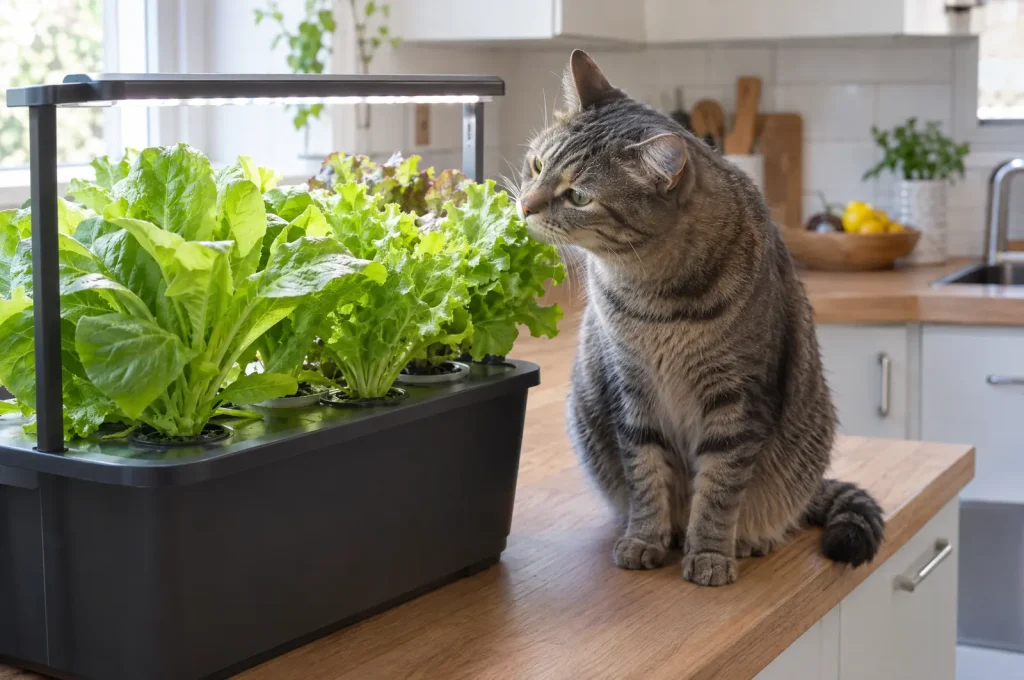
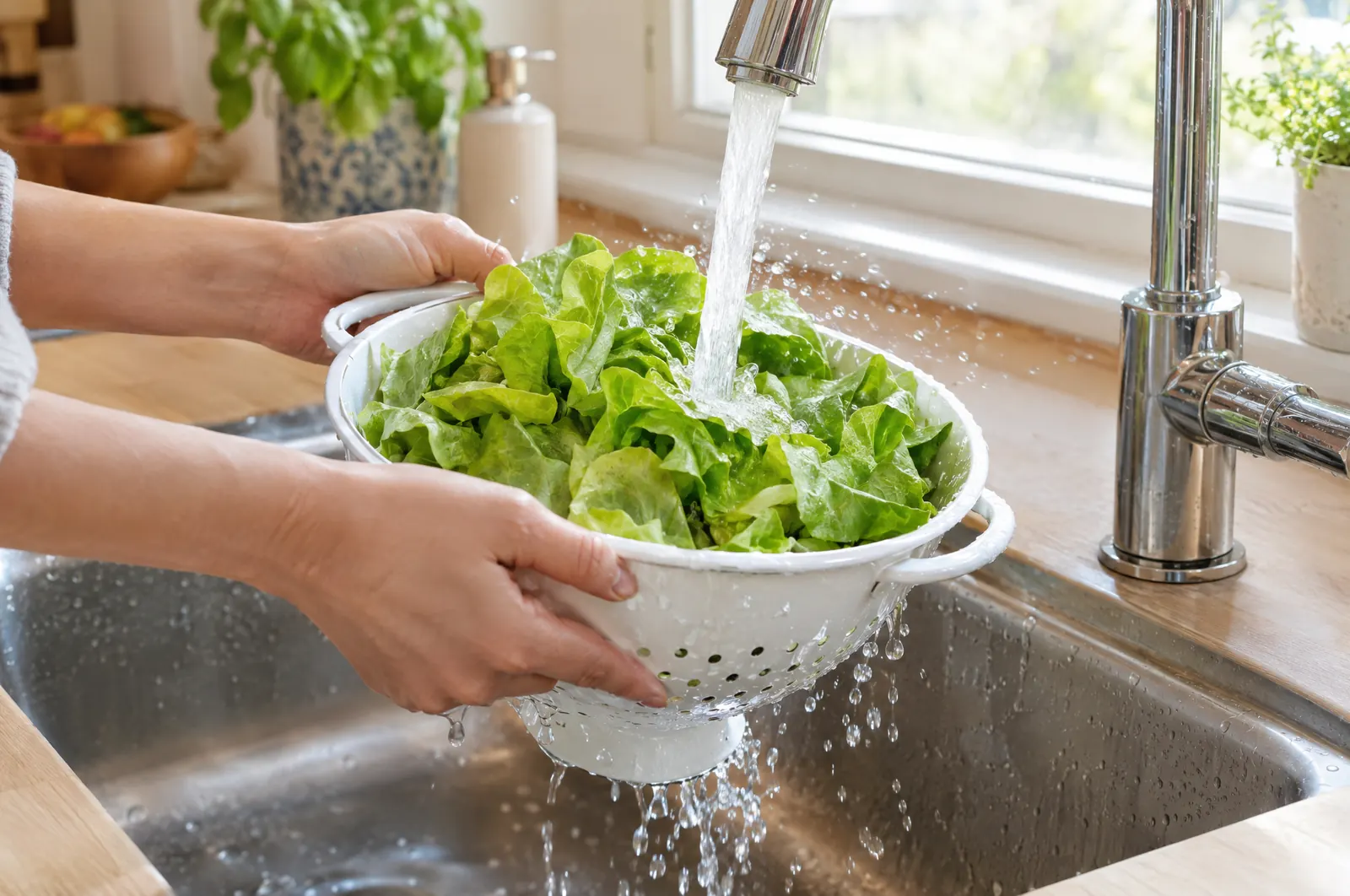
On the washing itself, the FDA position is short and worth following exactly. Wash all produce thoroughly under running water before preparing or eating it. Do not use soap, detergent or a commercial produce wash, because produce is porous and will take some of it up. Dry it afterwards with a clean cloth or paper towel. Keep it away from raw meat, and use a different board.
And the sentence that settles the whole question, in the agency’s own words: washing can reduce bacteria that may be present but will not eliminate it. Washing is a risk reduction step, not a sterilising one, which is precisely why the parts that come before it matter more.
So the honest answer is yes, wash them, and no, that is not the important part. Wash them at the point of eating rather than before storage, which is what this site already told you for entirely different reasons. The vitamin C cost is real and it is small, and it is a poor trade against the one step everybody agrees on. If you are pregnant, elderly, very young or immunocompromised, treat all of this with less latitude rather than more, because the consequences of being unlucky are not evenly distributed either.
One thing this article does not cover is sprouts. They are a different hazard for reasons our article on microgreens sets out, and they are the reason that article recommends one of the two and not the other.
Where this comes from
The outbreak details, the case and hospital numbers, the storm water pond and the statement that no clear route was identified are from the FDA’s own investigation page for the July 2021 Salmonella Typhimurium outbreak in packaged salad greens. The washing instructions and the line about reducing rather than eliminating bacteria are from the FDA’s consumer guidance, Selecting and Serving Produce Safely.
The root damage experiment, the reservoir conditions, the survival time in water, the outbreak count and the field contamination routes are from “Effects of Plant Age and Root Damage on Internalization of Shiga Toxin-Producing Escherichia coli in Leafy Vegetables and Herbs” by Wang, Deering and Kim of Purdue University, published in Horticulturae in 2021. The home garden practices are from Penn State Extension’s guidance on protecting home garden produce from contamination.
One caveat belongs to the reader rather than to the sources. Every number above was measured in a research greenhouse or a commercial one, and nobody has studied a bucket on a kitchen counter. The mechanisms transfer. The frequencies almost certainly do not, and in both directions.
Found this useful? Tell Google to show you more of it.
Add to Preferred Sources