Root Rot in Hydroponics, How to Spot It and Save the Plant
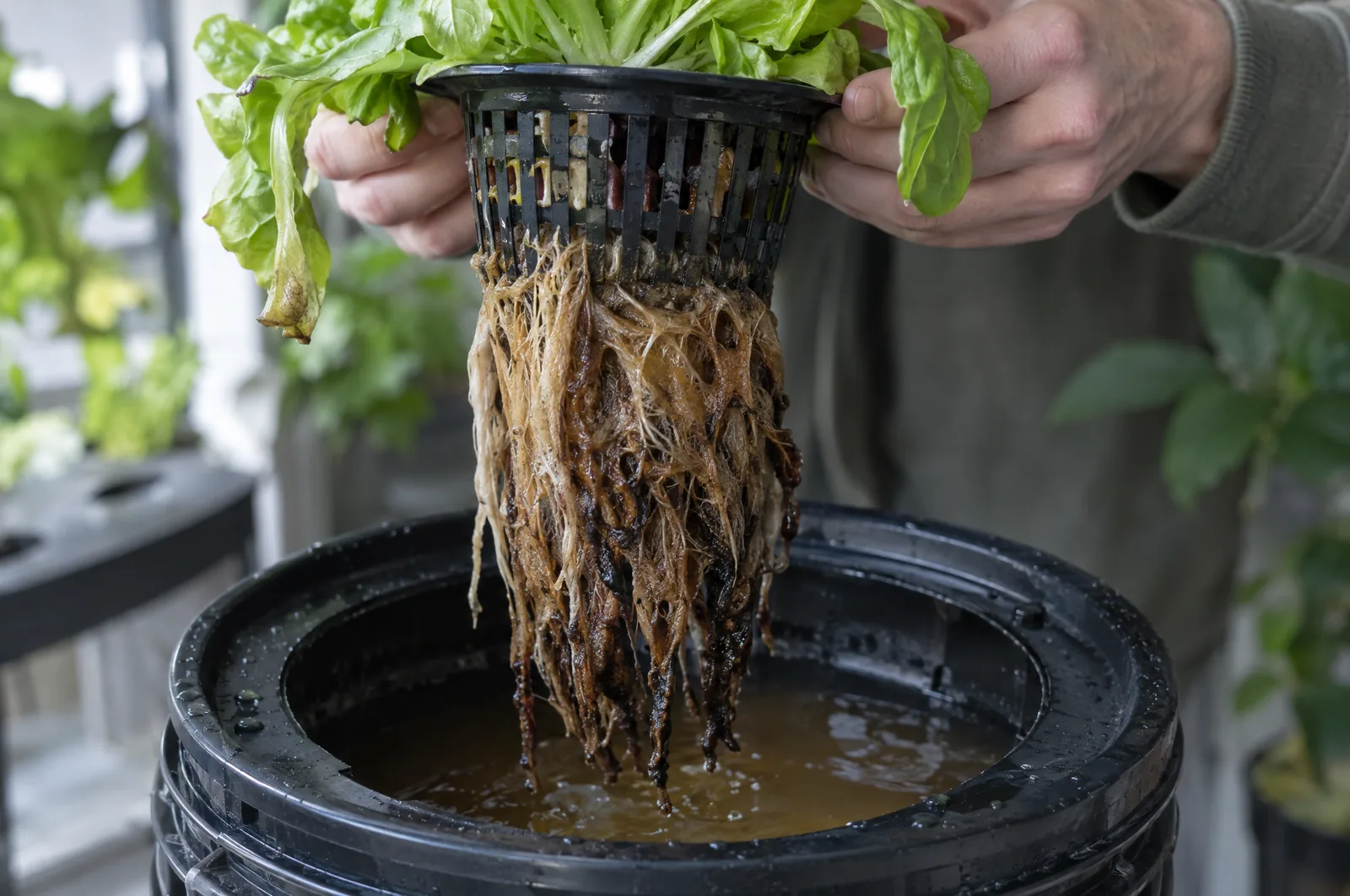
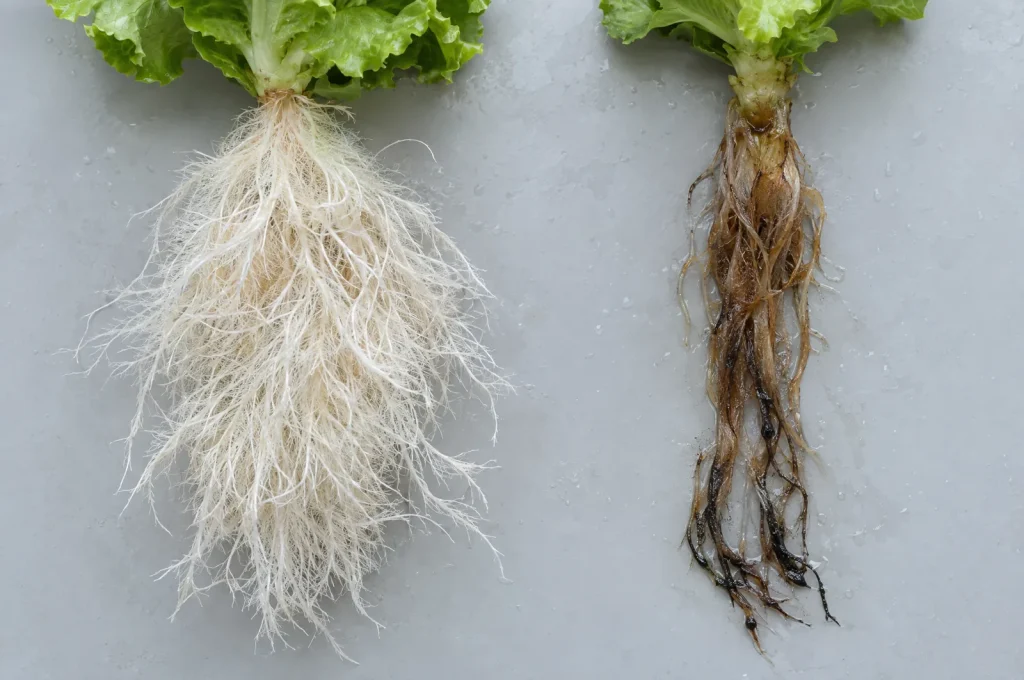
Healthy hydroponic roots are white or cream, and slightly fuzzy with root hairs. If yours are tan and slippery and the reservoir smells like a pond, you have root rot, and in a hydroponic system that almost always means Pythium. You can confirm it in about ten seconds with your fingers. The harder part is that most of the advice you will find treats what is in the reservoir rather than what let it in, which is nearly always warmth, stillness, or an injury to the roots.
The ten second test
Lift one plant out and look at the root mass in daylight.
- Healthy. White or cream, plenty of fine root hairs, firm, and smelling of almost nothing.
- Early rot. Brown lesions starting at the root tips, and noticeably few lateral roots for the size of the plant.
- Advanced. Brown through to black, slimy to the touch, with a swampy smell you will not mistake for anything else.
Then do the test that actually settles it. Pinch a discoloured root between finger and thumb and draw them along it. If the outer layer slides off and leaves a bare string behind, that is Pythium. The layer that came away is the cortex and the string is the vascular core. Plant pathologists call the result a rat tail, and the UConn alert on hydroponic lettuce names it as the field diagnostic that separates Pythium from the other root pathogens.
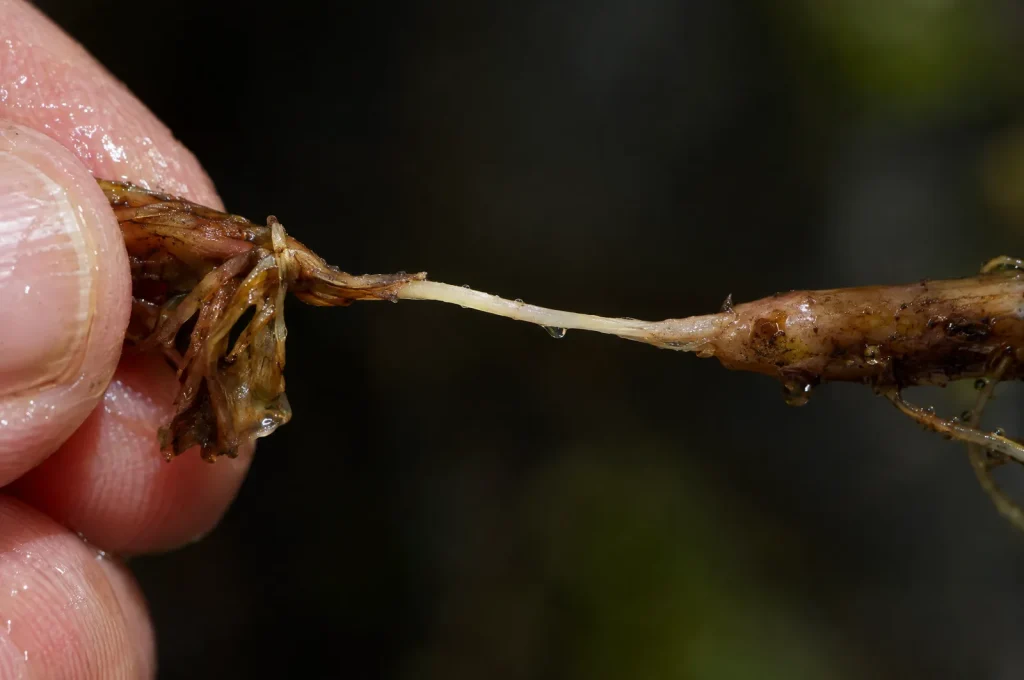
Two things it is not. Iron and tannins in the solution will stain roots tan without softening them, so roots that are discoloured but still firm, hairy and odourless are just stained. And roots that sat below the waterline in the dark are usually duller than the ones up in the air gap. Colour on its own is not the diagnosis. The cortex is.
Why your plant can look fine and still have it
The reason this one is worth knowing on sight is that the top of the plant is a poor witness.
In a Cornell trial, lettuce inoculated with Pythium aphanidermatum through the nutrient solution came out looking perfectly marketable, with no visible quality difference from the clean plants beside it. It weighed 24 g (0.85 ounces) less on average. If your harvests are quietly smaller than the figures you read online, this is one of the candidates, and nothing above the waterline will tell you.
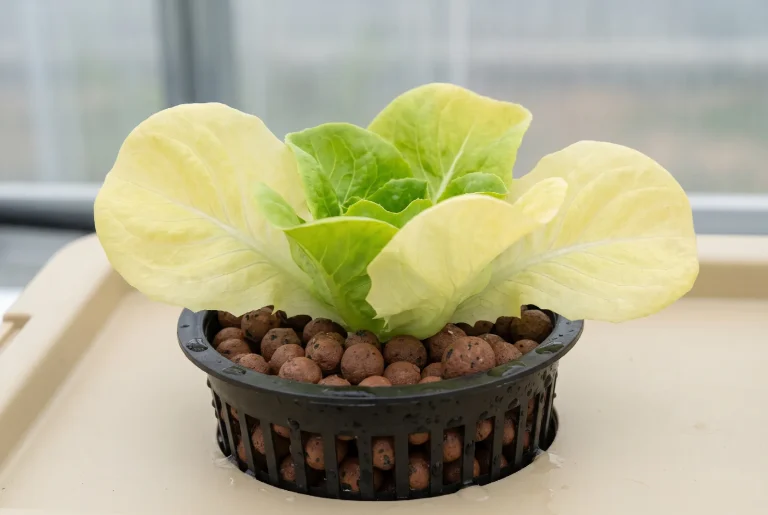
When symptoms do show up, they show up misleading. Plants stunt. Leaves go yellow, and that yellowing gets read as a feeding problem when the real fault is a root system that can no longer take nutrients up at all. It is worth ruling the simple causes out first, which is what the guide to yellowing hydroponic lettuce is for, but if the leaves are yellowing and the roots are brown, the roots came first.
The symptom that is genuinely specific is wilting in the hottest, brightest part of the day while the reservoir is still full. A plant surrounded by water that cannot move any of it has lost the machinery for the job. Early on it recovers by evening. Later it stops recovering.
Warm water is only half of it
Every guide tells you that warm water holds less oxygen. That is true, and it is worth seeing exactly how much less, because the number is a good deal smaller than the warnings around it suggest.
| Water temperature | Oxygen ceiling (mg/L) | Verdict |
|---|---|---|
| 50F (10C) | 11.3 | Ample |
| 59F (15C) | 10.1 | Ample |
| 68F (20C) | 9.1 | Target |
| 77F (25C) | 8.3 | Fine on paper |
| 86F (30C) | 7.6 | No margin |
Fresh water at sea level, from the USGS saturation values. The verdict column is against the 6 mg/L floor that extension specialists give for preventing root damage. Altitude lowers every figure in the table.
Going from 68F (20C) to 86F (30C) costs about 16 percent of the oxygen the water is able to hold, and 7.6 mg/L is still above the 6 mg/L that extension specialists give as the floor for preventing root damage. So heat on its own does not starve your roots. Three things stack on top of it, and together they are what does the damage.
- Demand climbs as supply falls. Biological respiration roughly doubles for every 18F (10C) rise, so the roots are asking for more oxygen at precisely the moment the water can carry less of it.
- Your reservoir is not at saturation. Those figures are a ceiling, not a reading. Still water exchanges oxygen only at its surface, and the gap between the ceiling and what you actually have is what an air stone closes. Cornell’s guidance for hydroponic solutions is above 6 ppm and ideally close to saturation at 8 to 9 ppm, and you do not get near that without aeration.
- Warmth suits the pathogen directly. Pythium aphanidermatum develops at higher temperatures while Pythium dissotocum establishes at lower ones, so there is no temperature at which you have simply opted out of the problem.
The band to aim for is a root zone of 68 to 75F (20 to 24C). For lettuce the optimum solution temperature is 75F (24C), which sits right at the top of that band, so lettuce growers have less summer headroom than they tend to assume.
Be honest with yourself about what cooling buys. Cornell ran a chiller holding spinach ponds at around 68F and found it reduced Pythium aphanidermatum without ever eliminating it. Cooling is a delay, not a cure. And cold is its own hazard at the other end. One Connecticut grower found ice crystals in the recirculation tanks over winter and had root damage across the whole growing area within days.
How it got in
Pythium is common enough that you will not keep it out altogether. What you can control is whether it finds an opening, and whether it travels once it has.
- Injured roots are the opening. Mechanical damage during a transplant, roots left to dry out while you change the water, and temperature extremes at either end all hand it a way in.
- It arrives on things. Surface water, dust, shoes, tools, reused net pots and seedling trays, bought seedlings, and now and then the growing medium itself.
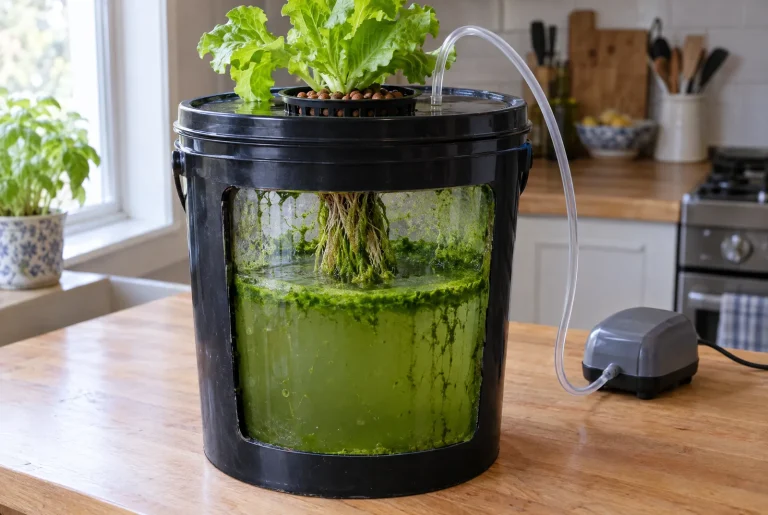
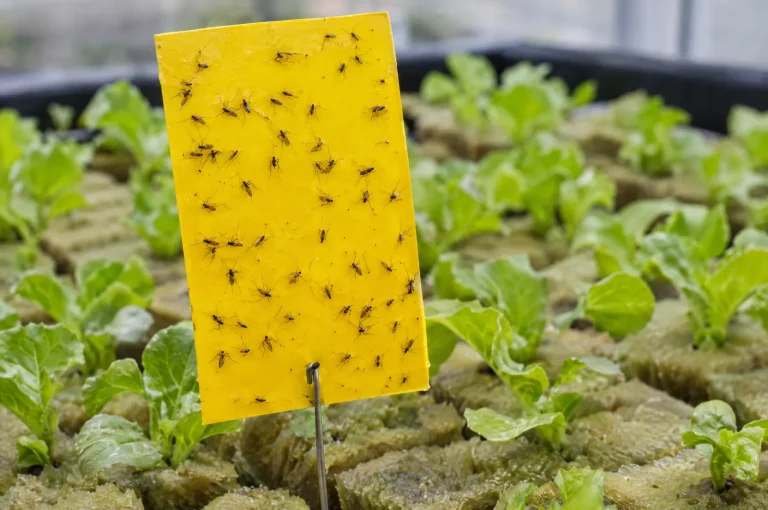
- Insects carry it. Fungus gnat larvae and adult shore flies are both known vectors, and both of them feed on algae. This is not the direct algae to root rot link that gets repeated online, which is wrong for the reasons set out here. It is a delivery route, and a better reason to clear the green film than the nutrients it steals.
- Recirculation spreads it. Both of the common species release zoospores, which swim under their own power. One infected net pot in an NFT channel or a shared deep water culture reservoir exposes everything connected to it. A row of separate Kratky jars has no such plumbing, which is one of that method’s underrated advantages.
Saving a plant that already has it
Here is the part most articles skip. Once Pythium has taken hold it is genuinely difficult to control, and the extension advice written for commercial growers is to throw infected plants out at the first sign. With a thousand heads of lettuce on the line that is the right call. With one bucket on a balcony, a single attempt is reasonable. This is the attempt, and the point at which to stop making it.
- Lift the plant and run the cortex test across the whole root mass. If most of it strips down to string, there is nothing left to recover and the plant goes in the bin.
- Rinse what remains under cool running water until the slime has gone.
- Trim every brown or soft root back to white tissue with clean scissors. Roots do not heal. They regrow.
- Empty the reservoir completely. Topping it up and hoping is not a step.
- Scrub the container by hand first, then sanitise, then rinse with plenty of clean water. The order is not optional. Sanitiser poured over biofilm barely works, and sanitiser left behind afterwards is phytotoxic.
- Refill at about half the usual strength. High fertility favours Pythium, and a trimmed root system cannot use full strength anyway.
- Fix the cause before the plant goes back. Cooler water, no light, and air moving through it.
- Look again after three days. New white tips mean it is working. More browning means it is not, and you have your answer.
Do not reuse the growing medium. Rockwool or clay pebbles that held a rotted root system leave with the plant, and net pots get the same scrub and sanitise as the reservoir.
What goes in the water, and what does not
Biological fungicides are the one additive with a real place, and the place is before anything has gone wrong. Several are labelled for root disease in greenhouse vegetables. They are preventative rather than curative, so adding one to a reservoir that already smells swampy is late. Read the label and check the product is registered where you live.
Hydrogen peroxide is the forum answer and it is the weak one. We went through the peroxide evidence in the article on algae. For root rot there are two further problems with it. The first is that the doses people quote differ by an order of magnitude. Three millilitres of 3 percent peroxide per gallon works out near 24 mg/L, while 8 millilitres per litre lands nearer 240 mg/L, and those cannot both be the right answer to the same question.
The second is what happened when somebody tested it. Lau and Mattson at Cornell grew deep water culture lettuce at 0, 37.5 and 75 mg/L of peroxide, and on conventional mineral fertiliser both peroxide treatments produced stunted or dead plants. The benefit they did find was specific to organic fertiliser. If you are feeding ordinary mineral nutrients, which nearly every beginner is, the tested condition is the one that went badly. That work was peer reviewed and published in Horticulturae in May 2021, where it was picked as an Editor’s Choice, so it is a settled result rather than a preliminary one, and a good deal more evidence than the dosing advice it contradicts.
Affiliate disclosure: some links below are affiliate links. We may earn a commission if you buy through one, at no extra cost to you. As an Amazon Associate I earn from qualifying purchases. Full disclosure.
Then there is the deeper objection. You would be dosing an oxidiser into the water holding the roots you are trying to save, in order to solve a shortage of oxygen that an air stone fixes permanently for roughly the price of one bottle of peroxide.
Cinnamon, chamomile tea and aquarium antibacterials come up often enough to be worth naming. None of them has evidence behind it for this.
Keeping it away
- An opaque reservoir with no light leaks, which deals with the algae at the same time
- An air stone running continuously, sized generously rather than to the minimum
- The reservoir out of direct sun and off hot concrete, insulated if it lives outdoors, with frozen bottles in it on the worst days
- Water that is not allowed to get too cold either
- Roots never left to dry out during a water change
- A full strip and scrub between crops, with old root matter removed before any sanitiser goes near it
- Fresh medium every time
- Fungus gnats and algae treated as one job rather than two
- A look at the roots once a week, which costs nothing and catches this while the plant can still be saved
Where this comes from
Symptoms, the rat tail diagnostic, the sanitation sequence, the insect vectors and the lettuce temperature and oxygen figures are from the e-GRO alert on Pythium root rot in hydroponic lettuce by Raudales and McGehee at the University of Connecticut. The root zone band, the zoospore behaviour, the root injury entry points and the chiller result are from the e-GRO alert on hydroponically grown basil and spinach by Mattson at Cornell. Further background from Penn State Extension’s Pythium fact sheet and Cornell’s greenhouse root rot fact sheet. Dissolved oxygen saturation values are the USGS figures for fresh water at sea level. The peroxide trial is Lau and Mattson at Cornell, published in Horticulturae in May 2021.
Found this useful? Tell Google to show you more of it.
Add to Preferred Sources