
10 science-backed benefits of hydroponic gardening
Grow up to 30% faster, use up to 90% less water, and harvest year-round. Here is what actually changes when you drop the soil.
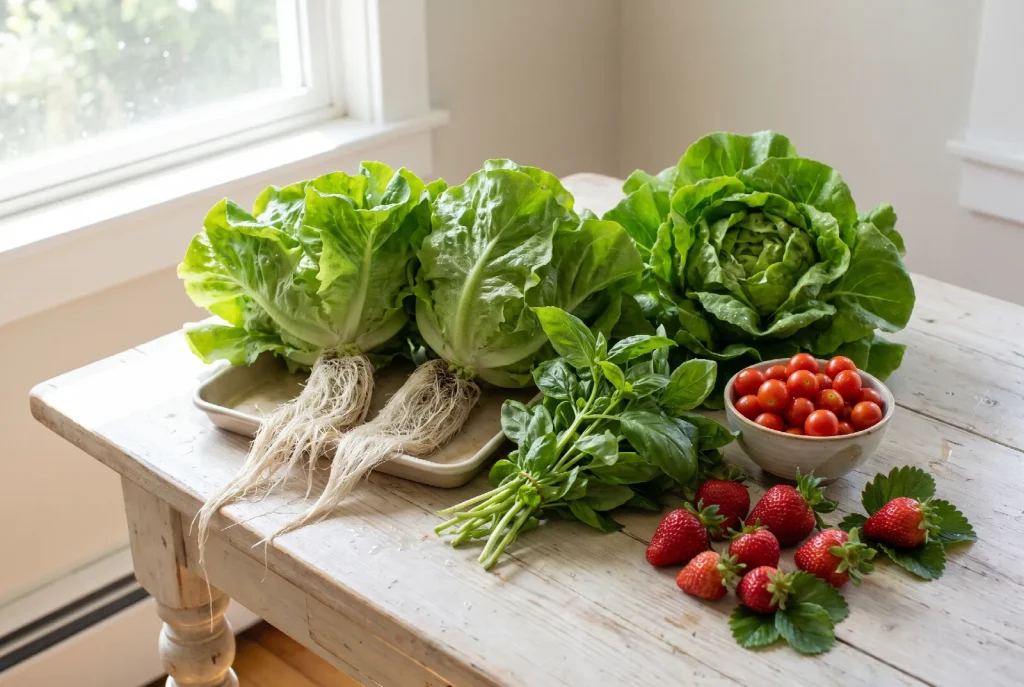
Every hydroponics article opens with the same three claims: faster growth, less water, higher yields. They are broadly true, but they get repeated without much explanation. Here is what is actually going on, and which benefits will matter to you as a home grower.
1. Plants grow up to 30% faster
In soil, roots spend energy searching for nutrients. In hydroponics the nutrients are already dissolved and in contact with the roots, so the plant redirects that energy into leaves and stems. Lettuce that takes 60 days in a garden bed is often ready in 30 to 40 days hydroponically.
2. You use up to 90% less water
This sounds backwards until you think about where garden water actually goes. Most of it drains past the root zone or evaporates from the soil surface. A hydroponic reservoir is a closed loop: the only water leaving the system is what the plant drinks or what evaporates from a small surface area.
3. No weeding, ever
Weed seeds live in soil. No soil, no weeds. That removes the single most tedious job in gardening, along with any reason to use herbicides.
4. Year-round harvests
An indoor system is not bound by frost dates or daylight hours. With a $25 grow light you can start lettuce in December and pick basil in February.
5. It works in tiny spaces
A mason jar occupies a windowsill. A four-plant bucket takes one square foot of floor. Vertical towers grow upward instead of outward. Renters, apartment dwellers, and people with no garden at all can grow real quantities of food.
6. Results are predictable
Soil varies wildly, even across one garden bed. A nutrient solution is the same every time you mix it. That consistency is what makes hydroponics easier to learn: when something goes wrong there are far fewer variables to check.
7. Fewer pests and diseases
Most common garden pests and pathogens overwinter in soil. Removing soil removes their habitat. Indoor systems add another barrier. You will still see the occasional aphid, but the pressure is a fraction of an outdoor bed.
8. You control exactly what goes in
No mystery pesticides, no soil contaminants, no wondering what the previous owner buried in the garden. You mixed the solution, so you know what is in it.
9. Higher yield per square foot
Plants can sit closer together because roots are not competing for nutrients in a shared soil volume. Combine that with faster cycles and a small system produces far more over a year than its footprint suggests.
10. It is genuinely satisfying
This one is not measurable, but it is why most people stay. Watching roots fill a jar, then picking a salad you grew on a windowsill in January, is a disproportionately good feeling for the effort involved.
The honest trade-offs
A guide that only lists upsides is a sales pitch. Here is the other side.
- Active systems need power. A DWC air pump running continuously costs a few dollars a year, but a long outage can stress plants. Passive Kratky systems avoid this entirely.
- You buy nutrients. Roughly $15 to $30 a year for a home-scale setup. Soil gardeners can compost instead.
- Mistakes move faster. The same directness that speeds growth also means a bad nutrient mix shows up in days rather than weeks. The upside is that fixes work just as fast.
- Some crops are a poor fit. Carrots, potatoes, and other root vegetables are genuinely easier in soil.
Convinced? Start with the $10 build
The fastest way to test all of this for yourself is a mason jar, a net pot, and 15 minutes.