Do Hydroponic Plants Really Grow Faster?
There is a number in the hero banner of this site. Thirty percent faster plant growth, sitting next to ninety percent less water, and our page on the benefits of hydroponics leads with it as well. That page is honest enough to say out loud that the three standard claims get repeated without much explanation. We have since gone through the water one properly. This is the growth one, and it did not survive the way the water claim did.
Where the number comes from
Follow thirty percent back and it does not end at a study. It ends at other websites quoting each other, which is where most round numbers in this subject end.
The oldest version of it we could find in a document anybody signed is United States patent 4,211,034, Hydroponic growing systems, filed by Barry J. Piesner in February 1978 and granted in July 1980. The patent states that plants in the system grow on an average of thirty percent faster than they would in a soil medium. It cites no trial, no measurements and no data of any kind. It is an inventor describing his own invention in a document whose purpose is to claim territory.
That is not proof the figure is wrong. It is a warning that nobody who repeats it, including us, has been pointing at a measurement. So here is what happens when you look for one.
Roots do not go looking for food
Our benefits page gives a mechanism along with the number. In soil, it says, roots spend energy searching for nutrients, and in hydroponics that energy goes into leaves instead. It is a satisfying picture and the soil science does not support it.
A nutrient ion has to end up touching a root before anything can happen, and there are three ways for it to get there. The root can grow into it, which is called interception. It can be carried along in the water the plant is drinking, which is mass flow. Or it can move through the soil water down a concentration gradient, which is diffusion. Purdue extension puts numbers on the three for a corn crop.
| Nutrient | Mass flow | Diffusion |
|---|---|---|
| Nitrogen | 80 | 19 |
| Phosphorus | 5 | 93 |
| Potassium | 18 | 80 |
| Calcium | 375 | 0 |
Percentage of a corn crop’s uptake that each route could supply. Interception, the root physically growing into the nutrient, is 2 percent or less for all of these and is left out. A figure above 100 means that route alone could deliver more than the crop takes up.
The calcium row looks broken and is not. Mass flow alone could deliver nearly four times what the crop takes up, because calcium simply travels along with the water a plant is drinking. That is also why adding calcium rarely fixes tipburn. The element is not missing. It is not being carried to the young leaves at the centre of a head, which are barely transpiring, and no amount of extra calcium in a tank changes where the water goes.
Read the interception column that is not there. The same publication quotes Barber’s estimate that perhaps one percent of the nutrients in a corn plant arrive because a root grew into them. A corn crop goes from 54 miles of root per acre at three weeks to over 32,000 miles by tasseling, and all that construction buys it one percent of its nutrition by interception. The roots are not out foraging. The nutrients come to them.
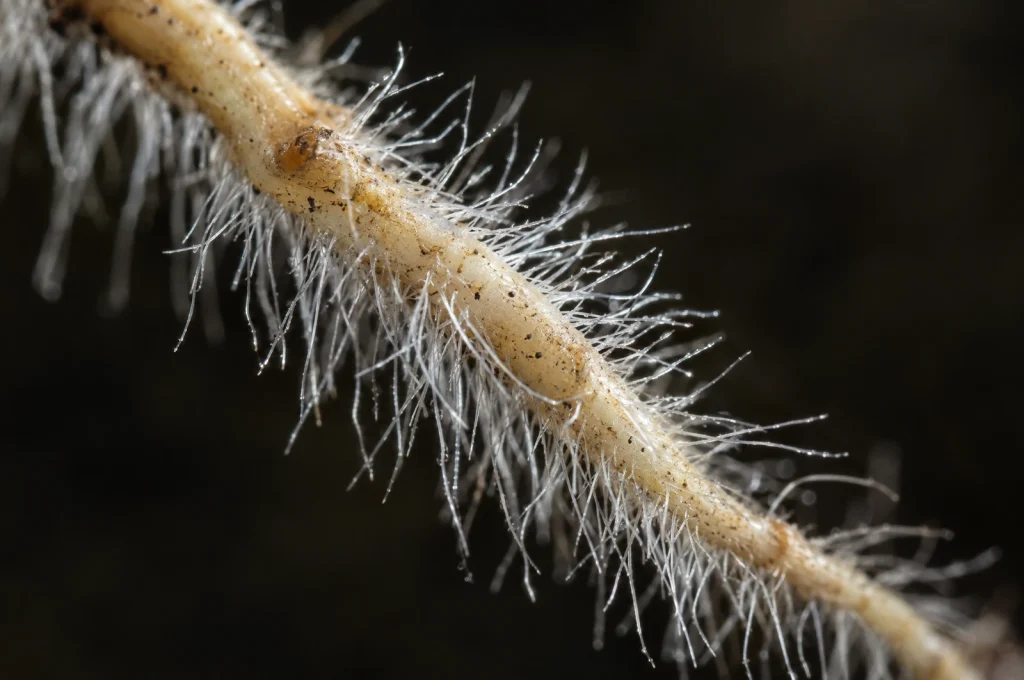
There is a second half to this that matters more. Getting the ion next to the root is free. Getting it inside is not. Uptake is an active process: the membrane blocks the ion, and the plant spends energy running it across on a protein carrier, choosing what it wants and leaving the rest. A reservoir does not remove that cost. It removes the delivery problem for the two nutrients that have a delivery problem, which is a real thing but a much smaller thing than the story we were telling.
The lettuce grown both ways at once
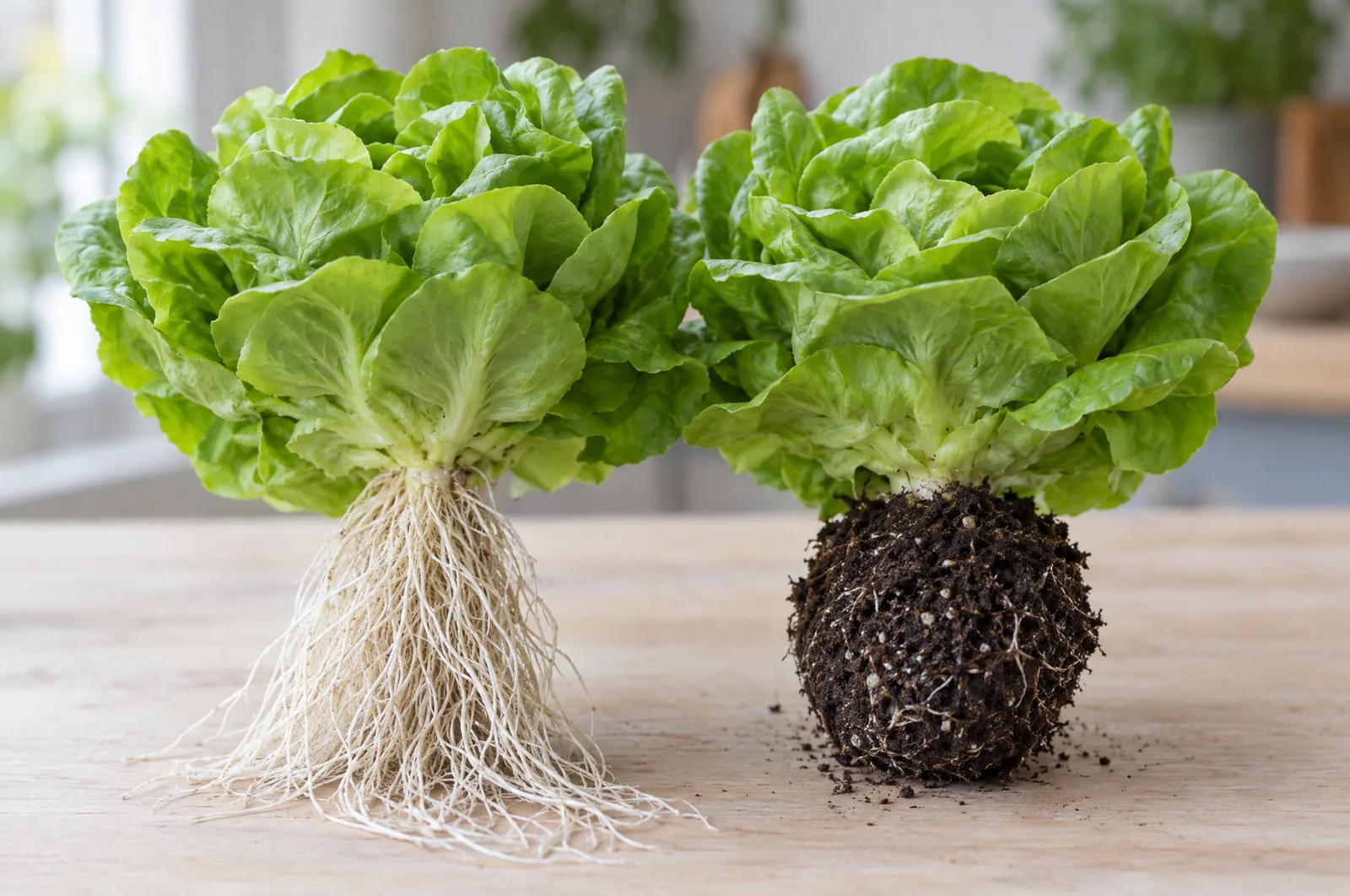
The obvious experiment is to grow the same cultivar both ways side by side and weigh the results, and it has been done. Lei and Engeseth at the University of Illinois took Giant Caesar lettuce and grew it for 35 days in laboratory built hydroponic and soil systems standing next to each other.
Above ground, nothing separated them. No significant difference in plant size, no significant difference in biomass, no significant difference in leaf features. Same cultivar, same room, same five weeks, same lettuce at the end of it.
What did differ was underground. The hydroponic roots were longer and heavier. The hydroponic leaves also held more water and less ash, which is the detail our article on whether hydroponic food is as nutritious is built around, because it quietly decides half the nutrition argument.
One study, one cultivar, one laboratory. It is not the last word. But it is a direct test of the claim in our own banner, and the claim lost. If a plant with its nutrients handed to it in solution grows no larger in 35 days than one that had to get them out of soil, the thirty percent is not coming from the root zone.
What 35 days actually costs
The figure people usually reach for is Cornell’s: a head of lettuce in 35 days from seed. Our article on how much lettuce you actually get works through that schedule and what it weighs. The part worth putting next to it is the list of conditions underneath.
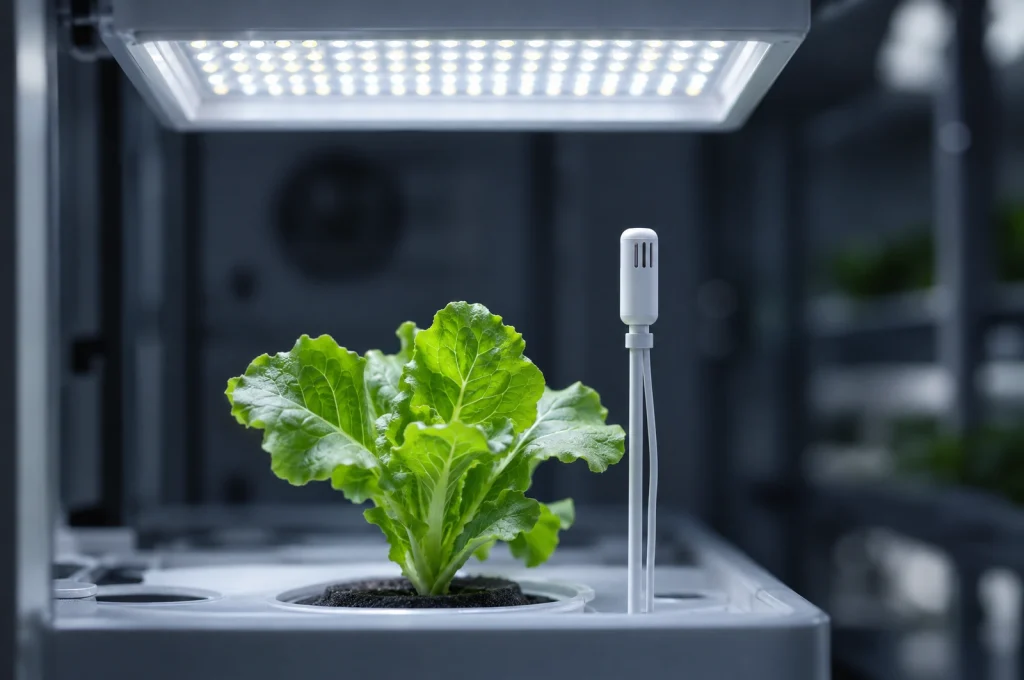
Cornell’s handbook sets air temperature at 75F (24C) by day and 65F (19C) at night. Solution no warmer than 77F (25C). Relative humidity held between 50 and 70. Carbon dioxide at 1500 parts per million whenever there is light to use it, against roughly 390 in ordinary air. A daily light integral of 17, which is the figure our article on tipburn uses as a ceiling rather than a target. Dissolved oxygen at 7 milligrams per litre, with crop failure below 3. pH between 5.6 and 6, and the strength our PPM and EC chart gives.
Count how many of those are about hydroponics. Two, at most. The rest is a building with the weather turned off and the air enriched. Thirty five days is what controlling all of that buys you, and the comparison people draw against a 60 day garden lettuce is a comparison between a greenhouse and a British spring, not between water and soil.
What hydroponics does genuinely remove
None of this makes the method pointless, and it is worth being precise about what it really takes off the table.
It removes the diffusion bottleneck. Look at that table again. Phosphorus arrives 93 percent by diffusion and potassium 80 percent, and diffusion through soil water is slow and short ranged. In a reservoir both are already in solution at the root surface. That is a real advantage, and it is at its largest exactly where soil is worst, meaning dry, compacted, cold or genuinely short of those two nutrients.
It removes water stress. A plant in soil between waterings is working harder to pull water in as the soil dries, and growth slows before anything looks wilted. A root sitting in solution never has that problem, which is the same reason a seedling given full strength feed gets hurt rather than helped, as our article on starting seeds explains.
And it does not remove the oxygen ceiling, it trades against it. Roots need oxygen to do that active uptake, and water holds very little of it. Our aeroponics page is the long version of that trade, and it is the one place on this site where a method genuinely raises the growth rate rather than the schedule.
Your system probably is faster anyway
Here is the part that saves the claim without rescuing the mechanism. If you put a jar of lettuce under a light on a kitchen counter in November and your neighbour sows a row outdoors on the same day, you will be eating first, by a wide margin. That is a true and useful thing.
It is just not about the water. You beat the outdoor row on temperature and on light, which is what the winter light gap article and the lighting guide are both really about. A pot of compost on the same counter under the same lamp would also beat the row, and by a similar margin.
The same correction applies to the yield claim standing next to it. Our environmental article takes apart the headline figure of eleven times the yield and finds a calendar and a spacing decision rather than a faster plant, which is also why succession planting matters more to your annual harvest than anything about the root zone does.
The honest version
If somebody asks you whether hydroponics grows plants faster, the defensible answer is that hydroponic systems usually produce crops faster, and that very little of the gain comes from the absence of soil.
It comes from the conditions people put around a hydroponic system, which they put there because they were already paying attention. Controlled temperature, enough light, water that is never short, a known feed, and a crop cut on a schedule. Every one of those is available to somebody growing in a pot of compost indoors, and most of them are not available to a row in a garden in March.
This is the same answer our comparison of hydroponics against soil arrives at from every other direction, and it has stopped being a coincidence. You have not found a faster kind of plant. You have taken over a set of jobs the weather used to do badly, and the plant is responding to the jobs rather than to the method. The banner will be getting a footnote.
Where this comes from
The thirty percent assertion is in United States patent 4,211,034, Hydroponic growing systems, Barry J. Piesner, filed 23 February 1978 and granted 8 July 1980. The routes by which nutrients reach a root, the table of percentages, Barber’s one percent estimate for interception, the corn root length figures and the description of uptake as an active carrier mediated process are all from Dave Mengel, Roots, Growth and Nutrient Uptake, Purdue University Agronomy Department publication AGRY-95-08, revised May 1995. The side by side growing comparison is Lei and Engeseth, Comparison of growth characteristics, functional qualities, and texture of hydroponically grown and soil-grown lettuce, in LWT, 2021. The set points are from the Cornell University Controlled Environment Agriculture programme’s hydroponic lettuce handbook, 2013 edition. Nothing here is our own trial, and the number in our own banner is the thing it was written to check.
Found this useful? Tell Google to show you more of it.
Add to Preferred Sources