Is Hydroponics Actually Better for the Environment?
The front page of this site says hydroponics uses up to 90 percent less water than traditional gardening. That claim has been sitting there unexamined since the day the site went up, and it is the kind of number that gets repeated because it sounds good rather than because anybody checked it. So this article checks it. The short version is that the water claim holds up better than I expected, and that water is the wrong thing to be measuring.
The water claim is fine
Start with the study everybody cites, which is worth reading properly rather than quoting. In 2015 Barbosa and colleagues compared lettuce grown conventionally in Yuma, Arizona against a modelled hydroponic greenhouse in the same place, and published it in the International Journal of Environmental Research and Public Health. Arizona was chosen deliberately. It is where a large share of American lettuce is grown, and the paper notes that the state puts about 69 percent of its freshwater withdrawals into agriculture.
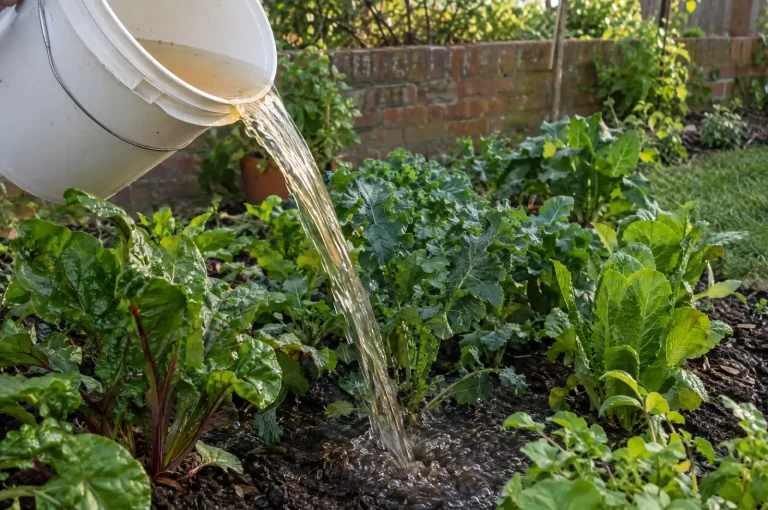
Conventional lettuce came out at 250 litres of water per kilogram of lettuce per year. The hydroponic greenhouse came out at 20. That is about 13 times less, which is a saving of roughly 92 percent, and it makes our front page look conservative rather than overblown.
That figure is a model rather than a measurement, so it is worth seeing whether anybody has weighed it in practice. A team at Chile’s agricultural research institute did, in a pilot floating raft system in the coastal desert of the north, across four seasonal cycles and two cultivars. Measured water productivity came out between 7.1 and 12.5 litres per kilogram of fresh lettuce, with the heaviest demand in summer and the lightest in autumn. Measured use was lower than the model, not higher.
Be fair to that trial about what it is. The authors say plainly that every seasonal observation came off a single bench sharing one reservoir, with no system level replication, so the seasonal comparison is descriptive and not a statistical result. What it does establish is the order of magnitude, and the order of magnitude agrees with the model.
The number that is not on the front page
The same Arizona paper measured something else at the same time, and it is the reason the study is still cited eleven years later.
Conventional lettuce needed about 1,100 kilojoules of energy per kilogram per year. The hydroponic greenhouse needed about 90,000. That is 82 times more energy to grow the same kilogram of lettuce, from the same study, in the same sentence as the water saving everybody quotes.
Nobody puts that on a front page, including us. It is the single most important number in the environmental question and it is almost always left out of the summary, which is how a genuine trade gets presented as a free win. Our aeroponics page already pulls apart a similar case, where a water saving figure that everybody attributes to NASA turns out to come from the company selling the equipment. The pattern is the same. The flattering half of a result travels and the other half does not.
It is not the grow light
Here is where the study earns its keep, because the breakdown contradicts the obvious reading. Almost everyone who quotes the 82 blames the lamp.
| Where it goes | kJ per kg per year |
|---|---|
| Heating and cooling | 74,000 |
| Artificial lighting | 15,000 |
| Circulating pumps | 640 |
| Total | 90,000 |
From the Arizona model. The pump that beginners worry about running day and night is the smallest line on the page, and the climate control nobody thinks about is roughly four fifths of the total.
Holding a polyethylene greenhouse at 23.9C in the Arizona desert is what costs the energy. The lamp is a sixth of it. The pumps are under one percent, and that is a greenhouse full of circulating pumps rather than the one aquarium pump in your bucket. Our guide to what size air pump you need declines to give a wattage for good reasons, but the direction is not in doubt. Whatever is worth worrying about in a home system, the bubbler is not it.
Which makes your kitchen a different question
That breakdown matters because the largest cost in it is one you do not pay. You are not holding a dedicated building at a set point for the benefit of lettuce. You are growing in a room that is already heated, or already cool, for the benefit of people. The heating line is being paid anyway and the plants are getting it for nothing.
There is one way to import the greenhouse’s problem into a kitchen, and our winter article recommends it. If the room genuinely drops overnight, an aquarium heater in the tank is the standard fix. That is sensible advice, and it is also the 74,000 kilojoule line in miniature. The moment you spend energy holding a temperature for the plants rather than for yourself, you have started paying the cost the Arizona greenhouse pays. A heated tank in a cold room is a much smaller version of that, not a different thing.
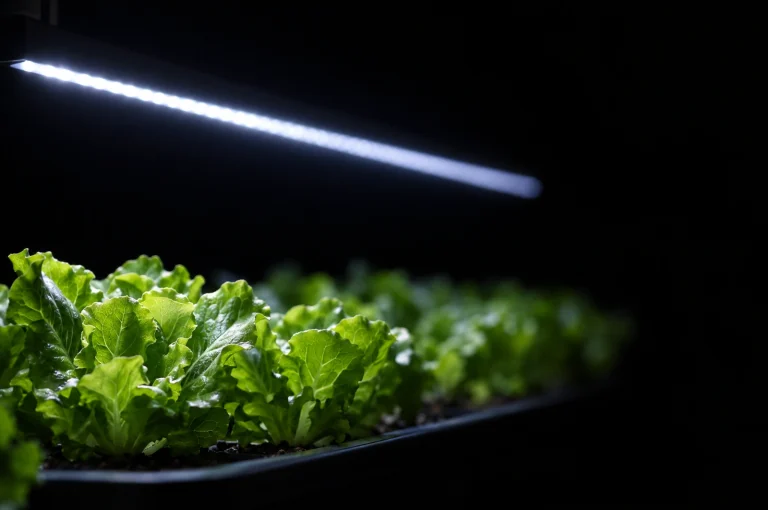
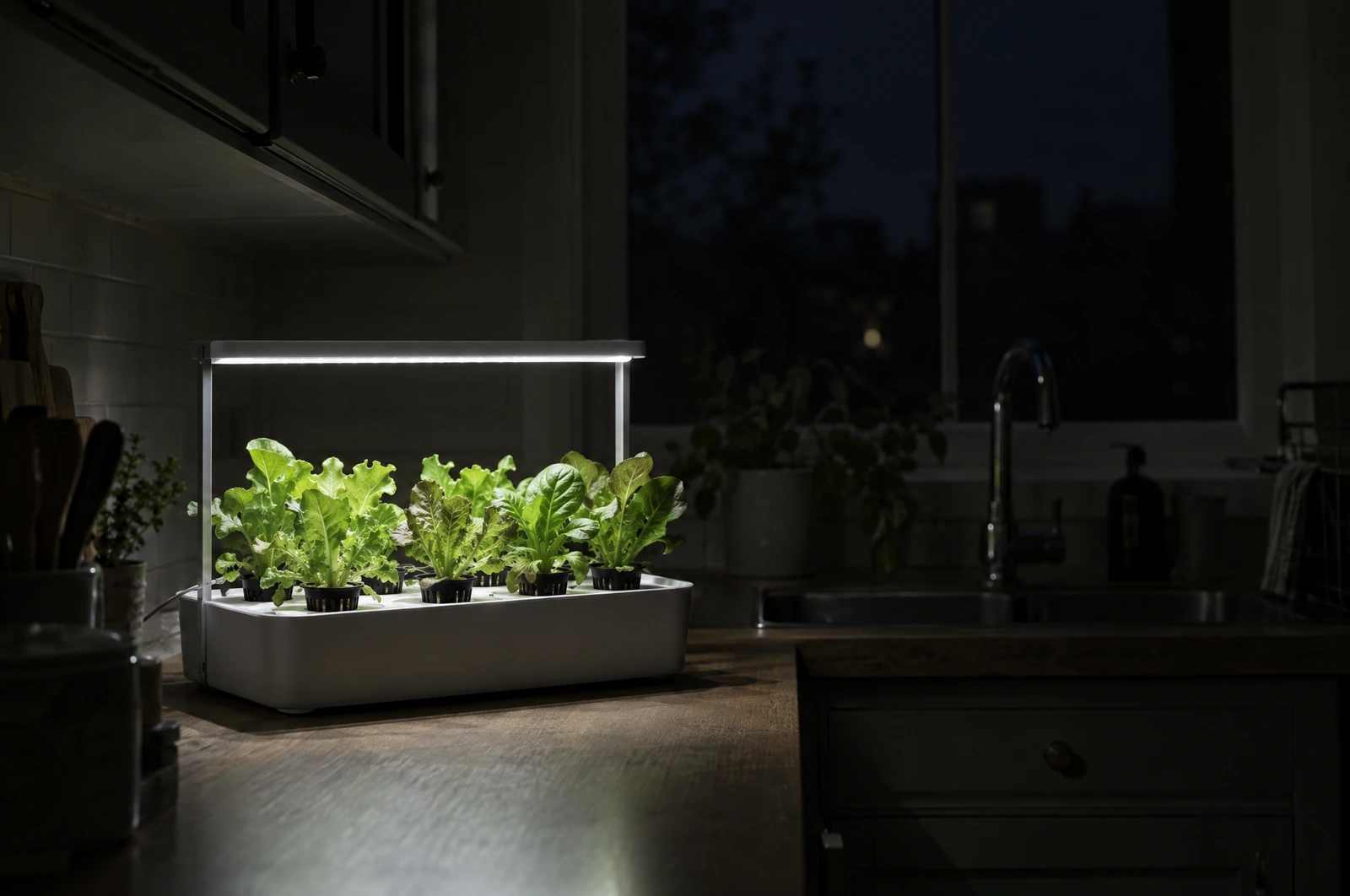
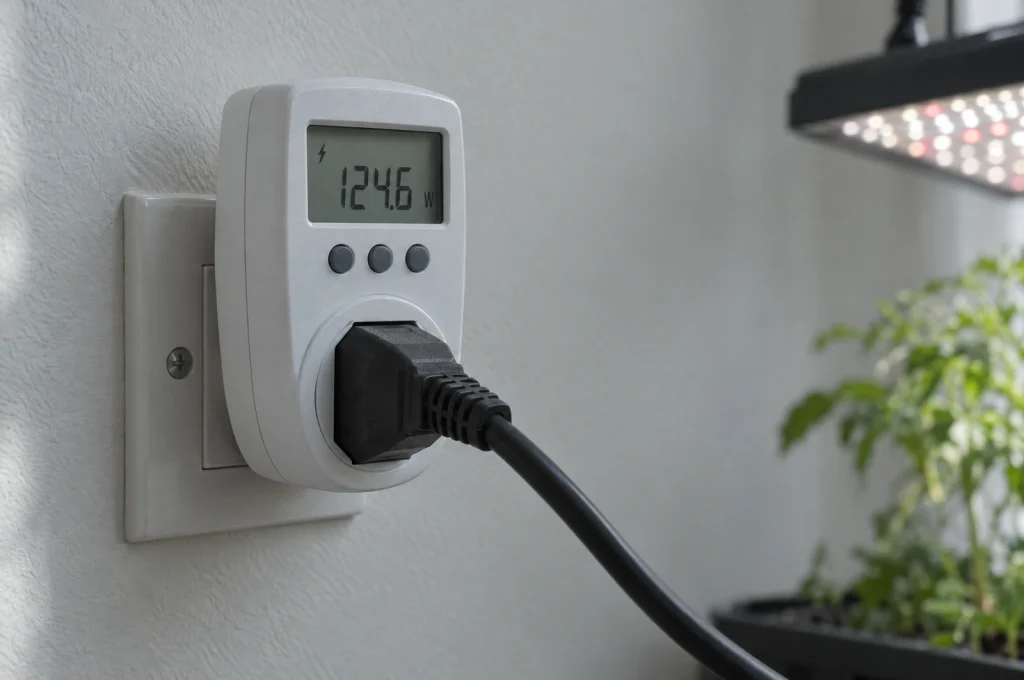
What is left is the lamp, and for most people the lamp is the whole of the home environmental question. Our grow light running cost calculator does that arithmetic in one line, and the thing to notice is that the sum works in energy exactly as it works in money. Watts times hours is the footprint as surely as it is the bill.
So the honest position for a home grower is in two halves. An unlit system on a windowsill, running a small pump or no pump at all, has an energy cost close to nothing and keeps the real water saving. A lit system in a cupboard is buying sunlight with electricity, and how good or bad that is depends almost entirely on what is generating the electricity where you live.
Our article on how much lettuce you actually get reaches the identical conclusion in money, that a lit setup is paying mains electricity to replace sunlight that is free outdoors. Nobody had made the same sentence about carbon. It is the same sentence.
What the Arizona study assumed
Three assumptions inside that paper move the answer, and the authors are open about all three.
The hydroponic side is theoretical. It was built from engineering equations populated with values from the literature and applied to a hypothetical 815 square metre greenhouse. The conventional side came from crop budgets and government agricultural statistics. Those are not the same kind of evidence, and the paper says so in its own abstract.
The lighting assumed a 24 hour photoperiod in order to reach a target of 17 moles per square metre per day. Lighting round the clock is an aggressive assumption, and a real greenhouse using daylight plus a shorter supplement would land lower. Our lighting guide covers what that daily total means and why most home growers never get near it.
And the conventional side assumed one crop of lettuce a year. The authors list this as a limitation themselves, noting that the same land usually grows warm season crops when lettuce is not in it. Give the field a second crop and the gap in both directions narrows.
Eleven times the yield is not eleven times the speed
One more figure from that paper gets misread constantly. The hydroponic greenhouse produced 41 kilograms per square metre per year against 3.9 for the field, which is about 11 times the yield.
That is not a plant growing 11 times faster. It is a 30 day harvest cycle running about twelve times a year against a field assumed to crop once, plus plants packed closer together. The multiple is mostly a calendar and a spacing decision rather than a growth rate.
This matters at home because you will not get twelve cycles unless you run the thing deliberately, which is the argument our article on succession planting makes from the other end. A system harvested once and then left is throwing away the only advantage that produced the big number.
Where the case is genuinely strong
None of the above says the environmental case is empty. It says the case is specific, and it is worth knowing which parts survive.
Water survives, and it matters most exactly where water is short, which is the argument the Arizona setting was chosen to make. Land survives, because the yield per square metre is real even after you discount it for the calendar. And containment survives. A closed reservoir does not leach nitrogen and phosphorus into a watercourse the way a fertilised field can, and our article on where the old reservoir goes sets out what that does and does not mean for the two teaspoons a fortnight you are actually responsible for.
Two things go the other way and deserve saying. Rockwool does not break down, which our growing medium guide is blunt about, and the salts you mix are mined or synthesised rather than composted. A soil gardener can feed a bed with the contents of a compost bin. You cannot.
The Arizona authors land somewhere similar. Their conclusion is that on their numbers hydroponics is not a suitable alternative for lettuce in Yuma, and that it becomes one in places that are short of water and rich in cheap renewable energy. That is a conditional answer rather than a verdict, and it is the right shape of answer.
Which leaves the front page claim standing, and standing alone. The water saving is real. It is just not the whole sentence, and the rest of the sentence is about electricity. Our comparison of hydroponics against soil ends by saying you have taken over a job soil was doing for free. The energy is what that job costs.
Where this comes from
The yields, the water figures, the 82 times energy result, the breakdown between heating and cooling, lighting and pumps, the 24 hour photoperiod assumption, the one crop a year limitation and the conclusion about renewable energy are all from Comparison of Land, Water, and Energy Requirements of Lettuce Grown Using Hydroponic vs. Conventional Agricultural Methods, by Barbosa and colleagues, in the International Journal of Environmental Research and Public Health volume 12, 2015. The measured water productivity of 7.1 to 12.5 litres per kilogram, the fresh weights and the authors’ own note about the lack of system level replication are from Water Productivity and Seasonal Performance of Floating-Root Hydroponic Lettuce Under Coastal Desert Conditions in Northern Chile, published in Horticulturae in 2026 by researchers at the Instituto de Investigaciones Agropecuarias. The front page claim being tested is our own.
Found this useful? Tell Google to show you more of it.
Add to Preferred Sources