Can You Grow Root Vegetables Hydroponically?
This site tells you to avoid root vegetables four separate times, on four separate pages, and gives much the same reason each time. They need depth and a loose medium, and they are genuinely easier in soil. The advice is sound and I am not about to take it back. The reason attached to it is not quite the reason, though, and because the reason is wrong the exception has been missed. One of the crops on that list grows better in water than it does in peat, and somebody has measured it.
A root vegetable is not one problem
Clemson’s extension factsheet puts carrots, beets, radishes and parsnips on a single page, which is a sensible thing to do for a soil gardener. They go in the same bed, in the same month, with the same fork. The numbers inside that page are not one crop’s numbers at all.
| Crop | Days to harvest | Pulled at |
|---|---|---|
| Radish | 21 to 30 | under 1 inch across |
| Beet | 50 to 70 | 1.5 to 2 inches across |
| Carrot | 65 to 75 | any usable size |
| Parsnip | 120 to 180 | 7 to 8 inches long |
All four from the same Clemson factsheet. The spread is the point. The fastest of them is eaten and forgotten before the slowest has finished deciding what shape to be.
A radish is a three week crop the size of a marble. A parsnip is a six month crop that wants a hole eight inches deep. Our list of plants for beginners treats those as the same decision, and so does our beginners guide. They are not the same decision, and the honest version needs them separated.
Depth is not the thing that stops you
Minnesota Extension is blunt about carrots and parsnips, and the sentence that matters is not about soil at all. Always direct seed these crops, it says. Never start them in pots, because their long taproots begin developing early and transplanting damages and misdirects their root growth.
Read that against how everything on this site actually works. A seed goes into a rockwool cube or a coir plug, the plug sits under a light until roots show at the bottom, and then the whole plug is lifted into a net pot. Our guide to growing media states the rule outright, that nothing gets transplanted bare, and our article on starting seeds is built entirely around that one move.
The method has exactly one moment where a plant is picked up, and a carrot is a plant you are not allowed to pick up.
The timing makes it worse rather than better. The same Minnesota page notes that carrot roots can reach their full length within three weeks of the seedling emerging. The length is settled while the plant above ground is still two thin leaves. Whatever depth that crop was ever going to get, it needed on the day it germinated, in the place it germinated, and no later decision can give it back.
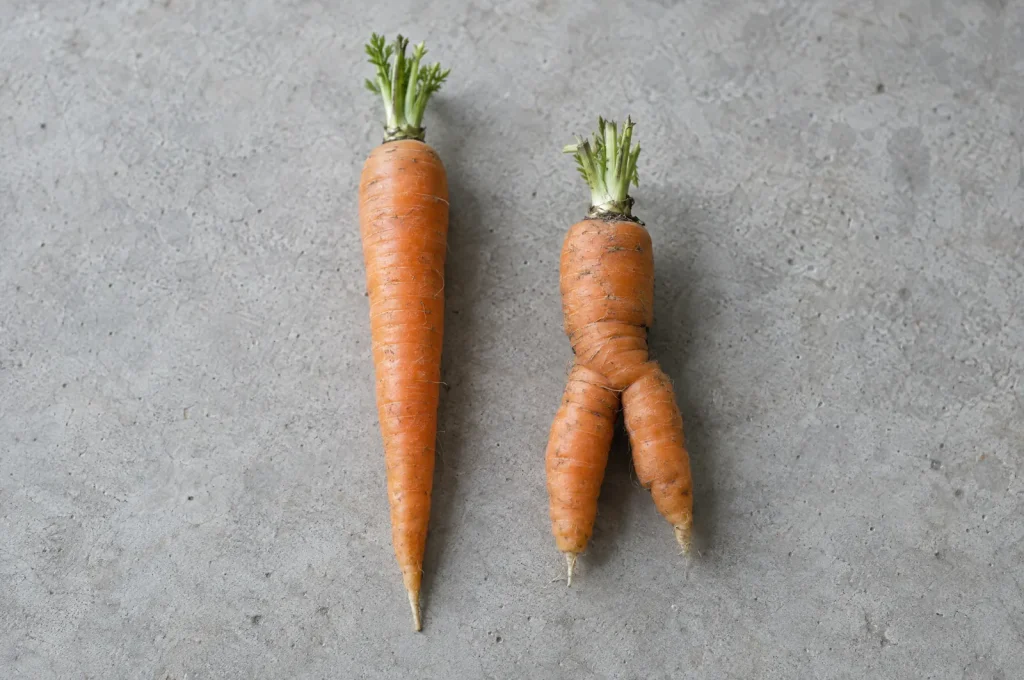
There is a second thing our pages have slightly wrong. Our comparison of hydroponics against soil says these crops need depth and something to push against. The first half is true and the second half is backwards. They do not want anything to push against. Clemson says carrots grown in heavy clay grow poorly and come out forked or misshapen, and Iowa State says compacted or heavy soils produce stunted, forked or twisted roots. Resistance is the thing that ruins them. What a carrot wants is depth with nothing in it.
Somebody ran the radish experiment
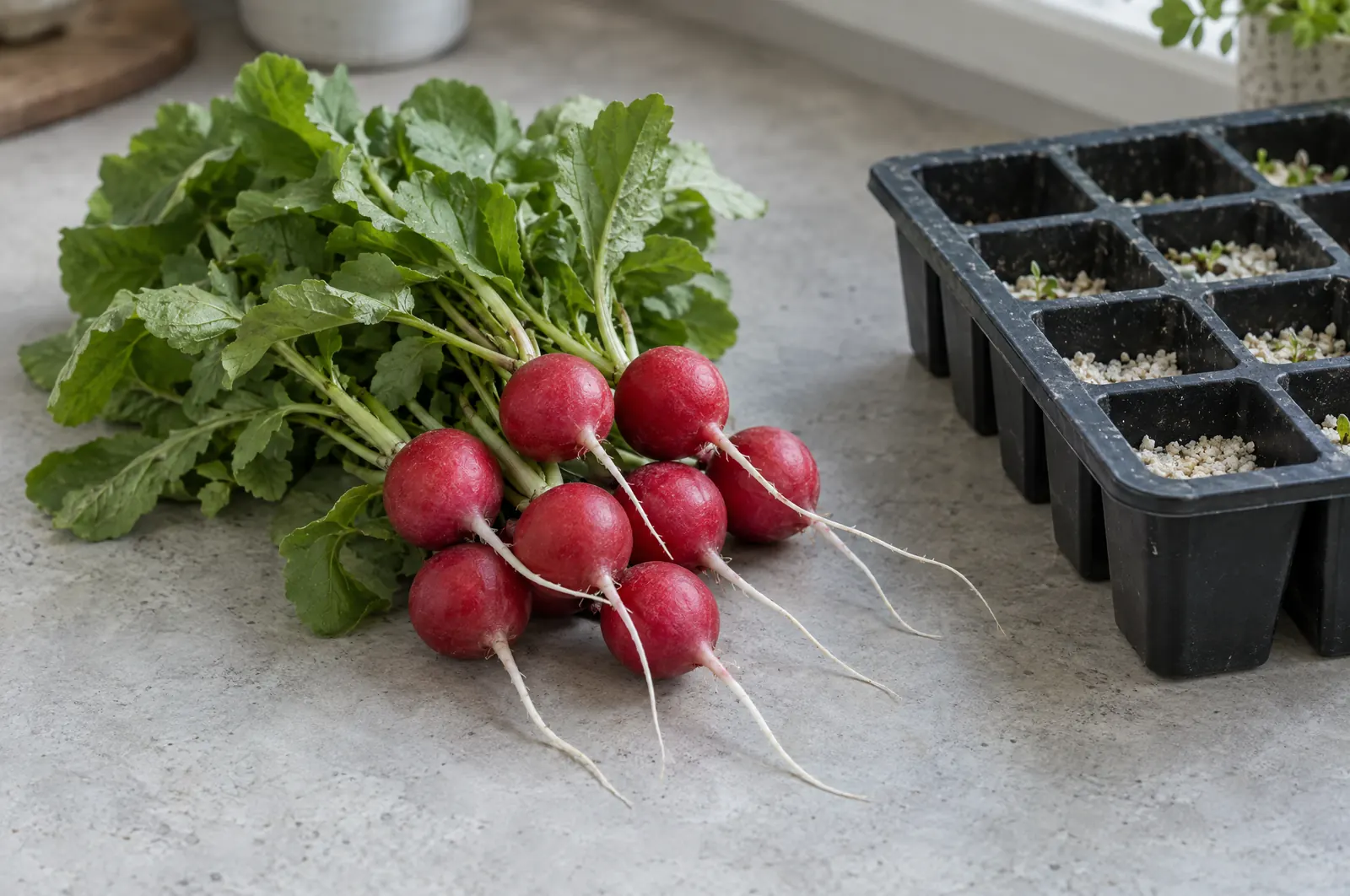
In 2018 M. Jakše published a greenhouse trial in Acta Horticulturae that did the obvious thing. Radishes of the cultivar Tinto F1, sown into plug trays filled with perlite and granulated rockwool in equal parts, with the trays floating on nutrient solution. The control was the same cultivar sown in peat on a growing table. Two cycles, April to May and then May to July, in Ljubljana.
Note what did not happen. Nothing was transplanted. The seed went into the plug and the plug went on the water, which is the step a carrot cannot survive and a radish does not need. Harvest was taken three times at weekly intervals, each time lifting whichever plants had formed a hypocotyl of at least two centimetres, which is roughly three quarters of an inch and sits neatly inside the size Clemson tells a gardener to pull at.
In the second cycle the floating system returned more than 60 percent marketable. The peat control in the denser trays went the other way entirely and began to flower, and fewer than 15 percent of those plants formed a usable root at all. The floating radishes were also ready 7 to 14 days earlier than the ones in peat.
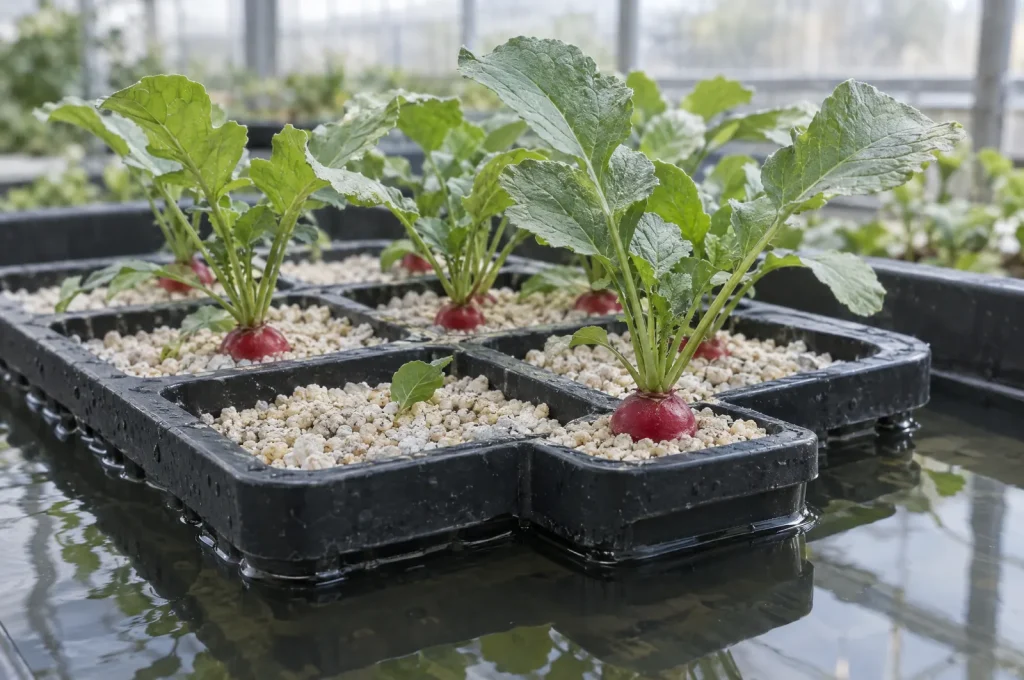
One more result from that trial is worth copying straight into practice, because it points the opposite way to instinct. The 40 cell trays, holding 264 plants per square metre, gave a higher share of marketable radishes than the 84 cell trays at 554 per square metre. Twice the plants, worse outcome. Our article on succession planting makes the same argument from the other end, that the way to get more out of a small system is more harvests rather than more plants at once.
Two inches was enough in orbit
If a plug tray still sounds too shallow to take seriously, there is a more extreme version of the same test. NASA’s Advanced Plant Habitat on the International Space Station is a chamber 18 inches square. Of that, two inches is given to the root system and 16 inches is headroom for the plant. The substrate is arcillite, a baked clay.
In November 2020 an astronaut harvested 20 radishes out of it, wrapped each one in foil, and put them in a freezer for the journey home. NASA picked radish partly because it is well understood and partly because it reaches maturity in 27 days.
Two inches of baked clay in orbit is not a recommendation for a kitchen windowsill. It is a boundary, and boundaries are useful. Whatever the radish is short of in a shallow system, it is not depth.
Our own ebb and flow page has quietly known this the whole time. It lists radishes among the crops that suit the temporary flooding well, which sits awkwardly beside two other pages telling you to avoid them. That contradiction is the reason this article exists.
Feeding it like a leaf crop is what loses the bulb
Here is where it goes wrong for somebody who learned on lettuce. Everything leafy greens teach you says that more nitrogen is more crop. You feed a lettuce and you get leaf, which is the part you wanted. Feed a radish and you get leaf, which is not.
The Jakše trial tested four nutrient solutions, two mixed from reagents and two from water soluble fertiliser, at two nitrogen levels. Adding nitrogen accelerated bolting. A bolting radish has committed to going to seed instead of to the part you were going to eat, and our article on when to harvest explains why nothing reverses that once it has started.
So the instinct that serves you well on a salad crop is the instinct to hold back here. I will be straight about the limit of this: the trial supports a direction, not a number. Our EC and PPM chart has no tested figure for radish and I am not going to invent one. Start at the lower end of the leafy green band, watch whether the plant is making leaf or making radish, and adjust from what you see rather than from a table.
Potatoes, where the answer is already on this site
The crop our pages name first is the one with the most hydroponic research behind it, and our aeroponics page has already laid it out. Seed potato multiplication is the single application where the method has been measured properly, it returns roughly three times the tuber count, and average tuber weight comes out higher in the conventional system. Far more, and smaller.
One figure is worth adding here, because smaller undersells it. A 2025 study grew the cultivar Red Scarlet both ways and counted 32.4 minitubers per starting microtuber against 7.5 in greenhouse soil. Then the sizes. In the aeroponic system 82 percent of the tubers were under 25 millimetres, about an inch. In the greenhouse it was 26 percent. Aeroponics did not grow four times the potato. It grew four times the number of potatoes and made nearly all of them marbles.
For seed stock that is exactly the right trade, and seed stock is what those systems exist to produce. For dinner it is no use at all.
You are probably already growing a beet
That leaves the beet, and the beet has a trick in it.
Beetroot and Swiss chard are the same species. Both are Beta vulgaris, one bred for the root and the other bred for the leaf. Our lettuce page already lists chard among the greens that run happily on the same settings as everything else in the system, and our winter article recommends it for the dark months because it holds without bolting when lettuce will not.
So the beet is not missing from this site. Only one half of it is.
And the half you are growing may be the better half. A 2025 comparison in Plants measured three beetroot cultivars root against leaf. Per 100 grams of dry matter the leaves held 11.84 to 12.23 grams of protein against 5.46 to 7.32 in the roots, 33.9 to 37.3 percent dietary fibre against 19.5 to 20.9, and 17.23 to 39.15 milligrams of total tocopherols against 0.09 to 0.31. The roots won on carbohydrate and on energy, which is roughly what a storage organ is for.
Those are dry weight figures, and our article on whether hydroponic food is as nutritious spends a long section on why that denominator changes the answer. Treat the ratios as a direction rather than as a plate of food.
The practical version is short. A beet root takes 50 to 70 days and is at its best between an inch and a half and two inches across, after which it goes woody. A beet leaf is a cut and come again green in a system built around 30 day crops. One of those fits what you have built and the other does not.
Which leaves a short list. Radish yes, sown in place and fed lightly. Beet for the leaves. Carrot and parsnip no, for a better reason than the one we were giving. Potato only if what you want next year is seed. Our pages were right, and now they are right for the correct reason, with one crop moved across the line.
Where this comes from
The days to harvest, the sizes to pull at and the heavy clay point come from Clemson Cooperative Extension’s factsheet on carrot, beet, radish and parsnip. The instruction never to start carrots and parsnips in pots, and the note that carrot roots reach full length within three weeks of emergence, come from University of Minnesota Extension’s page on growing carrots and parsnips, with the compaction finding from Iowa State University Extension. The floating system trial is M. Jakše, Growing radish in plug trays in a floating system, Acta Horticulturae volume 1209, 2018. The habitat dimensions and the radish harvest come from NASA’s own pages on the Advanced Plant Habitat and on the November 2020 harvest aboard the International Space Station. The potato figures are from a 2025 paper in Plants on in vitro tuberisation and subsequent minituber production in aeroponic and greenhouse conditions, and the beetroot leaf and root comparison is Almeida and colleagues, Exploring the biochemical profile of Beta vulgaris, also in Plants in 2025.
Found this useful? Tell Google to show you more of it.
Add to Preferred Sources