
Growing hydroponic herbs: a complete guide to year-round flavour
Basil, mint, cilantro, and parsley on a windowsill in January. Herbs are the crop that most changes how you cook.
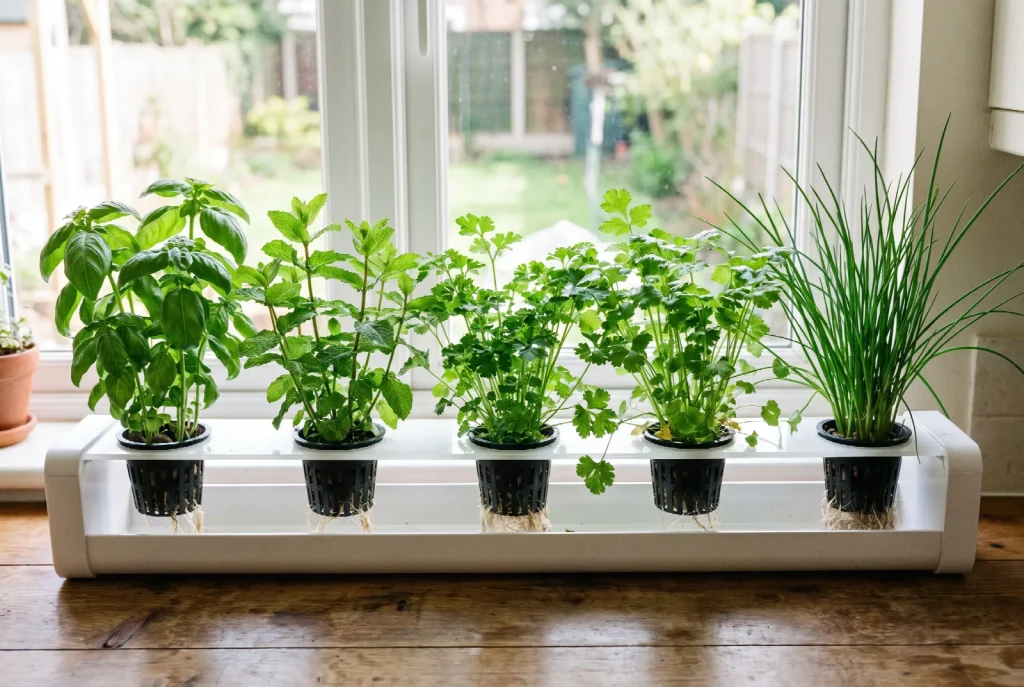
Herbs are the highest-value crop you can grow at home. A supermarket packet costs a few dollars, wilts in days, and is always the wrong quantity. A single basil plant in a jar produces continuously for months and costs about a dollar to run.
| Herb | Harvest | pH |
|---|---|---|
| Basil | 2 to 4 weeks | 5.5 to 6.5 |
| Mint | 3 to 4 weeks | 5.5 to 6.5 |
| Cilantro | 3 to 4 weeks | 5.5 to 6.7 |
| Parsley | 5 to 7 weeks | 5.5 to 6.5 |
| Chives | 4 to 6 weeks | 6.0 to 6.5 |
| Oregano, thyme | 6 to 8 weeks | 6.0 to 6.5 |
Weeks from transplant into the system, not from sowing. Add three to four weeks for the seedling stage if you are counting from seed.
The table says when. What follows is what each one actually does to you.
Basil is the best hydroponic herb by a distance. It loves warmth and light, it responds to cutting faster than anything else here, and it is the one crop that makes a windowsill system pay for itself. It also has one disease that decides how long a plant lasts, which the basil article covers properly along with which cultivars resist it.
Affiliate disclosure: some links below are affiliate links. We may earn a commission if you buy through one, at no extra cost to you. As an Amazon Associate I earn from qualifying purchases. Full disclosure.
Mint is vigorous to the point of nuisance. In soil it takes over a bed. In a shared reservoir it takes over the reservoir, because the roots keep going and will fill a net pot, then the channel, then whatever is next to it. Give it a container of its own and never share one with it. A spare five gallon bucket is the usual answer, and the article on what can share a reservoir explains why root volume, rather than nutrient strength, is the thing that actually decides these pairings.
Cilantro prefers cool and bolts above 75F (24C), which indoors usually means it bolts because the room is warm rather than because the season turned. It is the fastest of these to go from useful to finished, so sow it in small batches on a rotation rather than all at once. Bolting, and what it does to flavour, is covered in the article on when to harvest.
Parsley is slow to germinate and then extremely steady. Two to three weeks in the propagator is normal and is not a failure, which is worth knowing because most people throw the tray out at day ten. Once it is up it is the most forgiving herb here and will produce for months without complaint.
Chives are cut like grass and regrow indefinitely. There is no pruning technique to learn: take the outer leaves at the base, leave the centre, and the clump thickens rather than running to a stem.
Oregano and thyme are the woody pair, slower to establish and happier with a root zone that dries between waterings. They suit a drip system or an ebb and flow tray, where the medium drains properly between cycles, far better than they suit sitting in water. In a bucket they sulk.
Rosemary, which is the hard one
Rosemary is the herb people most often ask about and the one least suited to the systems on this site, so it is worth being straight about why.
It is a Mediterranean shrub. It wants a root zone that dries hard between waterings, it grows slowly enough that you are months from a useful harvest, and from seed it is both slow and unreliable. Everything that makes basil a good match makes rosemary a poor one.
If you want it anyway, two things improve the odds. Start from a cutting rather than seed, which skips the unreliable part entirely. And put it in a medium that drains, meaning a drip or ebb and flow build rather than water culture, and treat it as a long term resident rather than part of a rotation. A pot on the windowsill is genuinely the easier answer for this one, and there is no shame in saying so on a hydroponics site.
The pruning technique that matters
Most people harvest herbs wrongly, by picking individual large leaves off the bottom. That leaves a tall bare stem with a tuft on top, and the plant stops branching.
Instead, cut the stem just above a pair of leaves. The plant responds by pushing two new shoots from that junction. Do this from the moment the plant is about six inches tall and it doubles its branch count each time, giving you a dense bush instead of a spindly stick.
Cutting often does not cost you yield
The instinct is that every cut sets the plant back, and that taking less often means getting more overall. On basil at least, that turns out not to be true.
A 2023 study grew Genovese basil in hydroponic and aquaponic floating raft systems and harvested it by consecutive cuts. Its finding on this point is blunt: the number of cuts did not influence yield. What the repeated cutting did change was how the plant distributed its dry matter and which nutrients it took up, not how much it produced.
Which means the weekly harvest that makes herbs worth growing is not a compromise you are making against total production. You can cut, within the limit below, and keep cutting.
Keep basil from flowering
Once basil sets flower buds it diverts everything into seed and the leaves turn bitter. Pinch out flower buds the moment you see them and the plant carries on producing leaves for months longer.
What they want from the system
Herbs are undemanding, and the few things they do ask for are easy to get wrong.
- Light. Twelve to sixteen hours a day at modest intensity, which our lighting guide sets out alongside the shadow test for working out whether a windowsill is already enough. For herbs it often is.
- Strength. The soft herbs sit at the low end of the bands in our PPM and EC chart. Feeding them like a tomato produces soft growth and weaker flavour rather than more of it.
- Room. The soft herbs share a reservoir happily with each other and with lettuce. Mint does not share with anything.
- A rotation. Cilantro finishes fast and parsley starts slowly, so sowing a few cells each week rather than a tray at once is what keeps a windowsill in herbs continuously, which is the whole argument in succession planting.
Where this comes from
The finding that repeated cutting did not reduce yield is from “Hydroponic and Aquaponic Floating Raft Systems Elicit Differential Growth and Quality Responses to Consecutive Cuts of Basil Crop”, published in 2023, which grew Genovese basil cultivar Sanremo in both systems and reports that the number of cuts did not influence yield while it did change dry matter partitioning and nutrient uptake. The harvest times and pH bands in the table are our own published figures, consistent with the crop pages and the PPM and EC chart, and the harvest column is counted from transplant rather than from sowing. The pruning technique, the one third rule and the behaviour notes for each herb are practice rather than published measurements, which is why they are described rather than quantified.
Need a system to grow it in?
Every plan on this site is free and costs under $50 to build.