
Hydroponic troubleshooting: a visual guide to common problems
Yellow leaves? Brown roots? Stunted growth? Find the symptom, understand the cause, and apply the fix.
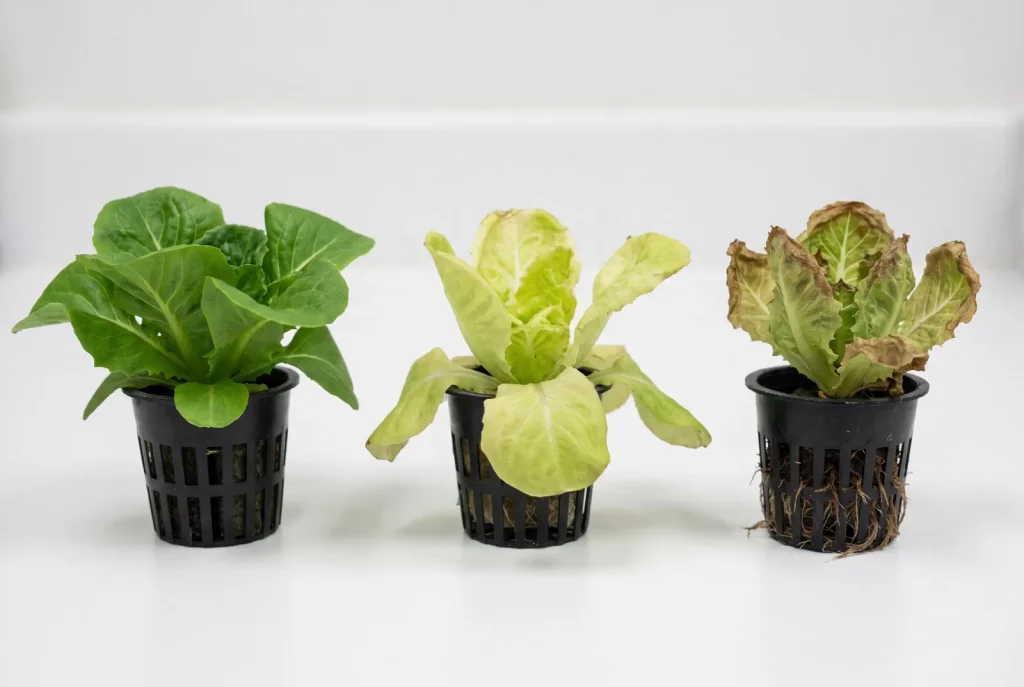
Almost every hydroponic problem traces back to one of five causes: pH out of range, nutrient strength wrong, not enough oxygen at the roots, wrong light, or a reservoir that has got too warm. Work through the symptom below and you will usually land on one of them.
Yellow leaves
Where the yellowing appears tells you a lot.
| Pattern | Likely cause | Fix |
|---|---|---|
| Oldest, lowest leaves yellow first, evenly | Nitrogen shortage. The plant is moving nitrogen from old leaves to new growth. | Check pH, then increase nutrient strength toward the full label rate. |
| Yellow between the veins on new leaves, veins stay green | Iron lockout, almost always a pH problem rather than a shortage. | Bring pH down into 5.5 to 6.5. The iron is present, just unavailable. |
| Yellow between veins on old leaves | Magnesium shortage, common with soft or filtered water. | Use a nutrient with added cal-mag, or add a cal-mag supplement. |
| One lower leaf yellowing on an otherwise healthy plant | Normal. The plant is retiring an old leaf. | Nothing. Remove the leaf and carry on. |
Brown, slimy roots and a swampy smell
Cause: root rot. Healthy roots are white or cream and slightly fuzzy. Brown, slippery roots with a bad smell mean pathogens have taken hold, and it is nearly always because the solution was too warm, too still, or exposed to light.
Fix: rinse the roots under cool running water and trim away the slimy brown material with clean scissors. Empty and scrub the reservoir. Refill with fresh solution and add a teaspoon of 3% hydrogen peroxide per gallon. Then remove the cause: move the reservoir out of direct sun, confirm the air stone is bubbling freely, and use an opaque container.
Tall, pale, floppy growth
Cause: not enough light. The plant is stretching to find some. Fix: move it to a brighter position or add a grow light 6 to 12 inches above the canopy. Note that stretched stems do not recover, so the fix affects new growth only.
Crisp, bleached or burnt leaf tips
Cause: either light burn, from a lamp too close, or nutrient burn, from a solution mixed too strong. Light burn appears only on the top leaves directly under the lamp. Nutrient burn starts at the leaf tips and edges throughout the plant.
Fix: raise the light, or dilute the reservoir with plain water and re-check the strength before the next mix.
Green film on the reservoir or medium
Cause: algae, which needs only light plus nutrient water. Fix: block the light. Use an opaque container, wrap it, or paint it. Algae is not directly harmful but it consumes nutrients and oxygen and can clog pumps.
Wilting even though the reservoir is full
Cause: the roots cannot take water up. Usually root rot, sometimes a solution mixed far too strong, occasionally roots that never reached the water in a Kratky system. Fix: lift the net pot and look at the roots. What you see will tell you which of the three it is.
Flowers that drop without setting fruit
Cause: no pollination, which is normal indoors where there is no wind or insects. Fix: hand pollinate. Flick each open flower daily, or touch an electric toothbrush to the stem behind the flower cluster. See our tomatoes and peppers guide.
The Weekly Grow
Get weekly growing tips in your inbox
One email per week. No spam. Just practical tips, new plans, and honest gear guides.
Unsubscribe anytime. We respect your inbox.