
Aeroponics: the fastest growth, and the least forgiving system
Roots hang in open air and are misted with nutrient solution at intervals. Maximum oxygen, maximum growth rate, and a very small margin for error.
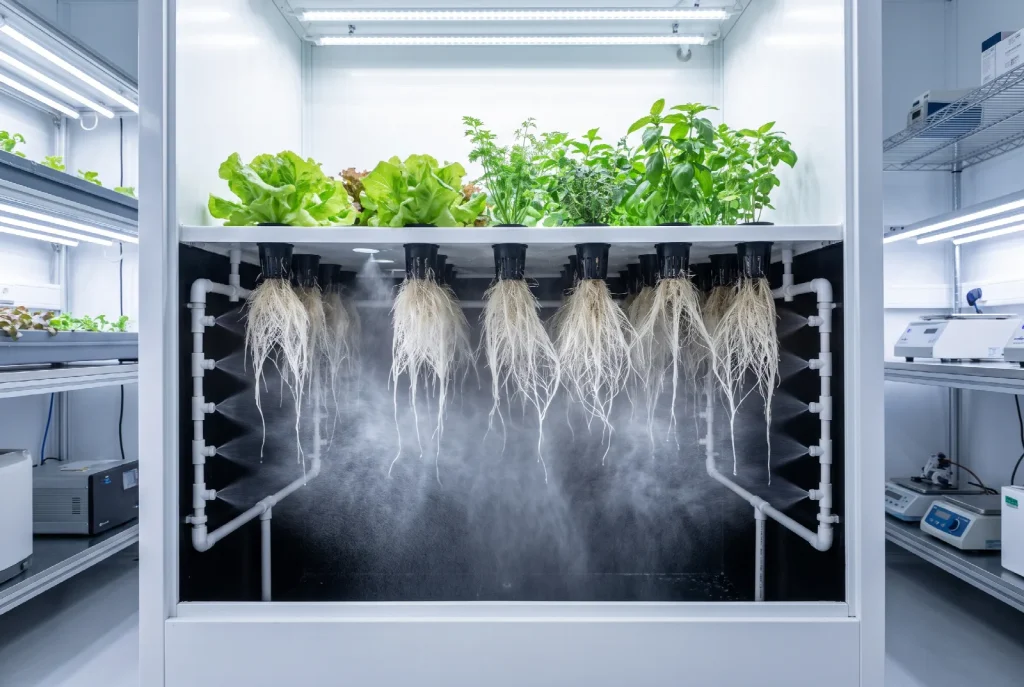
Aeroponics grows plants with their roots suspended in air inside a closed chamber, wetted by a fine spray of nutrient solution delivered on a timer. There is no growing medium and no reservoir around the roots at all. It produces the fastest growth of any hydroponic method, it is the method commercial seed potato producers use, and it is the one design on this site that can kill a crop in an afternoon.
What aeroponics actually is
A plant sits in a collar in the lid of a sealed chamber. Its stem is above the lid, in the light. Its roots hang below in the dark, touching nothing. Nozzles on a manifold inside the chamber fire a spray of nutrient solution across those roots for a few seconds at a time, every few minutes, and the solution that does not cling to the roots drains off the floor of the chamber and returns to a tank.
That is the whole of it, and the thing that distinguishes it from everything else on this site is what the roots sit in between sprays, which is air. In deep water culture the roots sit in solution. In nutrient film technique they lie in a shallow film of it. In ebb and flow and drip systems they sit in a medium that holds moisture between waterings. Aeroponics gives them nothing to sit in, which is the source of both its advantage and its fragility.
Worth separating from two things it gets confused with. Fogponics uses an ultrasonic fogger rather than a pressurised nozzle and produces a much finer suspension. Misting a medium is not aeroponics at all, whatever the product listing says, because the medium is doing the water holding and the roots are not in air.
Why it grows faster than anything else
Root oxygen is the ceiling on growth rate in every other method. Roots respire, respiring uses oxygen, and the oxygen has to arrive dissolved in water, where there is very little of it. Warm water holds less. This is the mechanism behind most of the root rot on this site, and the reason an air stone earns its place in a bucket.
Aeroponics removes that ceiling rather than raising it. Roots in open air have as much oxygen as they can use, and the mist delivers water and dissolved nutrients without ever displacing it. Nothing else does both at once. Everywhere else you are trading oxygen against water contact, which is what every system on this site is really a design for.
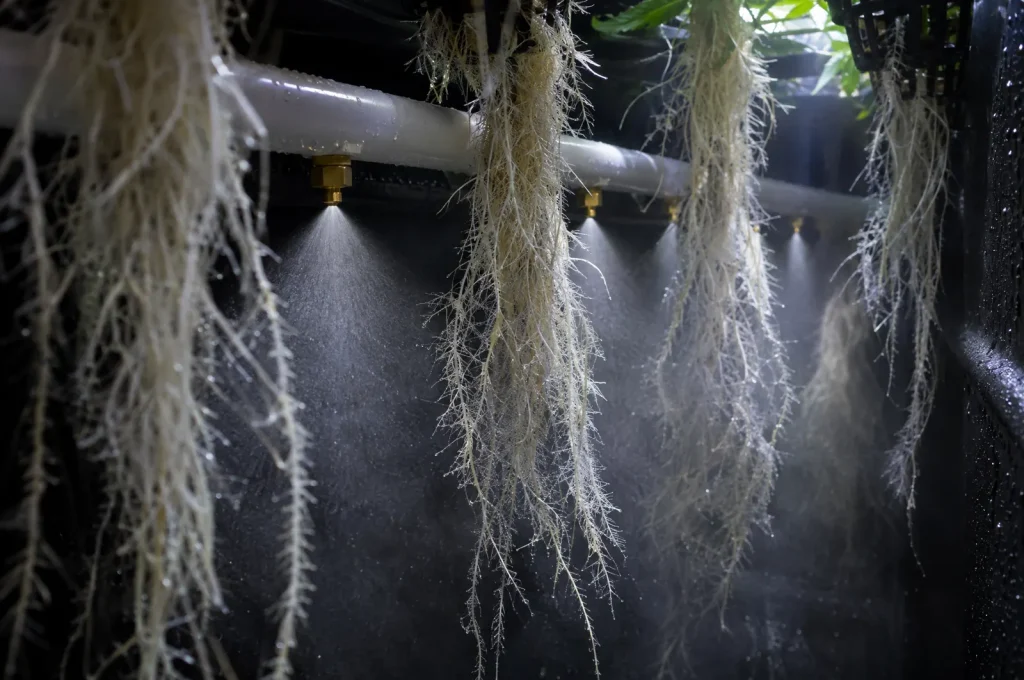
The roots look different as a result. They grow fine and feathery, with dense root hair rather than the thick white ropes a bucket produces, because they are foraging in air rather than reaching through water.
High pressure and low pressure are not the same thing
Almost everything sold to home growers as aeroponic is the low pressure kind. A fountain pump pushes solution through sprinkler style nozzles at whatever pressure it can manage, and the result is a coarse spray of large droplets. It works, it grows plants, and it is a reasonable thing to build. It is not what the research literature means by aeroponics.
High pressure aeroponics uses a diaphragm pump, an accumulator tank and a solenoid valve to deliver solution to the nozzle at a pressure high enough to atomise it. The commonly quoted target is a droplet in the region of twenty to fifty microns, at something around eighty to one hundred pounds per square inch.
| Spec | Low | High |
|---|---|---|
| Pressure | Pump only | 80 to 100 |
| Droplet | Coarse | 20 to 50 |
| Pump | Fountain | Diaphragm |
| Clogging | Less | Constant |
| Cost | Low | High |
Pressure in pounds per square inch, droplet in microns. The low pressure column is what most home kit is.
Droplet size matters because it decides whether the spray behaves like water or like air. Large droplets coalesce on the root and leave a film, which is the oxygen problem again. Very fine droplets carry so little water each that they have to arrive in enormous numbers to keep a plant fed, and the common report is that a mist that is too fine produces abundant root hair and a poor lateral root system. The twenty to fifty micron window is where both problems are small.
Be clear about the evidence behind that window. It is repeated consistently across patents, equipment makers and grower guides, and it is not something settled in the way the potato work below is settled. Treat it as the range the people building these systems have converged on rather than a measured optimum.
The timer is as much of the design as the nozzle. A spray of a few seconds every few minutes is typical, and the interval is doing two jobs: keeping a film of solution on the root, and letting that film thin enough between sprays that air gets back to the surface. Too frequent and you have built a very expensive and rather unreliable version of nutrient film technique. Too infrequent and the roots dry, which in this system takes minutes rather than hours.
What the evidence actually shows
Most claims made for aeroponics are made by people selling aeroponic equipment. There is one application where it has been measured properly and repeatedly, and it is worth knowing about even though you are unlikely to do it, because it is the clearest evidence that the method does what is claimed.
Seed potatoes start as disease free mini tubers, and growing those is a real industry with a real bottleneck, which is how many you get per plant. A 2021 study in Potato Research grew three cultivars at four planting densities, side by side, in an aeroponic system and in a conventional one.
| Cultivar | Standard | Aeroponic |
|---|---|---|
| Hermes | 290 | 787 |
| Sante | 364 | 1021 |
| Marabel | 334 | 1168 |
Tubers per square metre in the first production cycle, from Çalışkan and colleagues in Potato Research, 2021.
That is roughly three times the tuber count. Yield by weight came out at 5.9 to 9.3 kilograms per square metre in the aeroponic system, which the authors put at about twice the conventional figure, and the number of tubers per plant ran at 19.85 at the lowest planting density and 13.20 at the highest. They also note the figure usually observed for the method, an average of twenty to fifty mini tubers per plant across multiple harvests.
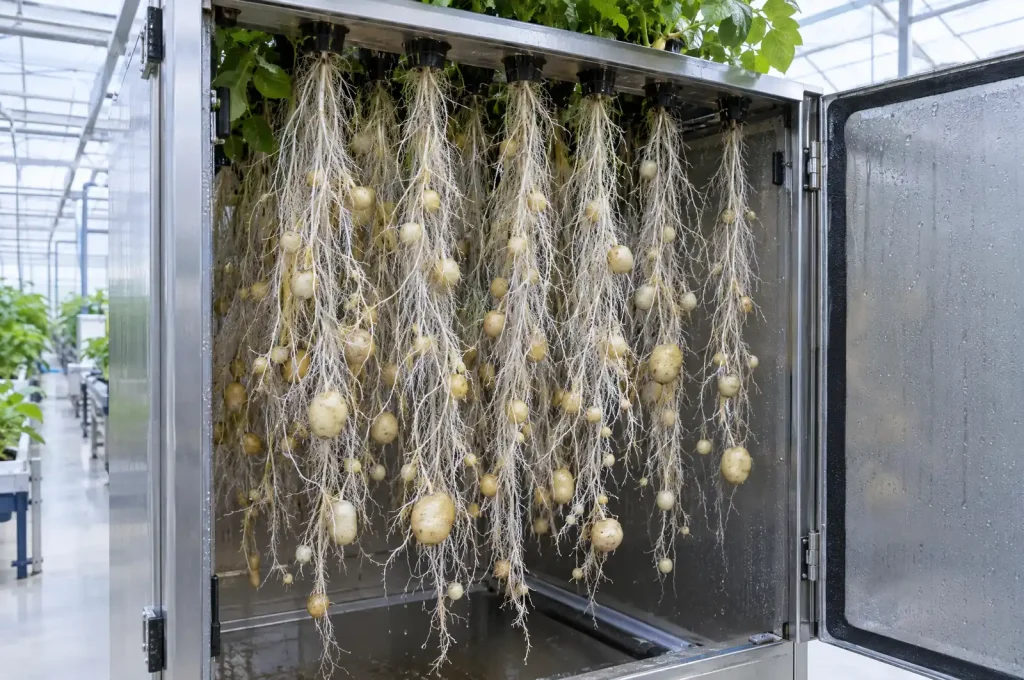
One number went the other way, and it is the honest part. Average tuber weight was higher in the conventional system. Aeroponics produced far more and slightly smaller. For seed potatoes that is exactly the right trade, because the crop is counted rather than weighed. Whether it is the right trade for whatever you are growing is a different question, and the answer is often no.
The NASA story is not quite the one you have read
Nearly every page about aeroponics says NASA researched it, and that aeroponics cuts water use by ninety eight percent and fertiliser by sixty percent. Both statements come from the same source and both are worth stating accurately.
NASA did take part. In 1997 it worked with AgriHouse and BioServe Space Technologies on a plant growth experiment flown on the Mir space station, using adzuki beans. The experiment was not an investigation of aeroponics. It was testing whether a non pesticide disease control treatment still worked in microgravity, since pesticides are heavily restricted in a closed habitat. NASA’s own write up is specific about what drew it to the method, and it was not root oxygen. It was that misting carries less water than any alternative, and water is weight on a launch vehicle.
The famous percentages appear in that same NASA write up, in a sentence that begins “According to AgriHouse”. They are the figures of the company selling the system, reported by NASA, not findings NASA produced. They may well be about right. They are not the independent verification they are usually presented as, and it is a small example of how a vendor claim becomes a fact by being quoted next to a space agency.
Where it goes wrong
What it does well
- The fastest growth rates of any hydroponic method
- Uses the least water and nutrient of any system
- Very high density in a small footprint
- Excellent for rooting cuttings
Where it struggles
- A pump failure kills bare roots in under an hour
- Misting nozzles clog constantly and need cleaning
- Highest cost and most components of any design
- Almost no buffer against nutrient or pH errors
Clogging is the failure you will actually meet. A nozzle fine enough to atomise is fine enough to block, and it blocks from the things a working reservoir is full of: undissolved fertiliser, calcium scale from hard water, and biofilm. A blocked nozzle does not announce itself, because the pump still runs and the other nozzles still spray. The plants over the blocked one are the only sign, and by the time they show it they have been dry for a day. Filtration and a weekly look inside the chamber are not optional here.
The failure window is the real problem. Every other design on this site gives you a buffer measured in hours or days. A Kratky jar has no pump to fail. A bucket holds solution whatever the pump does. A medium stays damp. Bare roots in a warm chamber with the mist stopped are in trouble inside an hour, and the article on leaving a system unattended is largely a list of things that do not apply to this one.
There is no dilution to hide behind. Mix the solution wrong and it reaches every root almost immediately, undiluted by any volume sitting around them. The same is true of pH. Everything in the pH guide and the PPM and EC chart matters more here than anywhere else on the site, and a meter you have calibrated stops being a nicety.
And the chamber is shared. Every root is in the same air and wetted by the same spray, so a root pathogen that arrives has nothing in its way. There is no medium to slow it and no separate container to isolate it.
Should you build one, and what to grow
The case for building one at home is narrower than the enthusiasm suggests. If the goal is salad on a windowsill, every other system on this site gets you there for less money and with far less that can go wrong, and the mason jar plan does it for about ten dollars. Growth rate is rarely the thing standing between a beginner and a lettuce.
Where it genuinely earns its keep at home is propagation. Rooting cuttings is the one job where the method’s advantages all point the same way: a cutting has no roots yet, wants humidity and oxygen rather than a reservoir, and goes into the chamber for a fortnight rather than a season, which keeps the exposure to a pump failure short. The article on taking cuttings covers the technique, and a chamber shortens the rooting stage considerably.
For a full crop, lettuce, herbs and strawberries all suit it. Heavy fruiting crops are possible and rarely worth the added risk, because a tomato occupies the chamber for months and gives a pump failure that many more chances to happen.
Not sure which system to build?
Compare all six side by side on cost, difficulty, and what they grow best.
Where this comes from
The mini tuber figures are from “Comparison of Aeroponics and Conventional Potato Mini Tuber Production Systems at Different Plant Densities” by Çalışkan, Yavuz, Yağız, Demirel and Çalışkan, in Potato Research volume 64, pages 41 to 53, published 2021. The tuber counts per square metre, the 19.85 and 13.20 tubers per plant at the lowest and highest densities, the 5.9 to 9.3 kilograms per square metre, the statement that this is about twice the conventional figure, and the note that average tuber weight was higher in the conventional system are all stated there. The NASA account and the AgriHouse percentages are from NASA’s own Spinoff article “Progressive Plant Growing Has Business Blooming”, which describes the 1997 Mir experiment with AgriHouse and BioServe Space Technologies, says the agency’s interest was the low water requirement and the payload weight that follows from it, and attributes the water, fertiliser and pesticide reduction figures to AgriHouse rather than to NASA.
The droplet and pressure figures are the weakest thing on this page and are labelled as such above. They come from equipment patents, manufacturers and grower documentation rather than from controlled work, and they are offered as the range practitioners have settled on. Costs, timings and failure modes are our own, from building and running these systems rather than from any publication.
Answer five questions about your budget, space, experience and what you want to grow, and our system comparison tool ranks all six against your answers, with the reasoning shown, and an honest “nothing fits” when nothing does.