Going Away, and the One Measurement That Tells You How Long
You are going away for a week, or a fortnight, and there is a system in the kitchen with plants in it. So you search for how long a hydroponic system can be left alone, and you get numbers. Every one of them is about somebody else’s reservoir, somebody else’s crop, and somebody else’s window. The number you actually need is specific to your system, and finding it takes one day and a marker pen. Do it a week before you travel, not the night before, because the answer tends to be smaller than people expect and the fixes all need a little notice.
Why the published numbers will not help you
It is not that nobody has measured plant water use. It is that the measurements disagree enormously, and for good reason.
Published figures for a mature greenhouse tomato run from roughly a third of a litre a day in one tropical greenhouse trial up to nearly two litres a day in bright commercial conditions. That is a sixfold spread for the same crop. Lettuce figures are worse, and depend heavily on whether the number describes a seedling or a finished head.
The reason is that water use is driven by transpiration, and transpiration is driven by light, temperature, humidity and how much leaf the plant has. Double the light and the plant drinks considerably more. A warm dry room pulls water through a plant much faster than a cool damp one. None of that is a property of the crop, so none of it can be looked up.
Worth knowing, because it reframes the whole problem: that water is not being wasted. The transpiration stream is the delivery mechanism for calcium, which is why a plant that transpires too little gets tipburn even in a full reservoir. A thirsty system is a working one.
The measurement
One ordinary day, with the lights on their usual schedule and the room at its usual temperature, tells you nearly everything.
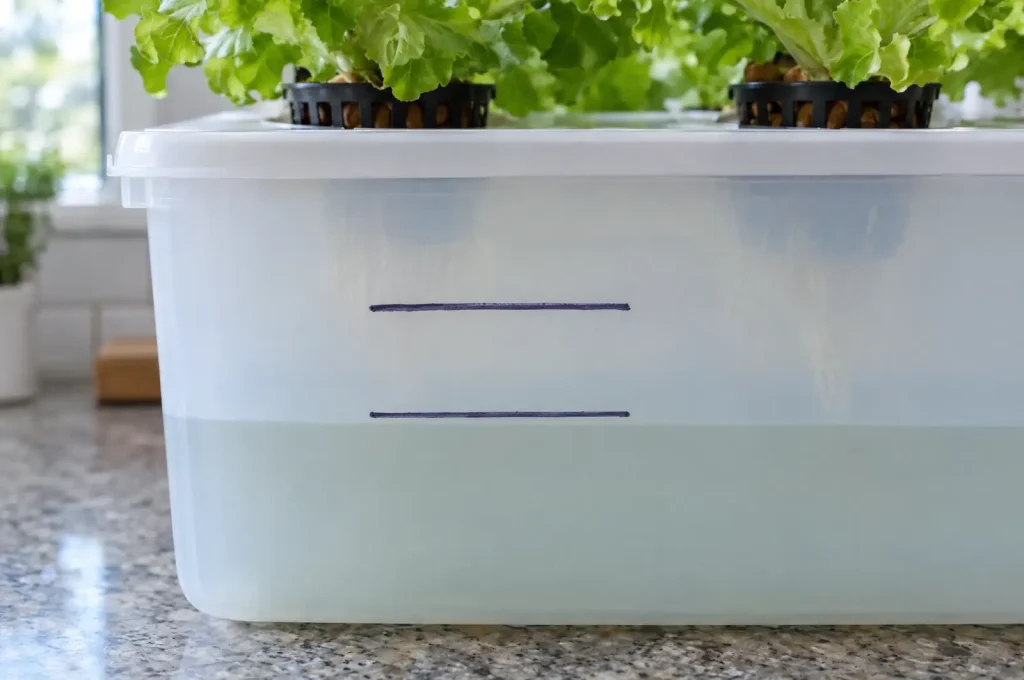
- Fill the reservoir to its normal level and mark the water line on the outside with a permanent marker or a strip of tape.
- Wait twenty four hours. Not an afternoon. The plant drinks on a daily cycle and an afternoon reading will overstate it.
- Mark the new line and measure the gap between the two in inches or centimetres. That is your daily drop.
- Work out your usable depth, which is the part of the tank below the fill line that the plants can actually have. See the next section, because this is where people get it wrong.
- Divide. Usable depth divided by daily drop is roughly how many days the system will run unattended.
| Drop per day | 4 inches usable | 8 inches usable |
|---|---|---|
| Quarter inch | 16 days | 32 days |
| Half inch | 8 days | 16 days |
| One inch | 4 days | 8 days |
| Two inches | 2 days | 4 days |
Days of running time from a measured daily drop. Take off a couple of days as margin, because the last of the water is the worst of the water.
Measure on a bright warm day rather than a dull one if you can, because the answer you want is the worst case rather than the average.
Usable depth is not the depth of the tank
This is the step that turns a confident calculation into a dead crop. You cannot have all the water in the container.
- In deep water culture, the roots have to stay in the water. Established roots hang well down, so there is more slack here than people fear, but the bottom inch or two is still not available to you in practice.
- Any system with a pump needs the intake covered. A pump that sucks air runs dry and can burn out, and then you have lost the aeration as well as the water. This is the limit that usually bites first.
- In nutrient film and drip systems the reservoir is the whole supply, because almost nothing is held in the channels. The volume in front of you is all there is.
- The last of the solution is the strongest. Plants take water faster than they take salts in warm bright weather, so the level falls and the concentration climbs. The article on changing your reservoir covers that drift properly. For this purpose it is enough to know that the final days of a long absence are fed the strongest and most unbalanced solution of the whole run.
What actually fails, in order
Running out of water is the thing everyone plans for, and it is only the most likely failure rather than the fastest one.
- The pump stops. This is the one that ruins a holiday, because it works on a timescale of hours rather than days. A power cut, a tripped socket or a failed pump takes out a nutrient film or drip system almost immediately, since the roots have no reservoir of their own. In deep water culture the plants keep their water but lose their oxygen, and warm still water with roots in it is the exact recipe for root rot.
- The room gets hot. A closed house in summer is warmer than the house you left. Solution temperature climbs, dissolved oxygen falls as it does so, and root rot follows. This is the failure that happens even when the water lasts.
- The water runs out. Slower, more predictable, and the one your measurement is for.
- Light reaches the solution. A reservoir filled to the brim and a lid left loose will grow algae happily for a fortnight with nobody watching.
- The timer fails. Rare, but a light stuck on for two weeks will cook a lettuce and a light stuck off will end it.
Buying yourself time before you go
These are in order of how much difference they make, and the second one is the one nobody suggests.
| What you do | Buys you | Costs |
|---|---|---|
| Bigger tank | Most | Space |
| Harvest first | A lot | The crop |
| Fewer light hours | Some | Growth |
| Cooler room | Some | Nothing |
Ranked by effect on how long the system runs without you.
Harvest before you go deserves the most attention, because it attacks the demand rather than the supply. Water use scales with leaf area, so a plant cut back to its inner leaves drinks a fraction of what a full one does. If the crop is anywhere near ready, taking it is better than trying to keep it alive in your absence, and the method in the article on when to harvest leaves the plant able to regrow while you are away rather than dying of thirst.
Affiliate disclosure: some links below are affiliate links. We may earn a commission if you buy through one, at no extra cost to you. As an Amazon Associate I earn from qualifying purchases. Full disclosure.
Cutting the light hours works for the same reason and is the easiest thing on the list. Two hours a day off the timer reduces transpiration directly, and the lighting guide has the normal schedules to come back to. The plants grow more slowly, which is exactly what you want from a crop nobody is watching.
Then the housekeeping. Change the reservoir the day before rather than topping it up, so the solution is correct rather than drifted at the start of the longest unattended stretch it will ever have. Seal the lid and close the gaps around the net pots. Move the system out of direct sun. Check the pump is not making a noise it did not use to make.
If somebody is checking in, give them one instruction rather than five: top up with plain water to the marked line, and touch nothing else. Plain water, not solution, because the strength is already climbing without them.
The system that does not care
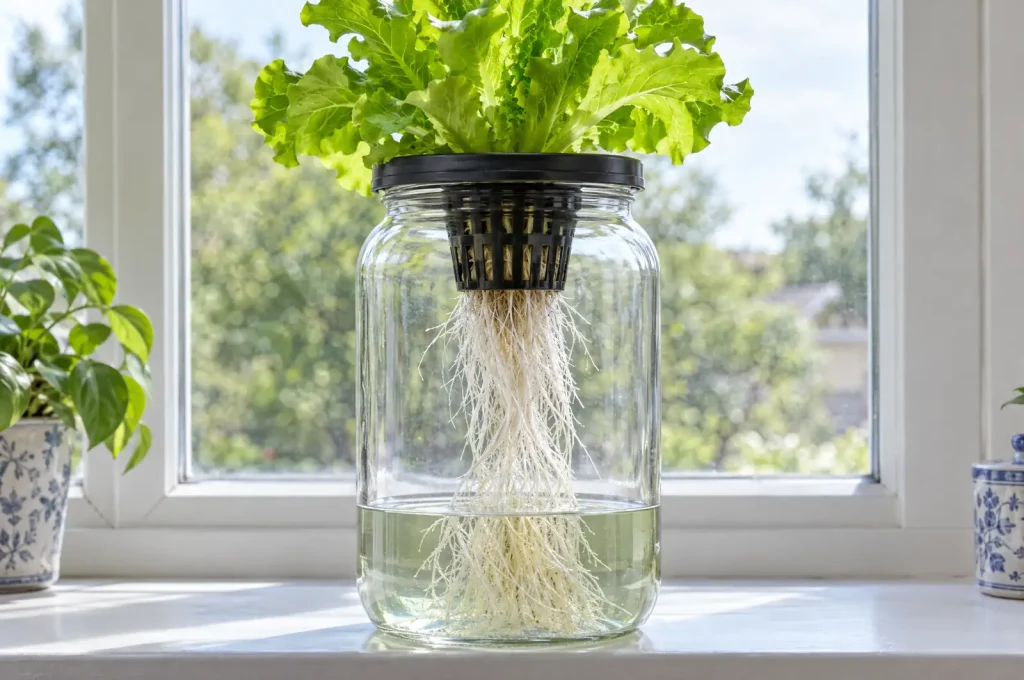
There is one method here that treats a fortnight away as completely normal, which is the Kratky method. It has no pump, so there is nothing to fail and no power to cut. It is designed around the water level falling, with the roots following it down and an air gap opening above, so a dropping level is the method working rather than the method failing. There is no topping up to miss.
Being fair about the limits, it suits leafy greens and herbs rather than fruiting crops, it runs one crop and then stops rather than continuing indefinitely, and the tank has to be sized for the whole crop at the start. But if you travel often and you have been fighting to keep a pumped system alive through it, the honest answer may be that you picked the wrong method rather than that you are doing it badly. The mason jar build costs almost nothing to try.
Coming back
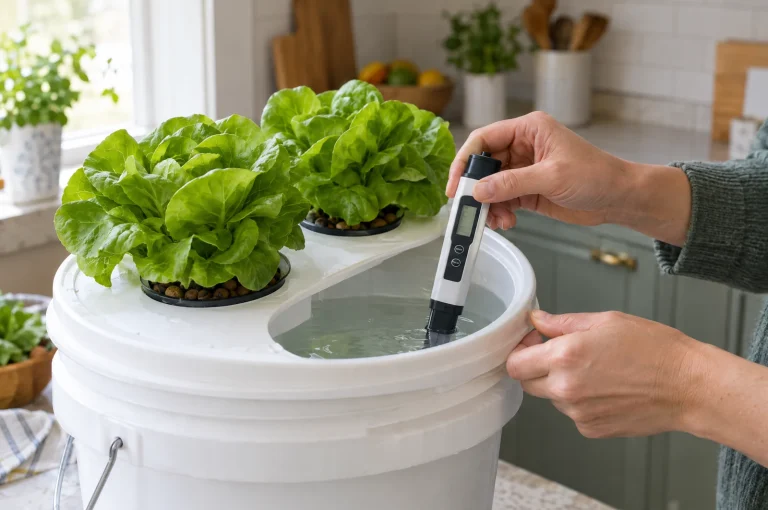
Resist the urge to pour fresh water in the moment you walk through the door. Read the meter first, because what it says tells you what the plants have been living on, and the reading is gone the second you dilute it.
- Read EC and pH before adding anything. A high EC confirms the solution concentrated while you were away, and the PPM and EC chart will tell you how far off it is.
- Then change it rather than top it up. After two weeks of unattended drift the solution is not worth rescuing.
- Look at the roots before you decide the crop survived. White and firm is fine. Brown and slimy means the warm still water did its work.
- Turn a few inner leaves over. A fortnight of still air in a closed house is when tipburn appears, and it shows up on the young leaves rather than the obvious ones.
Where this comes from
The honest answer on the numbers is that this article deliberately does not give you a per plant water use figure, because the published ones do not agree well enough to be useful at home. The range quoted above, from about a third of a litre a day for a greenhouse tomato in a tropical trial up to nearly two litres a day in bright commercial conditions, is drawn from greenhouse irrigation research and from an extension figure for mature greenhouse tomatoes that I was not able to open and verify at source, so treat the upper end as indicative rather than established. The lettuce figures in circulation disagree by considerably more than that, largely because some describe a seedling and some a finished head. None of that changes the method here, which is to measure your own drop rather than inherit anybody else’s. The relationship between transpiration, light and calcium delivery is from the Cornell controlled environment programme and the e-GRO alert already cited in our article on tipburn. The root zone and dissolved oxygen points are from the same e-GRO material behind our root rot article.
Found this useful? Tell Google to show you more of it.
Add to Preferred Sources