Electricity Beside an Open Tank, and the Breaker Myth
Seventy eight pages on this site and not one of them has mentioned the obvious thing about an active hydroponic system, which is that it is mains powered equipment running continuously beside an open tank of water, usually in a kitchen or a garage, often on an extension lead resting on the floor. The actual risk is low and this article is not going to pretend otherwise. It is also almost entirely removable by three habits that cost nothing, and one very widely held belief about the fuse box is wrong in a way that matters.
What your breaker is actually for
Start with the belief, because almost everyone holds it and it is the reason the rest of this feels unnecessary.
The Electrical Safety Foundation International, writing with the United States Consumer Product Safety Commission, describes the job plainly: circuit breakers and fuses in your home panel sense overcurrent conditions and short circuits, and reduce the risk of fire in your electrical wiring. That is the whole remit. They are watching the cable.
A breaker protects the wiring in your walls from catching fire. It does not notice a person. The current that will stop a heart is a tiny fraction of what it takes to trip a breaker rated for a lighting circuit, so a fault that is lethal to you can be comfortably within what the breaker considers normal. It will sit there and let it happen.
The device that does protect a person
There is a separate device for that, and it is the one piece of equipment in this article worth going out of your way for. In North America it is a ground fault circuit interrupter, a GFCI. Elsewhere the same thing is called a residual current device, an RCD.
| Device | What it protects |
|---|---|
| Fuse or breaker | The wiring, from fire |
| GFCI or RCD | A person, from shock |
Two different jobs, and having one does not give you the other. Most homes have the top row by default and the bottom row only in certain rooms.
The same guidance describes what it does. It disconnects power automatically when a plugged in product leaks electricity to ground. It protects against shock or electrocution when a plugged in product is dropped into a sink, pool, pond, puddle or hot tub, with the honest footnote that a shock may still be felt in the split second before it trips. And it cuts off current when a person touches a product that is leaking electricity, such as a heater.
Here is the part that decides whether you already have one. The National Electrical Code requires this protection on bathroom, garage, kitchen and outdoor outlets in new homes. Read that list again, because it is a list of the places people put hydroponic systems. If your house is recent and the system is in the kitchen or the garage, you are probably already covered. If it is in a bedroom, a spare room or a cupboard on the landing, you very likely are not.
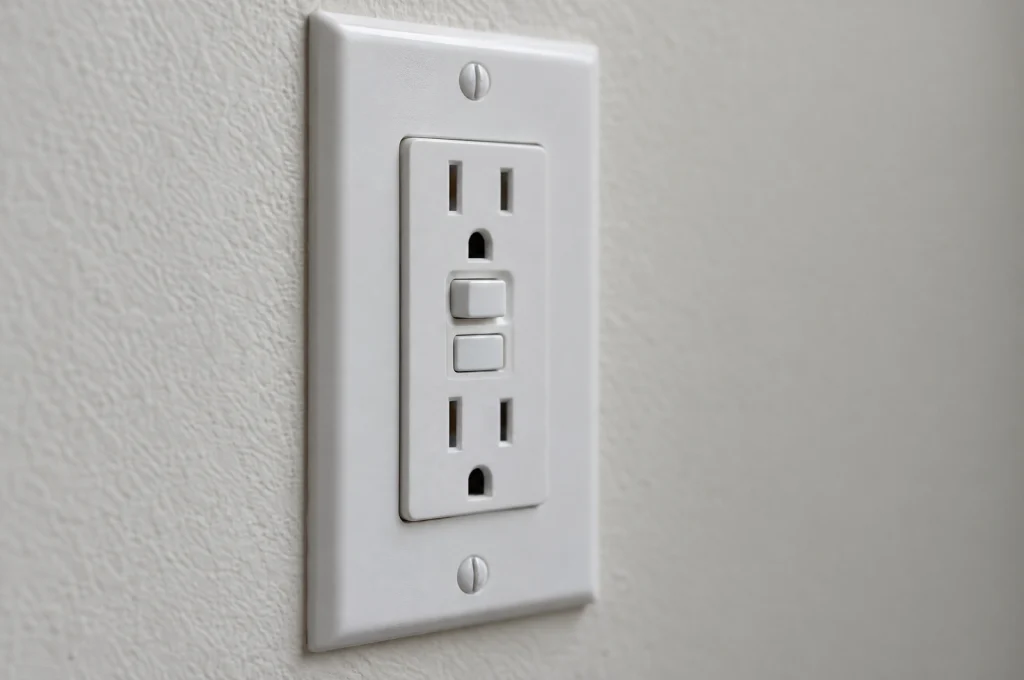
Two things follow. If there is no protection on that outlet, a portable plug in GFCI goes between the socket and the plug and costs very little, which the same guidance recommends for indoor equipment as well as outdoor. And whichever kind you have, test it, using the method they give: plug a night light into the protected outlet, switch it on, press the test button, and the light should go out. Press reset to restore it. A device nobody has ever tested is an assumption rather than a protection.
The loop that costs nothing
The second habit comes from the aquarium trade, which has been solving this exact problem for far longer than hydroponics has, and it is printed in the safety instructions of equipment people buy without reading them.
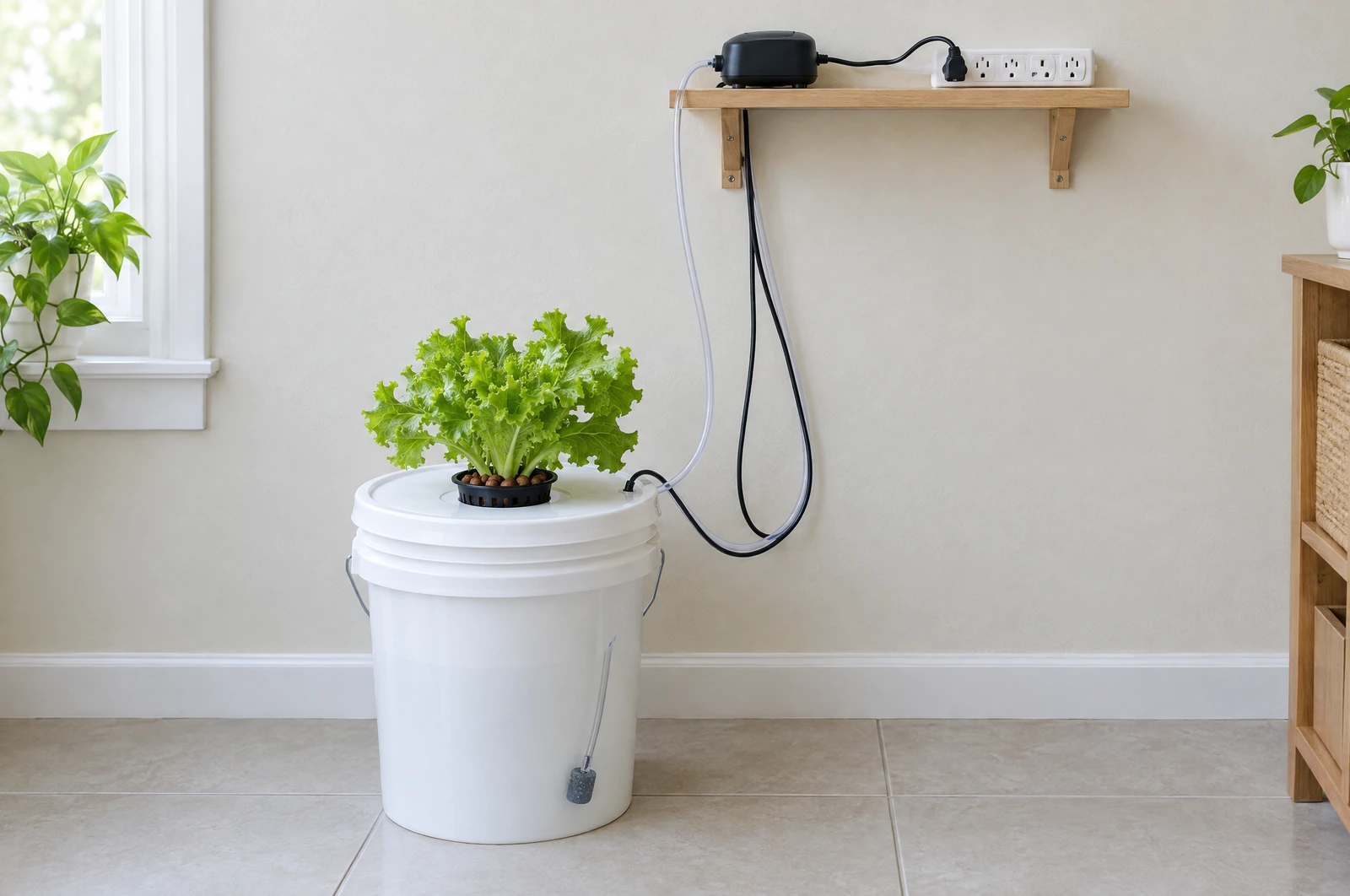
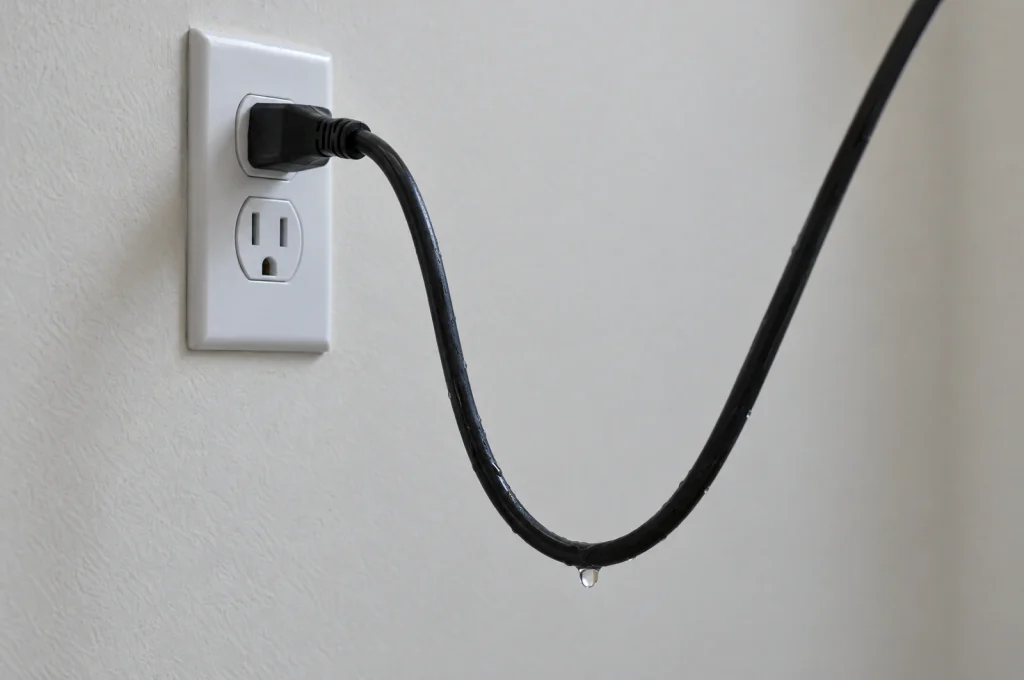
Water that gets onto a cable does not stay where it landed. Gravity walks it along the cable to the lowest point, and if the lowest point is the plug, that is where it arrives. A drip loop is the fix, and the manual for a common submersible aquarium heater defines it exactly: the part of the cord below the level of the outlet, or below the connector if an extension lead is used, arranged to stop water travelling along the cord and reaching the outlet.
In practice it is a deliberate sag in the cable between the system and the socket, hanging lower than the socket, so anything running down the cable collects at the bottom of the loop and drips onto the floor. It takes about ten seconds and needs nothing but slack. The same manual adds the other half of it, which is to position the equipment to one side of a wall outlet rather than directly beneath it, so water dripping off the tank never lands on the socket in the first place.
If the outlet does get wet
This one is worth committing to memory now rather than working out in the moment, because the instinctive action is the wrong one.
Do not pull the plug out. The manual is emphatic and puts it in capitals. If the plug or the outlet has got wet, you first disconnect the fuse or breaker that supplies power to that appliance, and only then unplug it and examine the outlet for water.
The reasoning is uncomfortable once you see it. Reaching for a wet plug means putting your hand on the one object in the room most likely to be live, while standing on a floor that now has water on it. Walking to the consumer unit first costs you fifteen seconds and removes the entire problem. The same instruction tells you to unplug a system before cleaning it or taking parts off it, which is worth folding into your routine when you are changing the reservoir with your hands in the tank.
Which of your kit actually matters
Not every item on the equipment list carries the same weight, and it is worth knowing which ones to be careful with.
- The air pump is the mildest. It draws a few watts, nothing of it goes into the water but a rubber tube, and the air pump article already tells you to keep it above the water line, which happens to deal with the electrical question at the same time as the siphoning one.
- The light sits above everything. Its weak point is the driver and the cable rather than the panel, and the thing to avoid is running it where condensation can collect on it.
- A water heater is the one to respect. It is the only common item that deliberately puts a mains powered object inside the tank, which is why its manual carries the warnings quoted above. If you run one through a cold spell, as the winter article suggests, inspect the cable each time you change the reservoir and replace it at the first sign of damage rather than the second.
- A timer is a timer. Mechanical or digital, it is a dry item that belongs nowhere near the tank, and it is the easiest thing in the room to site sensibly.
The extension lead on the floor
Almost every home system ends up on one, because a reservoir rarely lives next to a socket, and the usual arrangement puts the socket strip on the floor directly under the tank. That is the one place in the room where a spill is guaranteed to end up.
Get it off the floor and out from under. A shelf, a hook, a bracket on the wall, anything that means the strip is higher than the puddle will ever be. Use a lead rated for what you are plugging into it, which for a pump and a light is undemanding but is still worth reading off the label rather than assuming. Do not chain one lead into another. And take the plug out by the plug, never by pulling on the cord, which is the habit that quietly destroys the strain relief on the one cable you most want intact.
If none of this is available where the system currently sits, that is a reason to move the system rather than a reason to accept the arrangement. A Kratky jar remains the one method on this site that plugs into nothing at all, which is worth remembering if the only spot you have is genuinely unsuitable.
Keeping it in proportion
None of this makes indoor growing a dangerous activity, and an article that left you nervous would have failed at the job.
The equipment involved is small, most of it is low wattage, and millions of aquariums have run beside millions of sofas for decades on exactly the same principles. A bucket build draws less power than a phone charger for most of the day. What is unusual about this hobby is not the risk level but the combination: an open body of water, equipment running every hour of every day rather than for an hour at a time, and a grower who regularly has both hands in the tank.
Three habits cover nearly all of it, and the total cost is one inexpensive device and no effort at all. Have ground fault protection on the outlet and test it. Hang a drip loop in the cable. Keep the socket off the floor and out from under the tank. After that the subject can go back to being something you never think about, which is the correct place for it.
Where this comes from
The description of what breakers and fuses do, what a ground fault circuit interrupter does, the National Electrical Code requirement covering bathroom, garage, kitchen and outdoor outlets in new homes, the recommendation of a portable plug in unit where no protection exists, and the night light test procedure are all from the Outdoor Electrical Safety Check published by the Electrical Safety Foundation International in cooperation with the United States Consumer Product Safety Commission and the Canada Safety Council. It is written for outdoor use, and the parts quoted here are the ones about water and electricity meeting, which is the situation an indoor reservoir creates on purpose.
The drip loop definition, the instruction to position equipment to one side of an outlet, the instruction not to unplug a wet cord but to kill the breaker first, and the advice on unplugging before maintenance and never yanking a cord are from the instruction manual for the Fluval P series submersible aquarium heater. Aquarium equipment carries this material because the hazard is identical, and a hydroponic reservoir is an aquarium without the fish.
The wiring rules quoted are North American. The devices and the physics are the same everywhere, but the names differ and so do the regulations about which circuits must carry protection, so check your own national wiring standard rather than ours. Nothing here is a substitute for an electrician, and anything involving the consumer unit itself is their work rather than yours.
Found this useful? Tell Google to show you more of it.
Add to Preferred Sources