Changing Your Hydroponic Reservoir, and Why Topping Up Is Not Enough
Nobody enjoys this job, so everybody looks for a way around it. The way around it is always the same: keep topping the reservoir up, watch the meter, and change the solution when the meter says to. That sounds disciplined and it is wrong, and there is a published set of measurements that shows exactly how wrong. A grower holding a perfect EC for three weeks ran his lettuce into a nitrogen deficiency, and his meter never once told him.
What topping up actually does
Plants do not drink your solution. They take water and they take individual nutrients, at rates that have nothing to do with each other and change with the weather, the crop and the stage it is at.
So the mixture in the tank does not get weaker in the tidy way people imagine. It gets lopsided. Whatever the crop is using fastest runs down, and whatever it is using slowly builds up, because every top up pours more of it in. Do that for a few weeks and the reservoir is no longer the thing you mixed. It is a different solution that happens to have the same total strength.
The number that hides it
Here is the problem with the meter. EC measures dissolved salts all together as one figure. It cannot tell you which salts, and it has no way of distinguishing the nitrogen your lettuce is desperate for from the sulfur it has been ignoring for a fortnight.
Researchers at the University of Arkansas were called in by a commercial lettuce grower whose yield had dropped. He had done everything the internet tells you to do. He topped off daily with fresh solution and held EC between 1.8 and 2.2. They sampled his tank when it was freshly mixed and again after three weeks.
| Nutrient | Fresh (mg/L) | After 3 weeks |
|---|---|---|
| Nitrogen | 190 | 60 |
| Phosphorus | 144 | 329 |
| Potassium | 309 | 446 |
| Sulfur | 266 | 817 |
| Calcium | 157 | 101 |
| Magnesium | 44 | 69 |
From the e-GRO alert on nutrient replenishment, University of Arkansas. Solution EC over the same three weeks went from 2.00 to 2.24 mS/cm, which is to say it never left the target range.
Read that table twice. Nitrogen fell by about two thirds. Sulfur more than tripled, phosphorus more than doubled, and calcium dropped by about a third. And the meter moved by almost nothing, because the things building up were replacing the thing running out, unit for unit, on a scale that cannot distinguish between them.
The cruel part is the feedback loop. Because the accumulating salts were pushing EC up on their own, holding the target meant adding less fresh fertiliser, which meant adding less nitrogen, which was the one element actually running out. Following the meter faithfully is what starved the crop. The researchers are blunt about the conclusion, that maintaining a constant EC does not guarantee an adequate long term nutrient supply.

None of this makes EC useless, and our PPM and EC chart is still the right way to mix a solution and the right way to catch a tank that has gone badly wrong. It just cannot certify that an old solution is still a good one. That is not what the instrument does.
What it looks like when you leave it
The Arkansas grower lost yield before he lost appearance, which is the usual order and the reason this goes unnoticed. A solution going lopsided does not announce itself. It produces a plant that is slightly disappointing in a way you put down to something else.
When it does become visible, these are the three it tends to show up as, and all three are easy to misread.
- Pale older leaves and a plant that has simply stopped growing. That is nitrogen, the element the table shows running down fastest, and it reads exactly like underfeeding. The instinct is to add more solution, which is what caused it. Our guide to yellowing hydroponic lettuce works through the alternatives worth ruling out first.
- pH that will not stay where you put it. A fresh solution resists pH change far better than an old one. When you find yourself adjusting every day, the answer is usually not more adjuster. It is that the solution has lost the buffering it had when you mixed it.
- Tip burn and scorched leaf edges. Accumulated salts, the exact process in the table seen from the plant’s side. Easy to blame on a solution mixed too strong, when the strength on the day you mixed it was correct.
The common thread is that every one of them has an obvious wrong answer that makes it worse. That is why a change on a schedule beats a change on symptoms.
So how often
For a home system, every two weeks is the honest default, and the main thing that shortens it is a small reservoir carrying a lot of plant.
Think in volume per plant rather than in litres. Roughly a gallon of solution for a small leafy plant and two to three for anything fruiting is a sane floor, and below that the solution swings faster than you can sensibly manage. This is the real argument for not crowding a bucket. Six lettuces in a five gallon tank is not six times the harvest of one, it is a reservoir that now needs changing twice as often and that punishes you for a week away.
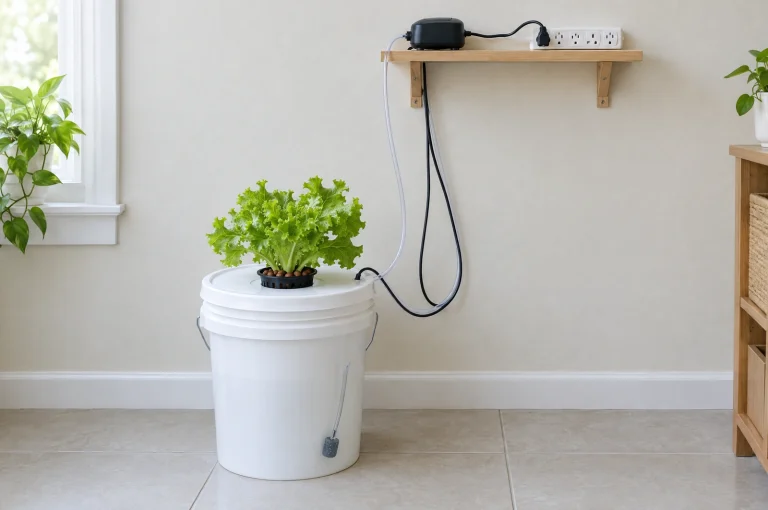
- Deep water culture and bucket builds. Every two weeks, and weekly once a plant is big relative to its bucket. A single mature plant in five gallons will move that solution a long way in seven days.
- NFT and ebb and flow. Every two to three weeks. The larger shared reservoir buys you time, which is the real advantage of the extra plumbing.
- Drip. Every two weeks, and watch it more closely if you are growing in coco, which holds and exchanges nutrients of its own accord.
- Kratky is the exception and it is exempt on purpose. The whole method is one tank of solution drawn down to nothing across the life of the crop. There is no topping up and no changing. You are not maintaining a reservoir, you are spending one. It is also the one method that copes with being left alone for a fortnight.
Commercial growers run far longer than any of this, with some large raft systems going months between changes, because their reservoirs are enormous relative to the crop and because they test the solution properly rather than guessing. Neither of those is true of a bucket on a balcony.
What the meter can still tell you
Between changes, EC is useful for one specific decision: what to top up with. Mark the level on the side of the reservoir when you fill it, let it drop, and read the meter before you add anything.
- EC has risen. The plants took water faster than they took nutrients, which is the normal summer case. Top up with plain pH adjusted water, not solution.
- EC has fallen. They took nutrients faster than water, which happens in cool bright weather and with fast growers. Top up with solution at the usual strength.
- EC has barely moved. Top up with solution at about half strength and carry on.
This is worth doing properly because the default behaviour, topping up with full strength solution every time, is the one that concentrates salts the fastest. It is also the one that feels most like looking after your plants.
Doing the change
- Mix the new solution first and let it come to room temperature. Pouring cold water onto warm roots is a genuine shock and it is avoidable.
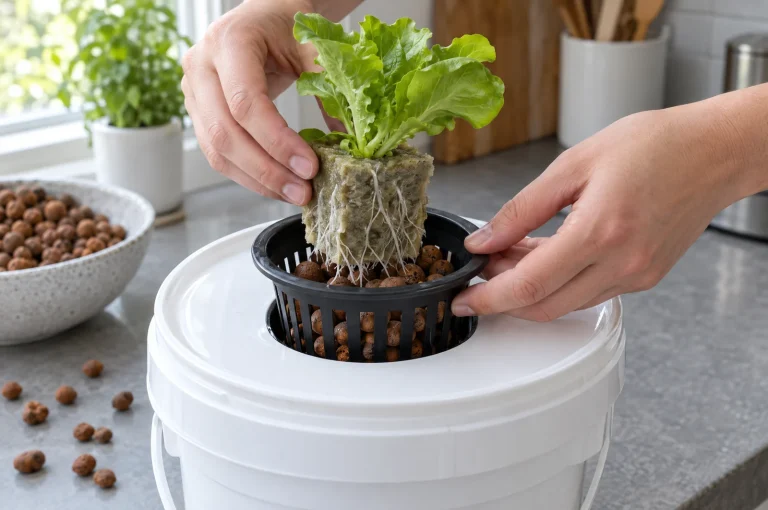
- Lift the plants out on their lid or in their net pots and rest them somewhere out of direct light. Roots must not dry out, so this is a five minute job rather than a leisurely one.
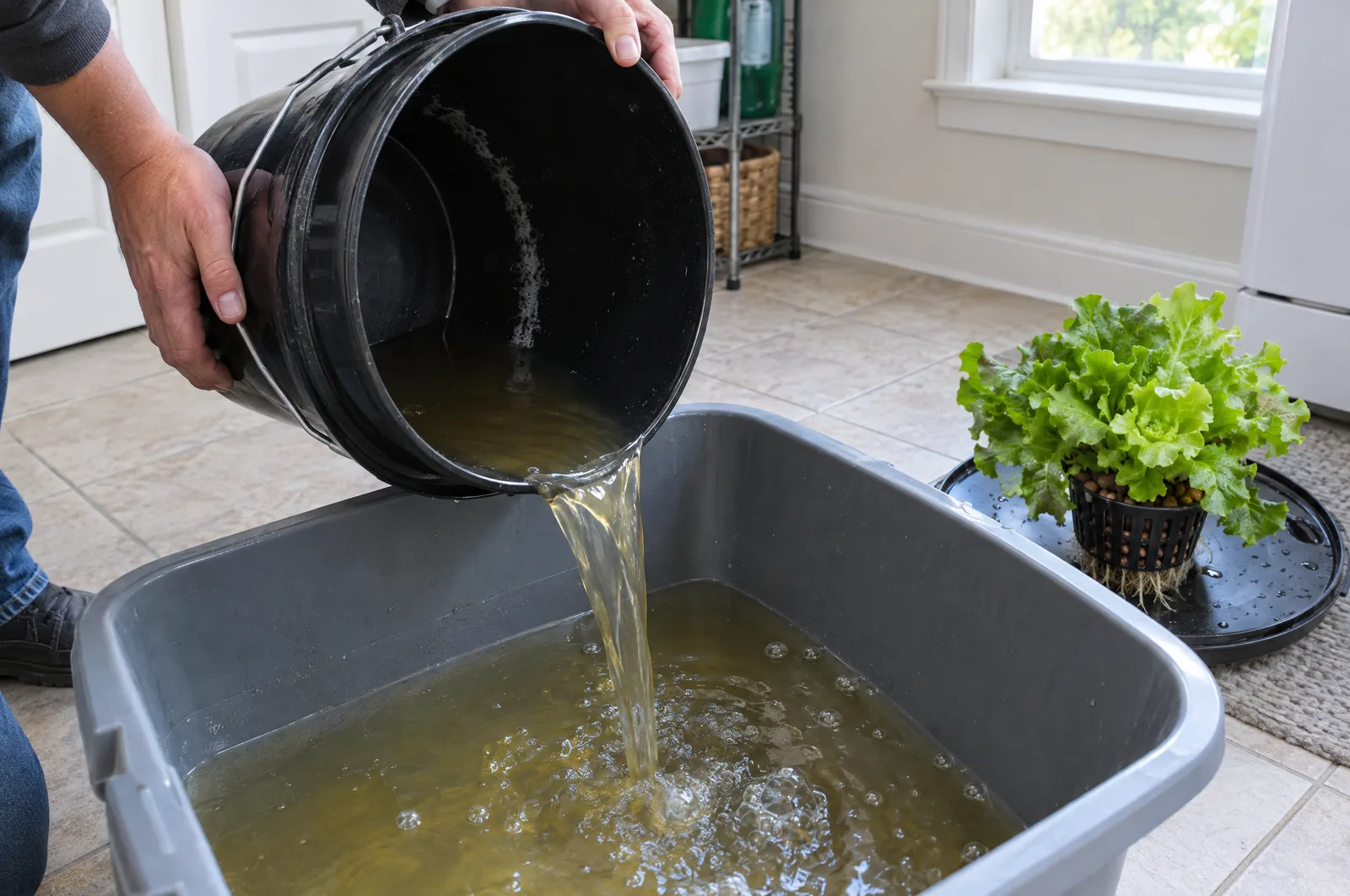
- Tip the old solution out. Onto the garden is fine, it is dilute fertiliser.
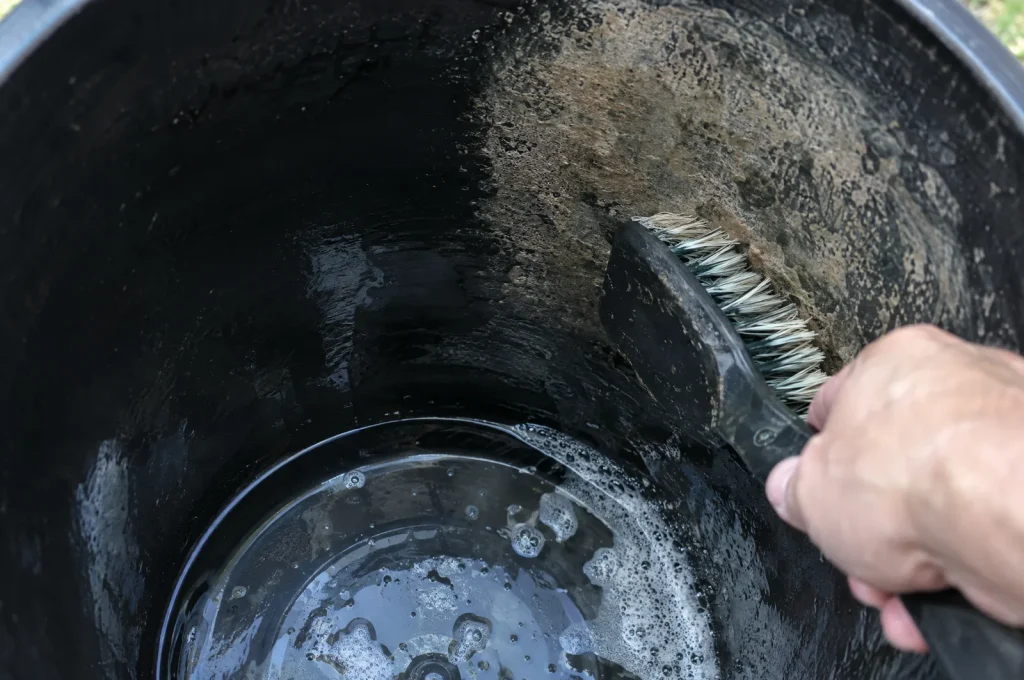
- Scrub the tank, which is the part everyone skips. See below.
- Rinse, refill, check pH, and put the plants back so the roots sit where they were before.
Do not mix the new solution in the old tank. The film on the walls is most of what you are trying to remove.
While it is empty
An empty reservoir is the only chance you get at the inside of it, and the five minutes here are worth more than the change itself. It does of course have to be empty into something, and where the old solution should go is a question worth settling once rather than deciding at the sink every fortnight.
The slick you can feel on the walls is biofilm, and biofilm is where the organisms behind root rot shelter from anything you pour in afterwards. The pale crust at the old waterline is accumulated salts, the physical residue of exactly the process in that table. Both come off with a brush and warm water, and neither comes off with a sanitiser applied over the top of them. Remove the material first, then sanitise if you are going to, then rinse thoroughly so nothing is left to burn the roots.
Check the air stone while you are in there, give the pump a rinse, and have a look at the lid for light leaks, since that is what feeds algae. A reservoir change is the one moment all of these are accessible at once.
Where this comes from
The three week solution analysis and the conclusion drawn from it are from the e-GRO Edibles Alert on fine-tuning nutrient replenishment in hydroponics, by Dickson, Houston and Machesney at the University of Arkansas, which is also the source of the figures in the table. The observation that large raft systems can run for months between changes is from University of New Hampshire Extension. The intervals given for home systems are the conservative end of common practice rather than a research finding, and they are shorter than a commercial grower would use for the reasons set out above.
Found this useful? Tell Google to show you more of it.
Add to Preferred Sources