
Hydroponic nutrients 101: feeding your plants made simple
What nutrients are, how to mix them, and what happens if you get it wrong. Explained for people who have never done this before.
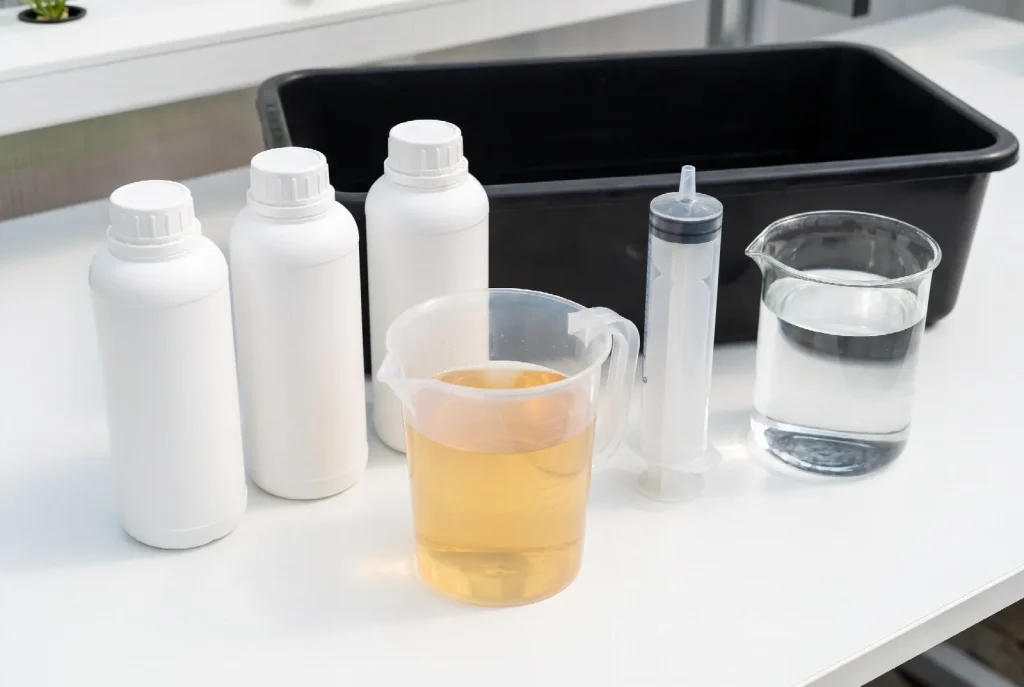
In soil, plant food arrives slowly as organic matter breaks down. In hydroponics you supply it directly, already dissolved and ready to absorb. That is the whole difference, and it is why a bottle of hydroponic nutrient is not interchangeable with a box of garden fertiliser.
What is actually in the bottle
A complete hydroponic nutrient contains seventeen elements. You do not need to memorise them, but it helps to know the shape of the list.
| Group | Elements | What they do |
|---|---|---|
| Primary macros | Nitrogen (N), phosphorus (P), potassium (K) | The three numbers on the label. Leaves, roots and flowers, and overall vigour. |
| Secondary macros | Calcium, magnesium, sulfur | Cell walls, chlorophyll, and protein building. Often short in soft or filtered water. |
| Micronutrients | Iron, manganese, zinc, copper, boron, molybdenum, chlorine | Needed in tiny amounts, but a shortage of any one stalls the plant completely. |
Why garden fertiliser will not do
One-part, two-part, or three-part?
- One-part. Everything in a single bottle. Simplest, and completely adequate for greens and herbs. Start here.
- Two-part (A and B). Splits the ingredients that would react and precipitate if concentrated together. A small amount of extra work for better stability.
- Three-part (grow, micro, bloom). Lets you shift the ratio as the plant moves from leafy growth to flowering. Worth it once you grow tomatoes, peppers, or strawberries.
How to mix, in the right order
Start with water, never concentrate
Fill the reservoir first. Adding water to concentrate rather than concentrate to water is how you get precipitate.
Add one part at a time
With multi-part nutrients, add the first part, stir until fully dispersed, then add the next. Never pour two concentrates together. Calcium and phosphate will bind into a white sludge your plants cannot use.
Mix, then measure pH
Nutrients change the pH of water, so measuring before you add them tells you nothing useful. Mix first, then test, then correct.
Use half strength for seedlings
For the first two weeks after transplanting, mix at half the label rate. Young roots burn easily, and a burnt root system is much harder to recover from than a slightly hungry plant.
How often to change the reservoir
Plants do not drink the solution evenly. They take up some elements faster than others, so the balance drifts even while the level and the EC reading look reasonable. In any recirculating system, replace the whole reservoir every two to three weeks. Between changes, top up with plain water only.
Working out what half the label rate actually means for your container is the fiddly part. Our nutrient dosing calculator converts any label dose into the exact amount for a jar, bottle or bucket.
Kratky systems are the exception. There you mix once and never change it, because the crop finishes before the drift matters.
Next: pH and PPM for beginners
The Weekly Grow
Get weekly growing tips in your inbox
One email per week. No spam. Just practical tips, new plans, and honest gear guides.
Unsubscribe anytime. We respect your inbox.