
Best hydroponic systems for beginners: buy or build?
Countertop units are convenient and expensive. DIY builds are cheap and take an afternoon. Here is an honest comparison of what each actually gets you.
Affiliate disclosure: The Hydroponist is reader-supported. When you buy through links on our site, we may earn an affiliate commission at no extra cost to you. We only recommend products we have researched thoroughly. Your trust matters to us. As an Amazon Associate I earn from qualifying purchases.
There are two honest answers to “what is the best hydroponic system for a beginner”, and which one is right depends almost entirely on whether you enjoy building things.
The core trade-off
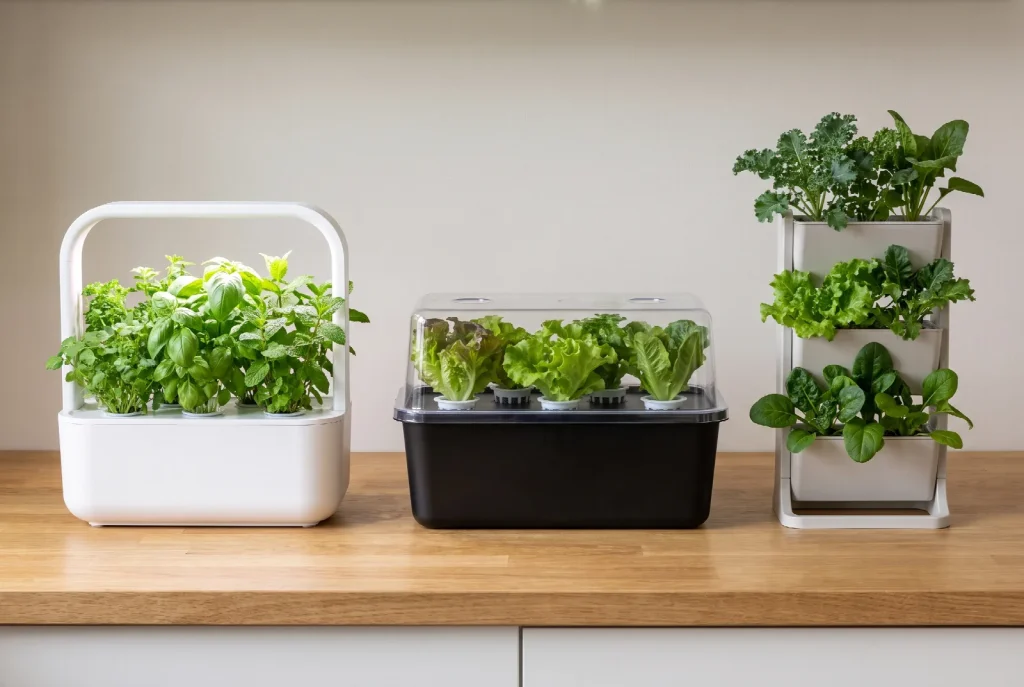
| Ready-made countertop unit | DIY build | |
|---|---|---|
| Upfront cost | $100 to $300 | $10 to $50 |
| Setup time | 15 minutes, out of the box | 15 minutes to 3 hours depending on the plan |
| Capacity | Typically 3 to 12 plants | As many as you build |
| Running costs | Proprietary pods and nutrients, often $15 to $30 per cycle | Generic nutrients, roughly $2 to $5 per cycle |
| Repairability | Proprietary pump and light. If it fails out of warranty, it is often scrap. | Every part is standard and replaceable for a few dollars |
| What you learn | Little. The system hides the mechanism from you. | A great deal, which is what makes the next system better |
| Looks on a kitchen counter | Genuinely good | Depends entirely on your effort |
When a ready-made unit is the right call
- You want herbs on the kitchen counter and have no interest in the hobby itself.
- You have no space or tolerance for a bucket with tubing coming out of it.
- It is a gift for someone who would never build one.
- You want something that looks designed rather than improvised.
What to check before buying one
- Can it take generic seeds and nutrients? Some units only accept proprietary pods, which multiplies running costs several times over. Many accept standard net pots if you look.
- What is the light’s actual wattage? Some built-in lights are underpowered for anything beyond herbs.
- Is the pump replaceable? Pumps are the first thing to fail. A unit with a serviceable pump lasts years longer.
- How big is the reservoir? A small reservoir means topping up every few days and much faster nutrient drift.
The DIY equivalents
For each price point there is a build on this site that does the same job for a fraction of the cost: the $10 mason jar for herbs, the $30 bucket DWC for a four-plant countertop equivalent, and the $50 PVC system for six to eight plants.
Build before you buy
Every plan on this site is free, and the most popular one costs about $10 and takes 15 minutes.
Answer five questions about your budget, space, experience and what you want to grow, and our system comparison tool ranks all six against your answers — with the reasoning shown, and an honest “nothing fits” when nothing does.