What Size Air Pump, and Why the Bubbles Are Not the Point
You are about to buy an air pump, and every number you can find disagrees with the next one. One page says half a litre of air per minute for each gallon of reservoir, another says one, another says two. For the same five gallon bucket you will be told two to four litres per minute on one site and three to five on the next. None of them says where the figure came from, and almost all of them are shops. The vagueness is not laziness. The pump rating is close to the least important number in the system, and once you know what actually moves oxygen into water, you can stop shopping by specification altogether.
Three things decide it, and the pump sets one
Aquaculture has worked on this problem for far longer than hydroponics has, because a pond full of fish fails faster than a bucket of lettuce does. The Southern Regional Aquaculture Center’s fact sheet on pond aeration sets out the gas transfer equation and then translates it, and the translation is the part worth having.
The rate at which oxygen moves between air and water depends on three things: the amount of turbulence, the ratio of air to water interfacial area to water volume, and how far the current dissolved oxygen level sits below saturation.
The third one is not yours to set. It is decided by how much oxygen your roots and the microbes in the tank are consuming, and by water temperature, which is the subject of the root rot article and the oxygen ceiling table in it. What a pump buys you is the other two, and it buys far more of one than of the other.
Why a still reservoir stops taking up oxygen
An open reservoir is already in contact with the atmosphere across its whole surface, which raises an obvious question. If air is sitting on top of the water, why does the water run short of oxygen at all.
The fact sheet answers it plainly. Even when the body of water is low in oxygen, the thin film at the surface of calm water becomes saturated almost immediately, and once it has, the rate of diffusion downward drops dramatically. Oxygen has to cross a layer that is already full.
A still reservoir is not short of contact with air. It is short of a way of taking away the water that has already had its turn. Turbulent mixing does exactly that, moving oxygenated surface water down and bringing depleted water up to be charged.
Your bucket is too shallow for the bubbles to do much
Now the uncomfortable part, which is that the bubbles themselves are not doing most of the work people assume they are.
Oxygen transfer from a bubble improves with smaller bubble size, with a deeper release point, and with a higher oxygen content in the gas. Depth earns its place twice over. Pressure from the water above raises the saturation concentration, which widens the deficit the bubble is working against, and deep water gives a long contact time, so more of the oxygen inside the bubble has crossed into the water before it surfaces.
| Depth | What that is |
|---|---|
| 15 to 30 ft | Wastewater basin |
| 3 to 4 ft | Pond, called inefficient |
| About 12 in | A five gallon bucket |
Depths at which diffused aeration is discussed in the aquaculture literature, with a home reservoir added for scale. The principle carries down to a bucket. The efficiency figures do not.
Wastewater plants build basins fifteen to thirty feet deep specifically to make diffused aeration work. Aquaculture ponds are a few feet deep, and diffusers are seldom used in them, because in shallow water the bubbles reach the surface too quickly for effective transfer. At three to four feet the figures quoted for most diffusers fall to a small fraction of what the same hardware achieves in a deep basin.
A five gallon bucket holds about twelve inches of solution. That is a third of the depth at which the aquaculture literature already calls bubbles inefficient. The bubble leaving your air stone has roughly a second of contact with the water, and most of the oxygen inside it goes straight out of the top of the tank.
Read that across carefully. Those figures come from a field where the question is oxygen for fish across an acre of water, and nobody has run the equivalent numbers for a bucket on a kitchen worktop. The physics carries down. The efficiency values do not, and they are quoted here for the direction of the effect rather than as measurements of your system.
Which means the stone is mostly a stirrer
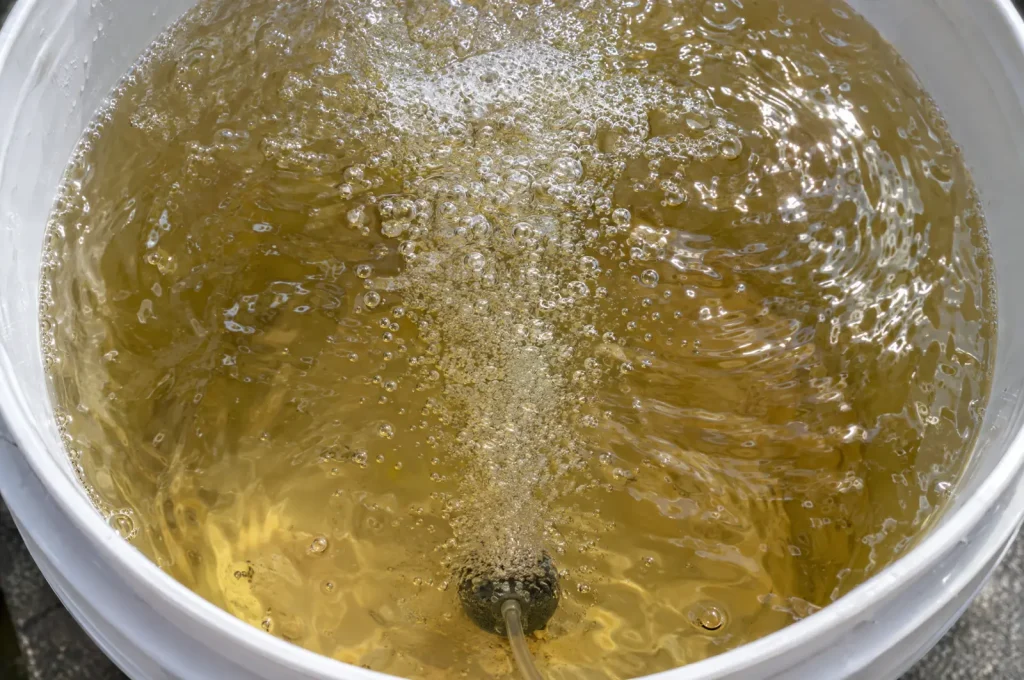
Put the two halves together and the picture inverts. The column of bubbles rising through a shallow reservoir drags water up with it, which pushes a constant slow overturn through the whole tank and keeps the surface broken rather than flat. That is the turbulence term in the equation, and in twelve inches of water it is doing the larger share of the work.
The bubbles are still transferring some oxygen directly. This is not a trick, and an air stone is not a con. But what you are actually buying is circulation, and that changes how you judge whether you have enough of it.
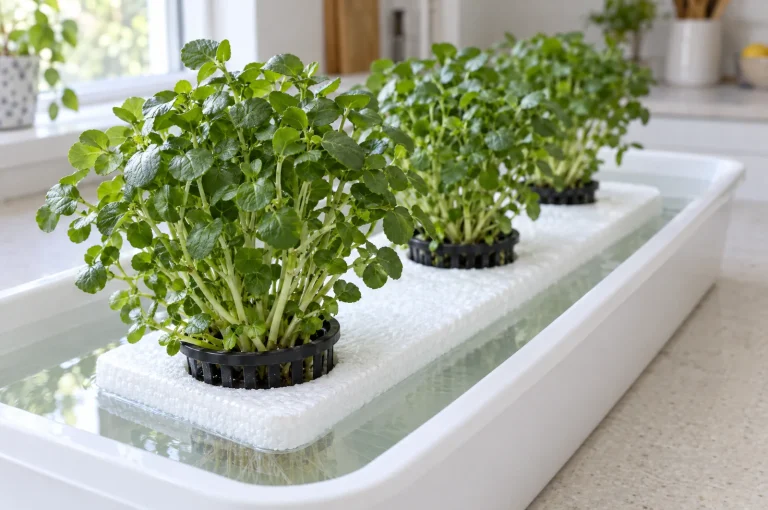
It also makes sense of something that otherwise looks inconsistent. A Kratky jar works with no pump at all, because it deliberately lets the level fall and leaves an air gap for the upper roots rather than trying to oxygenate the water from below. The pumped deep water culture bucket is solving a different problem, which is a full tank of standing water that has no reason to move. If circulation rather than bubbling is what a stone mainly provides, then where you put it in the tank should matter as much as how much air goes through it. That follows from the mechanism rather than from a trial anybody has published, so treat it as a reason to try moving the stone before buying a larger pump.
Finer bubbles, and the stone that quietly stops
Smaller bubbles do transfer better, for the straightforward reason that a given volume of air broken into many small bubbles presents far more surface to the water than the same air in a few large ones. So a fine pored stone beats an open tube end.
There is a catch, and the aquaculture people state it in the same breath. Fine pore diffusers run at low airflow are the most efficient option available and they foul and clog easily, which means they have to be cleaned often to keep working. The better stone is the one that needs more looking after. A coarse bubbler still running properly in December beats a fine stone that silted up in March and nobody noticed.
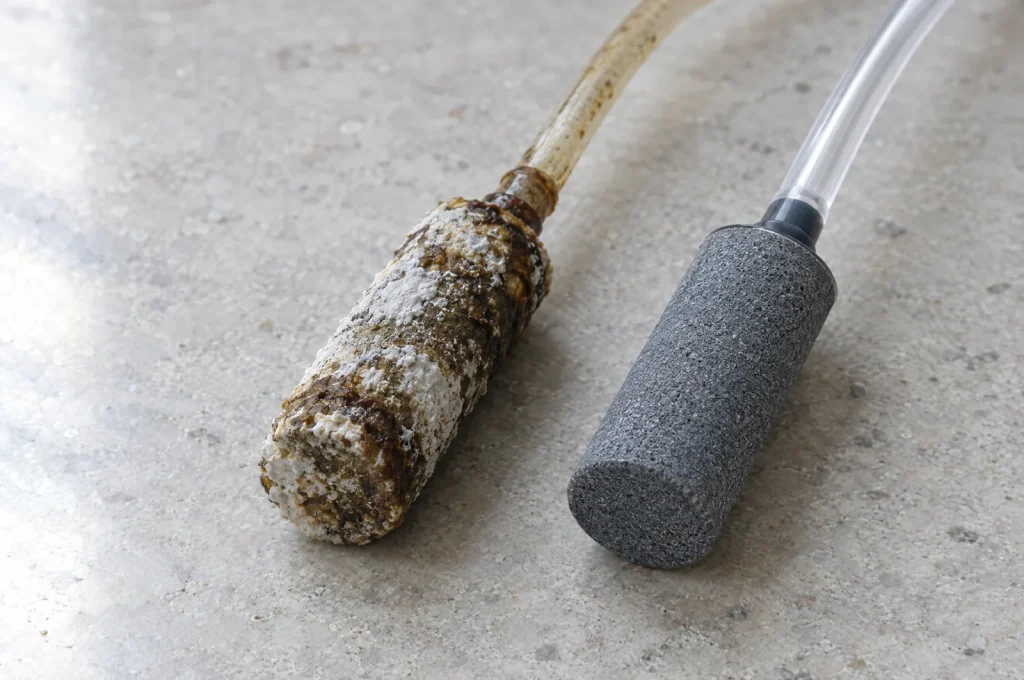
Noticing is the whole problem, because this failure is silent. The pump still hums. The tubing still feels pressurised. A stone furred with mineral scale from months of topping up, or filmed over with biology, simply passes less air, and the first symptom is a plant that has slowed down for no apparent reason.
- Look at the pattern, not the fact of bubbles. A stone that has gone lopsided, with vigorous bubbling from one end and nothing from the other, is already half blocked.
- Lift it out while the pump runs. Thirty seconds, once a month. You are checking that air comes from the whole face of it.
- Clean it in plain water. Scrub, rinse and refit. No detergent anywhere near a reservoir.
- Replace rather than fight it. Stones cost very little, and one that stays uneven after cleaning is finished.
The sensible moment for all of this is when you are changing the reservoir anyway, because the tank is empty and the stone is already in your hand. It is also worth a look before you go away, since a stalled stone is on the short list in the article on leaving a system unattended.
So what size, then
Back to the question you came with. The circulating rules of thumb run from half a litre per minute per gallon to two litres per minute per gallon, which is a fourfold spread, and a separate rule is quoted in watts rather than air at all. We have not found research behind any of them for a home sized reservoir, and the pages carrying them are selling pumps.
There is a second problem with shopping by the number. A pump’s rating is measured with nothing attached to it. Tubing length, the depth it has to push against and the resistance of the stone itself all take some of that back, so the figure on the box and the air arriving at the bottom of your bucket are different quantities.
Affiliate disclosure: some links below are affiliate links. We may earn a commission if you buy through one, at no extra cost to you. As an Amazon Associate I earn from qualifying purchases. Full disclosure.
Which leaves a much easier instruction. Buy an inexpensive aquarium air pump with tubing and a stone, fit it, and then judge it by the water rather than by the specification. If the surface is visibly moving across the whole reservoir and not just in one corner, you have enough. If half the tank is glassy, you need a second stone or a better placed one far more than you need a bigger pump. The budget gear list makes the related point that the pet aisle sells the same hardware as the hydroponics shop at a fraction of the price.
Too much air is not a problem worth worrying about. The cost of overdoing it is noise and a slightly faster drop in your water level, not damage.
Running it without annoying yourself
Three practical points that have nothing to do with oxygen and everything to do with whether the thing is still switched on in a month.
It runs continuously. Unlike a grow light it has no day and night cycle, because roots respire around the clock, and the bucket build plan covers the running cost, which is a couple of dollars a year.
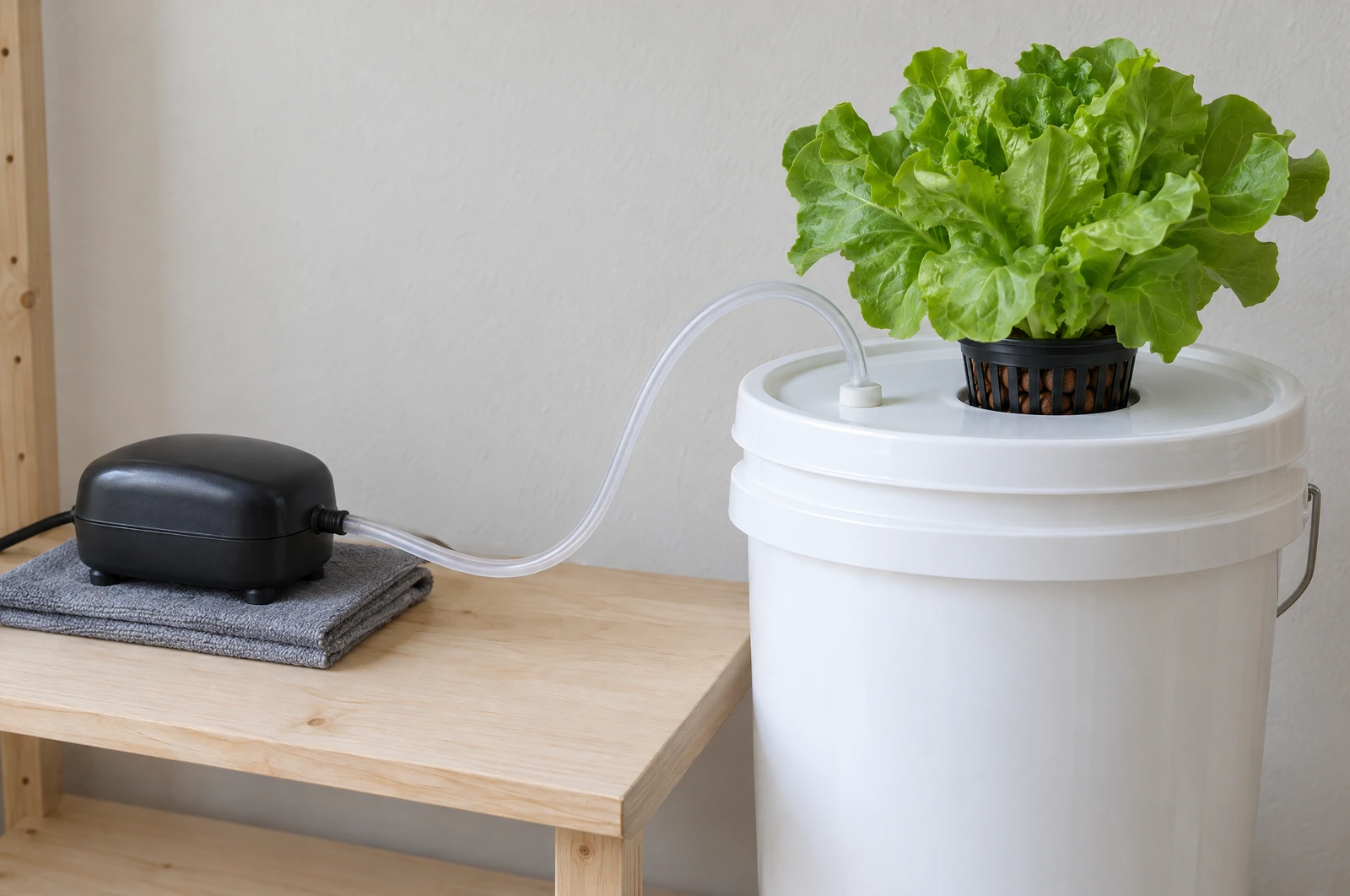
Keep the pump above the water line. If it sits lower than the reservoir and the power cuts, water siphons back down the tube into the pump, which ruins it and can empty part of your tank onto the floor. A one way check valve in the airline does the same job for very little if the pump has to sit low. Keeping it up there is good electrical practice as well as good plumbing, for reasons that article sets out.
Deal with the buzz on day one. A diaphragm pump sitting on a hard plastic lid turns the lid into a drum, and the noise is the single most common reason a pump gets switched off and forgotten. Stand it on a folded cloth or a scrap of foam, on a shelf or the floor rather than on the reservoir itself, and the problem disappears.
Where this comes from
The aeration principles, the behaviour of the surface film, the effects of depth and bubble size, and the fouling of fine pore diffusers are all from “Pond Aeration” by Craig Tucker of Mississippi State University, Southern Regional Aquaculture Center Publication Number 3700, dated September 2005. It is written for commercial fish ponds, and the depth figures quoted here describe aquaculture and wastewater practice rather than home reservoirs. The read across to a bucket is ours, and it is a read across of the mechanism rather than of the numbers.
The dissolved oxygen targets that sit behind all of this, including the saturation ceiling at different water temperatures and the floor that extension specialists give for preventing root damage, are set out with their sources on our root rot page rather than repeated here.
The sizing rules of thumb are reported as we found them, which is on retailer and affiliate pages rather than in research. We have quoted their spread rather than picking one, because the disagreement between them is the honest answer to the question. If anyone has run a controlled comparison of aeration rates in a five gallon home reservoir we have not been able to find it.
Found this useful? Tell Google to show you more of it.
Add to Preferred Sources