Hydroponic Watercress: Grow It, Never Pick It
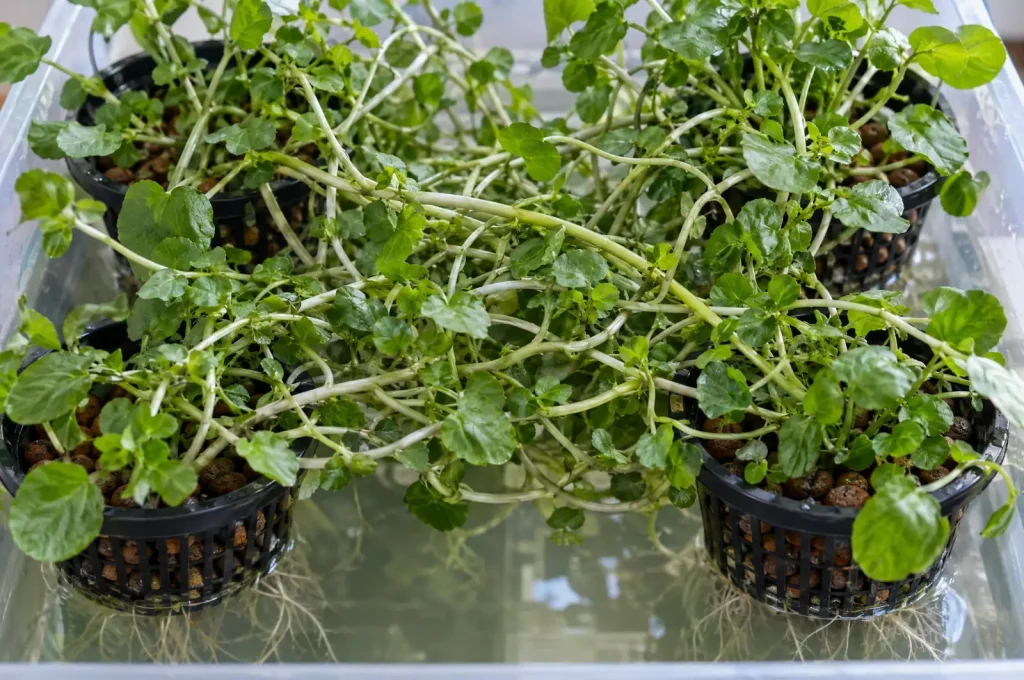
Our ranking of the crops that forgive a beginner puts watercress eleventh and sums it up in six words: actively wants to live in water. Our list of the five almost impossible to kill goes further, and says a hydroponic system is closer to its habitat than a garden bed. Both sentences point at a stream. Three different jobs are hiding in that one word. A jar takes over exactly one of them, cannot do the one that matters most, and watercress is still the right recommendation.
The one crop with a legal definition of how to grow it
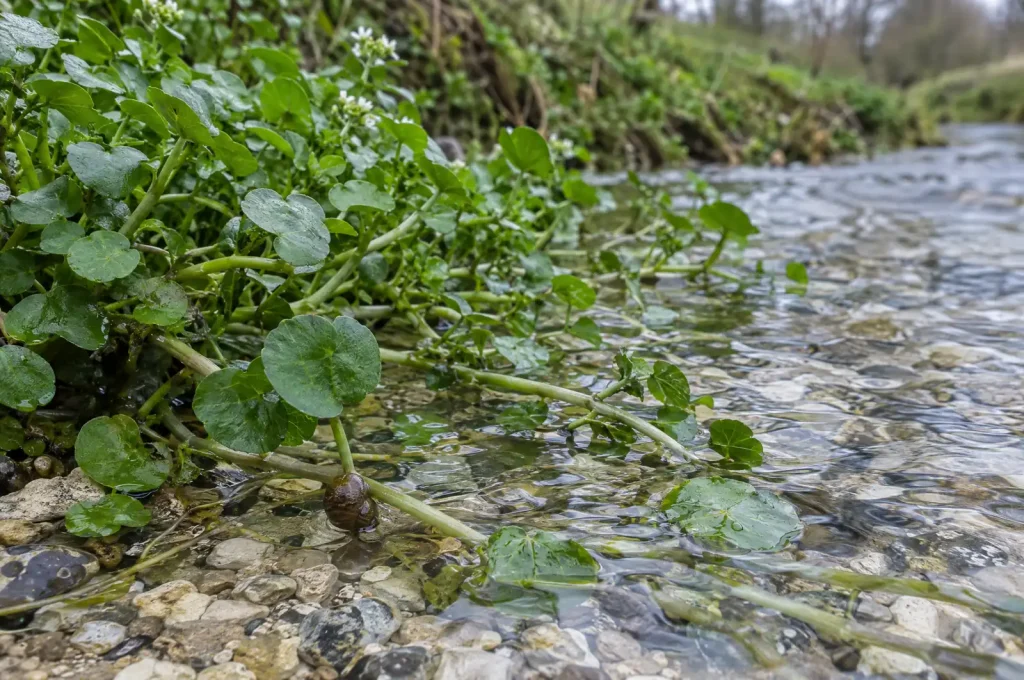
Watercress holds a protected name in the United Kingdom, and the specification behind it is a government document setting out what the word may mean. Most of it is what you would expect. The first requirement is not. Watercress must be grown in flowing water. Still water is not a weaker version of the method. It is outside the definition, and a crop raised in it cannot be sold under the name. Commercial production, the document says, simply replicates how the plant grows in the wild, using the nutrients from the flowing water.
So half of what our ranking says is safe. Watercress wants to be wet and takes a reservoir cheerfully. The other half was never checked against what the people who grow it think the habitat consists of. They think it consists of the flow.
What the flowing water was actually doing
Three jobs, and a reservoir takes over one completely and fails at another. Temperature first. Water rising from the springs and boreholes that feed the beds is typically 50 to 54F (10 to 12C), and the specification says in as many words that this affords protection from hot and cold weather, the flowing water cooling the crop on hot days and warming it on cold ones. A thermostat with no moving parts and no off switch.
Feeding second. Pure spring water, the document says, contains all the minerals needed for growth, with one exception: there is normally a lack of phosphorus. That is the entire fertiliser problem of commercial watercress. One element.
Flavour third. The pepper is phenethyl isothiocyanate, around 10 milligrams in 100 grams of fresh leaf, and the specification treats it as the thing being held steady. Keeping it even needs stable, stress free conditions, because a plant stressed by heat, cold or thirst produces variant levels of it.
Read those together and the trade becomes nameable. You win the feeding outright, because a bottle of hydroponic nutrient hands over the phosphorus a chalk spring cannot. You lose the thermostat completely. And since flavour tracks temperature, a little of that goes with it.
Seventy eight degrees is the number to remember
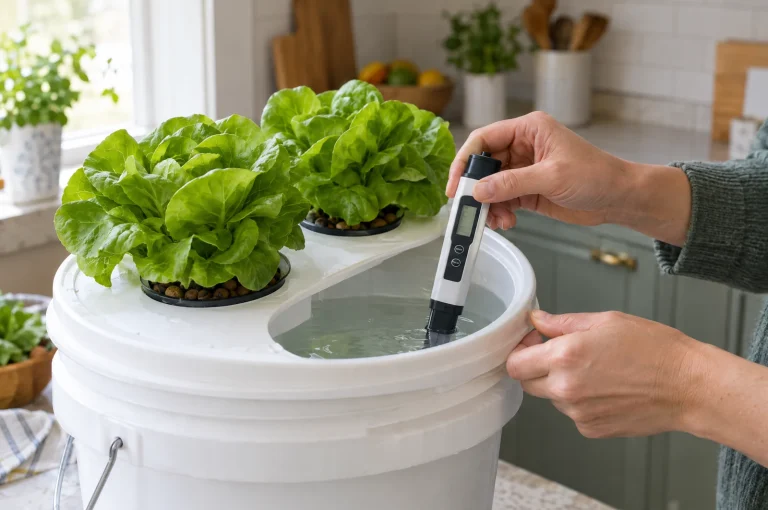
Losing the thermostat matters because somebody has measured the edge. The University of Hawaii extension service is blunt about it: solution temperatures exceeding 78F (26C) are detrimental to watercress growth, and water above that figure causes slow or poor growth. That is a lower ceiling than most beginner crops carry, and it sits just above the band our root rot page already asks you to hold. Follow the advice you were being given anyway and you are under it.
Air temperature is far less fussy. Below 60F (16C) growth slows, and the best Hawaii results came with daytime air of 70 to 85F (21 to 29C), which is an ordinary room. The plant above the water is comfortable in conditions the water below it is not, and that gap is the problem with a shallow tank on a sunny worktop.
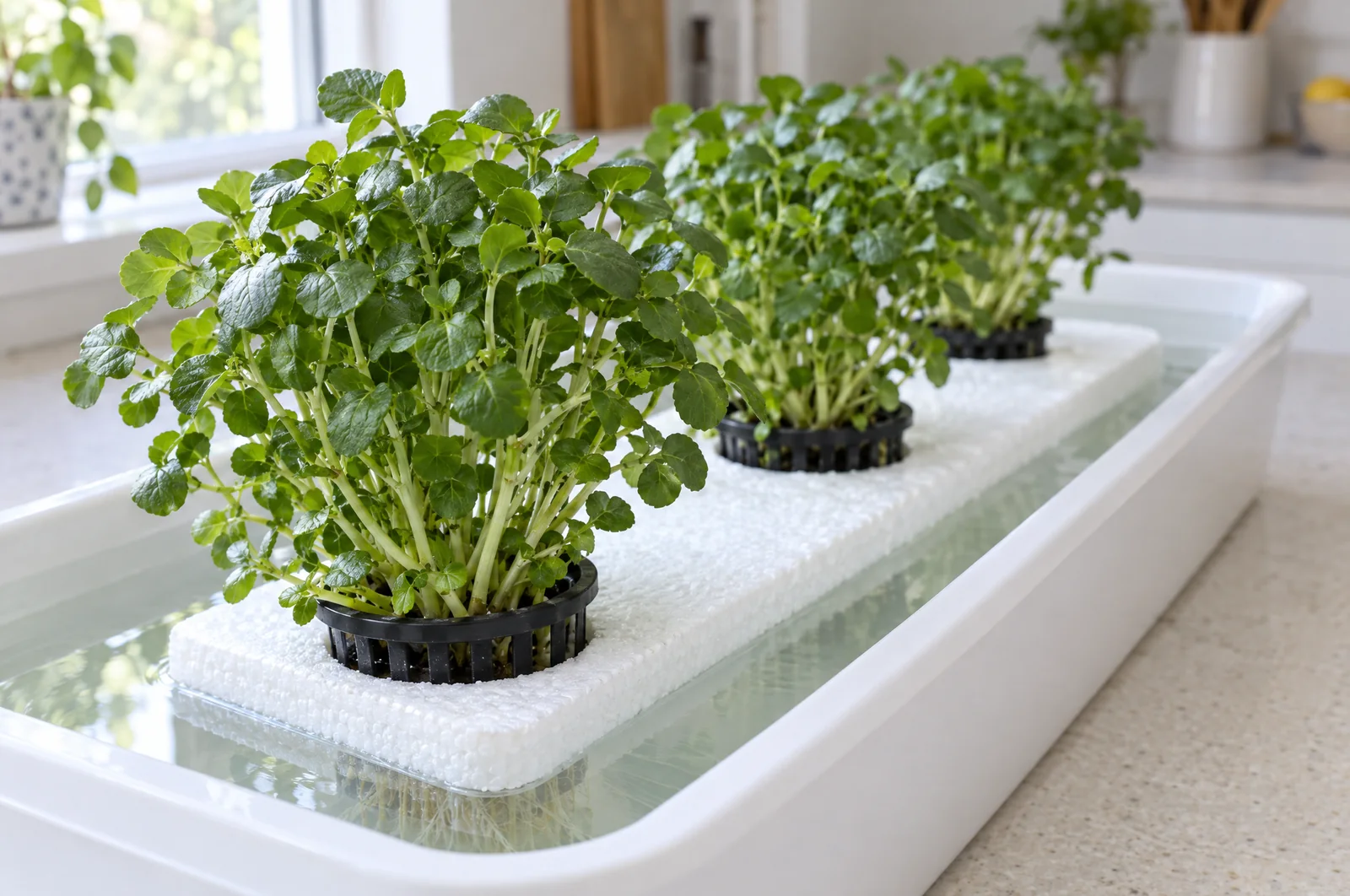
Which gives the fix, and it is a shape rather than a gadget. A shallow body of solution swings further and peaks higher through the day than a deep one. The recommendation is five inches or more, deeper being better, with an insulating cover at warm sites. Depth is thermal mass, and thermal mass is the cheap half of a chiller.
The man our jar is named after tested this crop in one
That Hawaii publication is by B. A. Kratky, whose non-circulating method this site teaches and whose name is on our simplest build plan. He put watercress into that system on purpose.
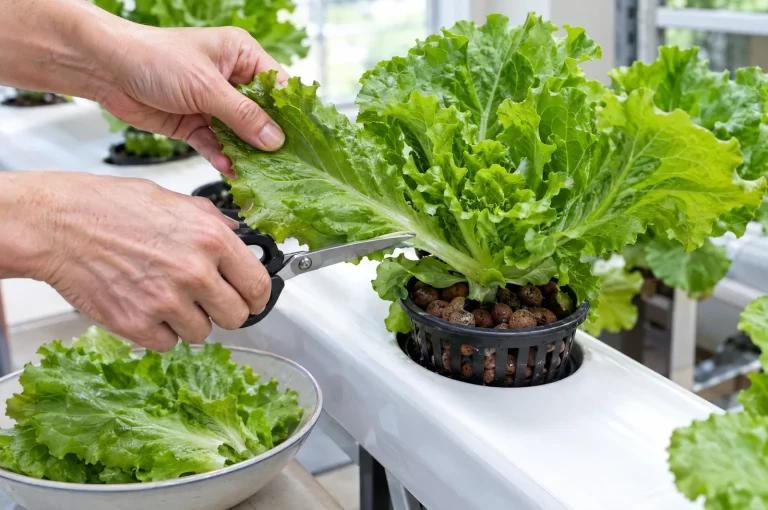
Still water works. Watercress has been grown in uncovered tanks of non-circulating solution a foot deep, on about 0.1 percent of the water flowing field production needs: as little as 1.5 gallons a pound against 3,800 to 6,900 in conventional ponds. Our environmental piece finds the usual water saving claim does less work than people think, and this is the crop where it does the most. It keeps producing, too: eight harvests in a year from one planting, fourteen over thirteen months, cutting the regrowth the way our harvesting article describes.
Then the part that contradicts the method it came from. In those tanks, nitrate nitrogen fell from 121 parts per million to 65 after a month and to 7 after five months when the solution was only topped up. Changing it every two months instead gave 49 and 88 percent higher yields in two trials. A Kratky jar is mixed once and left, and a lettuce finishes before that matters. A perennial cropped for a year does not. Changing the reservoir stops being optional the moment the plant outlives the solution.
What else is living in that stream
Our pages say watercress is rarely troubled by anything. Grown in flowing water it is troubled by a great deal. Crook root disease is caused by Spongospora subterranea f. sp. nasturtii. It infects the roots, which swell, turn brittle and bend into the hook that names it, then stunt and rot until plants lift out of the bed. It is the most important disease of United Kingdom watercress production, worst in winter, and it carries a passenger: the same organism is the vector for watercress yellow spot virus, and a spotted plant is unsaleable.
Since the 1950s the control has been zinc, dosed into the water flowing through the beds, with an old target of 0.1 parts per million passing the crop. A micronutrient, used as a pesticide, poured into a river. It works, and the cost caught up with it: zinc is toxic to the freshwater shrimp Gammarus, and growers are now held to a discharge limit of 0.075 parts per million.
None of it reaches a tank on your worktop, because none of it can get in. The pathogen arrives in moving water from upstream, and there is no upstream. Same shape as the root rot that keeps commercial growers off hydroponic spinach: a barrier built by scale, which stops at the kitchen door.
Washing does not fix it, so never pick it wild
One line in the protected name specification reads oddly until you know what it is for. There must be no permanent muddy areas which could be a habitat for the mud snail.
The snail is the middle of a life cycle. Fasciola hepatica, the liver fluke, lives in sheep and cattle, its eggs leave in their dung, and the larvae hatching in fresh water invade a snail. What the snail releases swims briefly and then encysts on whatever is standing in the water. The United States Centers for Disease Control put the human half plainly: humans and other mammals become infected by ingesting metacercariae-contaminated vegetation, and the example they give in brackets is watercress.
The French food safety agency assessed this crop specifically and reached the conclusion that matters here. Washing of watercress leaves, even with vinegar, it says, is insufficient to eliminate the hazard, and vinegar is totally ineffective regardless of concentration and contact time. The cysts are 250 to 300 micrometres across and translucent, so looking is no use either. Heat works, above 140F (60C) for several minutes, which is another way of saying there is no treatment that leaves you holding a salad.
Two things follow. Almost all recent human infections traced in France came from raw plants picked in the wild, so the advice is never to pick wild watercress, whatever the stream looks like. And cultivated is not a magic word: a 2002 outbreak in northern France came from commercial watercress, which is why the beds are regulated, surface water is banned, the snail habitat is engineered away and the water is tested four times a year. Our article on washing greens argues that clean leaves are a claim about dirt and not about safety. This is the crop where that distinction has a parasite attached, and where growing your own is the answer rather than a convenience.
First of forty seven, on a score that leaves out the best part
Watercress tops the nutrient density ranking people quote at you, and the ranking is real. Jennifer Di Noia scored 47 fruits and vegetables in 2014 on the average share of a day’s value of 17 nutrients per 100 calories. Watercress came first.
| Food | Nutrient density score |
|---|---|
| Watercress | 100.00 |
| Chinese cabbage | 91.99 |
| Chard | 89.27 |
| Spinach | 86.43 |
| Leaf lettuce | 70.73 |
| Kale | 49.07 |
| Arugula | 37.65 |
| Broccoli | 34.89 |
Scores above 100 were capped, and across the 47 foods they ran from 10.47 to 122.68 before capping, so watercress sits on a ceiling rather than at a measured height. Six foods failed the test altogether, among them garlic, onion and blueberry.
Two things are worth knowing before repeating it. The denominator is calories, and watercress is 95 percent water at 11 calories in 100 grams, so a 100 calorie serving is about 900 grams of leaf. Nobody eats that. The score is a rate, not a portion.
The second is the author’s own caveat, which for this crop is the funny one. It was not possible to include phytochemical data, she writes, so the scores do not reflect all of the constituents that may confer health benefits. Watercress finished first on a list that left out the compound it is famous for.
That compound is a weapon. Offered a choice, amphipods, caddisflies and pond snails all avoided fresh green watercress ten to one in favour of yellowed leaf carrying a fraction of the glucosinolate, though the green was twice as rich in nitrogen. Heat the leaf to deactivate its myrosinase and the preference flipped. The pepper is aimed at animals that eat the plant. It does nothing about a cyst that merely parks on it.
A reservoir is the one place you can turn that chemistry up. Growing watercress in nutrient solution across three sulphur and three nitrogen levels, Kopsell and colleagues found biomass and pigments moved with nitrogen and ignored sulphur, while aliphatic, aromatic and total glucosinolates moved with sulphur. Sulphur changed what was in the leaf without changing how much leaf there was. The Hawaii work adds a free second lever: an eight hour photoperiod for the week before cutting raised the pepper compound. Neither is available in a river.
One last correction to our own pages. The lettuce hub used to list watercress among the greens that run happily on the lettuce numbers, 1.4 to 1.8 on a meter. The only published figure we can find is higher, 1.7 to 2.2 and up to 2.5 in cool weather, taken in water so pure it read under 0.1 before the fertiliser went in, which on our chart’s convention of reading with tap water already in the reservoir would be higher again. One source is not enough for a row on the chart. It was enough to take watercress off that list.
Where this comes from
The flowing water requirement, the spring temperature, the phosphorus gap, the isothiocyanate figure and the mud snail clause are from the United Kingdom product specification for Watercress registered as a traditional speciality, reference F0085. Everything from Hawaii, meaning the temperatures, the depth advice, the water and harvest figures, the nitrate and solution change results, the strength range and the photoperiod finding, is from Growing Direct-Seeded Watercress by Two Non-Circulating Hydroponic Methods, by B. A. Kratky, University of Hawaii CTAHR publication VC-7, June 2015. Crook root, zinc and the discharge limit are from Horticultural Development Council final report FV 55g, led by John Walsh at Warwick HRI in 2004, which covers a single season and says so. The fluke life cycle is from the Centers for Disease Control and Prevention DPDx resource on fascioliasis, and the washing, vinegar, heat and French findings from the ANSES data sheet on Fasciola hepatica, 2011. The ranking is Defining Powerhouse Fruits and Vegetables: A Nutrient Density Approach by Jennifer Di Noia, Preventing Chronic Disease, 2014, with composition from USDA FoodData Central entry 170068. The sulphur work is Kopsell and colleagues in the Journal of Agricultural and Food Chemistry, 2007, and the feeding trials are Newman, Hanscom and Kerfoot in Oecologia, 1992.
Found this useful? Tell Google to show you more of it.
Add to Preferred Sources