What a Hydroponic System Costs You in Time
Nobody gives up on a hydroponic system because the lettuce disappointed them. They give up because a Tuesday evening arrives when checking the reservoir feels like a chore, and then another one does. This site has already worked out what a small system costs to build and what it gives back. The third number, the one that quietly decides whether the system is still running in March, is how many minutes a week it wants from you, and almost nobody publishes it.
The only people who measured this were growing in soil
Start by admitting what is not known. Nobody appears to have sat a group of households down and logged the hours their hydroponic systems took. The nearest thing to real data comes from the soil garden next door.
Between September 2016 and April 2018 a citizen science project in South Australia did exactly that for home food gardens. Thirty four households recorded their own inputs and outputs across 93 separate garden areas, and the results were published in PLOS ONE in 2020. Every hour in it was logged by the person who spent it.
One finding is worth the whole study. Those same gardeners had earlier been asked, in a survey, to estimate how long their garden took them each week. The survey estimates had a median of 3.6 hours. Their own logs, once they started keeping them, had a median of 1.3 hours, and the gap was statistically significant. People overestimate their own gardening time by something close to a factor of three, and the only ones who found out were the ones who wrote it down.
The second finding is a warning about numbers of this kind, the ones further down this page included. The project measured an average of 14 minutes per square metre per 30 days. An earlier Canadian study of 50 urban food gardens worked out at 41. Two careful measurements of the same thing differ threefold, so anyone quoting a single figure for how long a garden takes is really quoting their own garden.
Where the hours actually went
The same project broke that time down by activity, and the shape of it transfers to hydroponics far better than the totals do. Harvesting was the largest category at 31 percent, irrigation of all kinds second at 20 percent, and weeding and pruning 8 percent.
Then there is the figure that matters most here. Among the 25 participants who watered by hand or with a dripper rather than an automatic system, watering ran from 13 to 79 percent of everything they recorded, with a median of 37 percent.
A recirculating hydroponic system deletes most of that category and leaves the largest one untouched. The pump does the watering. Nothing does the harvesting. That is the honest shape of the trade, and it also explains why hydroponic maintenance feels so unlike garden work. What is left once the watering goes away is not cultivation. It is instrumentation.
What a hydroponic week actually contains
The individual jobs are already written up across this site, each with a cadence attached, so the list is not a matter of opinion. Only gathering it in one place is.
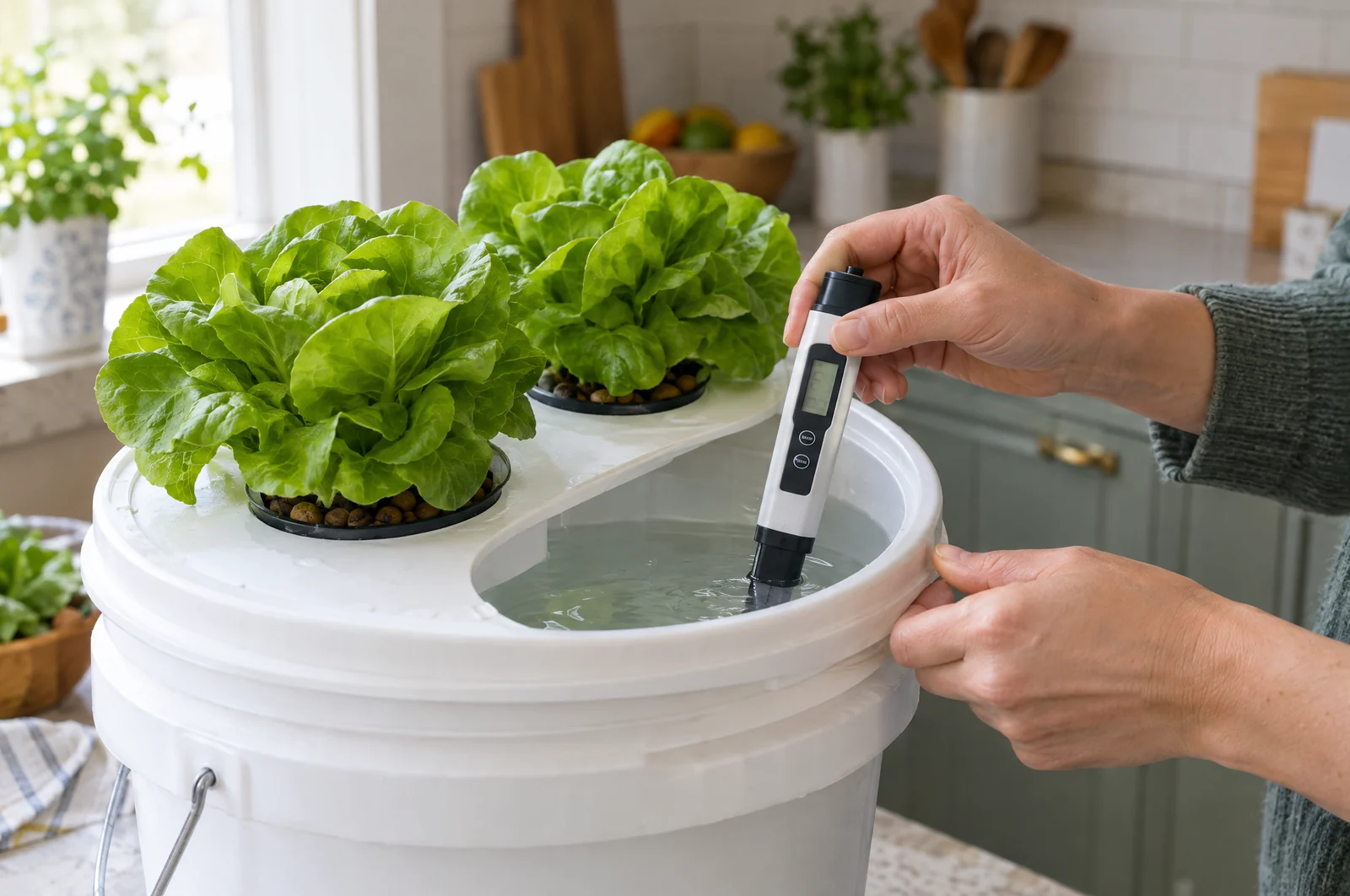
Our pH guide sets the checking interval by system, weekly for a bucket and every three or four days for NFT or drip. The reservoir gets topped up between changes and emptied every two weeks, weekly once a plant is large relative to it. Scouting means turning over the leaves of three plants, and our pest scouting page is explicit that it takes a minute. A pH pen wants calibrating monthly as a rule of thumb.
| Job | How often | Minutes |
|---|---|---|
| pH reading | Weekly | 3 |
| Top up level | Twice a week | 2 |
| Scout leaves | Weekly | 1 |
| Pick leaves | Weekly | 3 |
| Full change | Every 2 weeks | 20 |
| Calibrate pen | Monthly | 5 |
The cadences are from the guides linked above. The minutes are ours, and they are estimates rather than measurements, because nobody has run a stopwatch over a home hydroponic system and published the result.
Add those up for the commonest beginner system, a five gallon bucket build with two plants in the lid. Three minutes of pH, four minutes of topping up across two visits, a minute of scouting, three minutes of picking, a twenty minute reservoir change spread across the fortnight it covers, and one more for the monthly calibration. About twenty minutes a week.
Set that against the 1.3 hours a week those South Australian households logged for an entire food garden and the bucket looks like a bargain. Then do it per square metre and it inverts completely. Their gardens averaged a little over 3 minutes per square metre per week. A five gallon bucket occupies roughly a tenth of a square metre once you allow room to work around it, so at the soil garden’s rate that patch of floor should cost about twenty seconds. It costs twenty minutes. Per unit of floor, the bucket is something like sixty times more demanding, and that is not a complaint about buckets. It is the clue about where hydroponic time comes from.
The time belongs to the system, not to the plants
Read the job list again and ask which of those jobs gets longer when you add a plant.
The pH reading does not. It is one reading of one reservoir whether two plants or twelve are sitting on top of it. Topping up is one pour rather than a smaller one. The change is one change. Calibration is a property of the pen. Scouting barely moves, because you are sampling three plants rather than auditing all of them. Only harvesting scales, which is exactly the category the measured data found largest.
So put the same jobs on a wide tote with a dozen sites in the lid. The pH reading is still three minutes. Topping up a larger volume is still one trip. Scouting is still a minute or two. The change is a bigger container to empty and scrub, so call it thirty minutes rather than twenty. Harvesting is the one that multiplies. Somewhere around thirty five minutes a week, for six times the plants. Eleven minutes per plant becomes three.
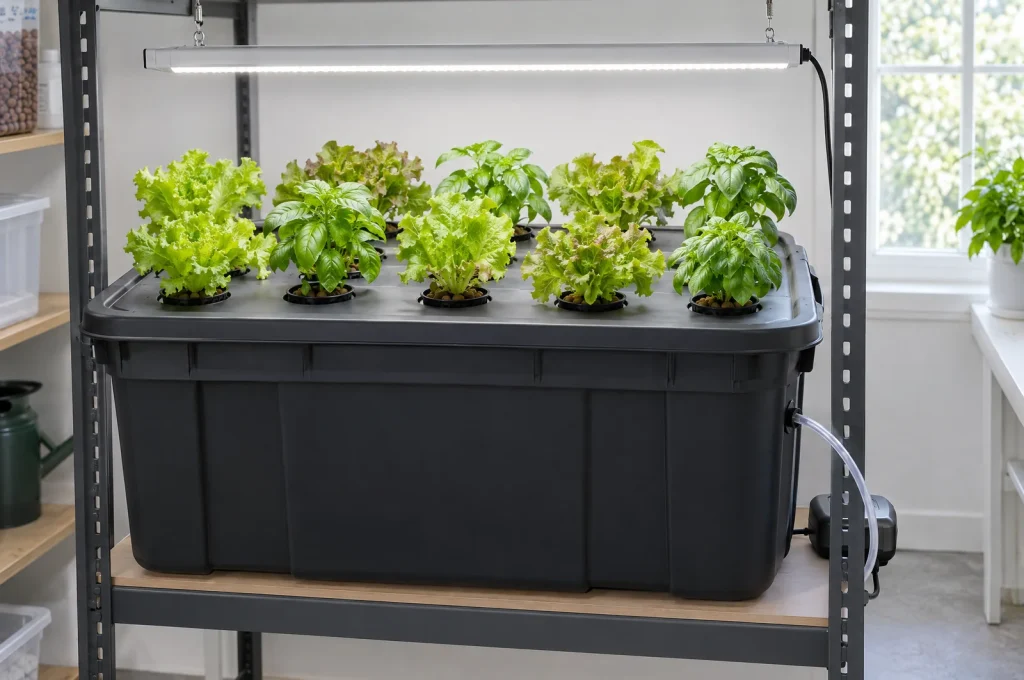
That inverts the usual instinct, which is that a beginner should keep things small. Keep it small to learn, certainly, because a failed mason jar costs a mason jar. But be clear about the price, because the overhead does not shrink with the system, and the smallest systems have the worst ratio of attention to food you will ever run. What improves it is more plants on one reservoir, and the limit there is not nutrient strength, which is the thing everyone checks. It is light hours and temperature, as our article on what can share a reservoir works through.
The jobs that are not weekly
Three things sit outside the weekly rhythm, and they are the ones that catch people out. The first is the build, which our own plans put at 15 minutes for a mason jar and two to three hours for the PVC system. One evening rather than a commitment, but it lands at the moment enthusiasm is highest and patience lowest.
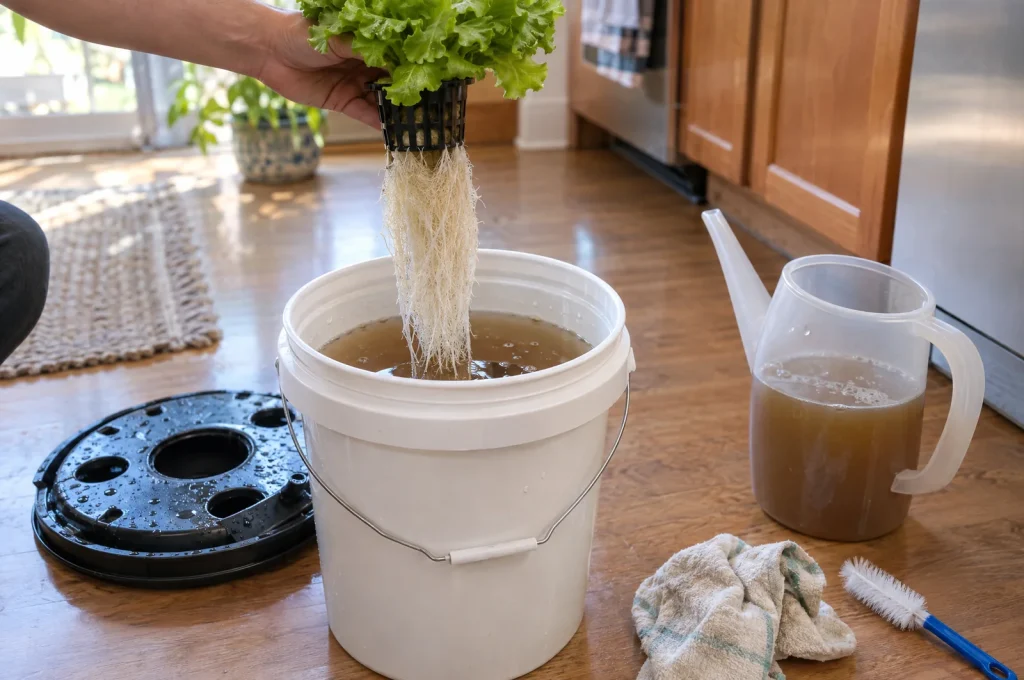
The second is the changeover. When a crop finishes the system gets cleaned properly rather than rinsed, because biofilm comes off with a brush or it does not come off at all. An empty reservoir is the only chance you get at the inside of one.
The third is absence. Going away pauses nothing, and how long a system survives alone is specific to yours. Finding out takes one day and a marker pen, and our article on going away puts that measurement a week before you travel rather than the night before.
Skipping a check does not save the time, it moves it
Everything on the weekly list is diagnostic. None of it makes a plant grow. It exists to catch a problem while the problem is still small, which means the honest way to read twenty minutes a week is as a premium paid against a much larger bill.
The bill is real enough. Root rot, once it has arrived, means lifting the plant, running the cortex test across the root mass, binning it if most of the root strips down to string, trimming every brown root back to white tissue, scrubbing and sanitising the container, and refilling at half strength while you fix the cause. That is an evening, and the crop may not survive it. Tipburn cannot be undone on the leaves that already have it, and a pest population found in the fourth week is a different animal from the same one found in the first.
There is one real exception, and it is a system rather than a discipline. A Kratky jar is mixed once and left, with no pump, no topping up and no weekly reading, because it finishes before the drift has time to matter. It genuinely takes almost no time at all. It also gives you one crop and then stops, which is the trade it is making.
So is twenty minutes a week worth it
The South Australian study answers the money version of that question from both directions, and the two answers disagree with each other. Counting only ongoing costs, 79 percent of those gardens were calculated to save more than 250 Australian dollars a year against retail prices. By that measure the garden pays for itself comfortably.
Now put a wage on the hours. The median return was 9.91 Australian dollars per hour of labour invested, against a minimum wage at the time of 18.93. Priced that way, 82 percent of the gardens were running at a loss, and that is before anyone counts what the garden cost to build.
Both are true at once, and there is no trick in it. A home food garden saves money on groceries and loses money on time, and which version you believe depends on whether you were going to sell that hour to somebody else. Our article on how much lettuce you actually get arrives at the same place from the direction of the crop. The case for a system on a windowsill is real, but it has never been an efficiency case.
The study does leave one thing worth ending on. Greater time invested correlated with greater yield, and with greater retail value returned, and both correlations were strong. The twenty minutes are not overhead you pay in order to stand still.
Where this comes from
The labour figures, the activity breakdown, the gap between estimated and recorded time, the returns per hour and the proportion of gardens running at a loss once a wage is applied all come from Csortan, Ward and Roetman, “Productivity, resource efficiency and financial savings: An investigation of the current capabilities and potential of South Australian home food gardens”, published in PLOS ONE in 2020. The 41 minutes figure is their citation of Codyre and colleagues in Canada. That work measured soil gardens rather than hydroponic systems, and it is used here for the shape of garden labour rather than as a figure for yours.
The cadences in the table belong to our own guides, which source them in turn. The minutes, the weekly totals and the comparison between a bucket and a tote are ours, and they are arithmetic built on estimates rather than anything that was timed. Your own numbers are the ones that count, and on the evidence of that study they will be lower than you think.
Found this useful? Tell Google to show you more of it.
Add to Preferred Sources