Tipburn, the Lettuce Problem That Adding Calcium Will Not Fix
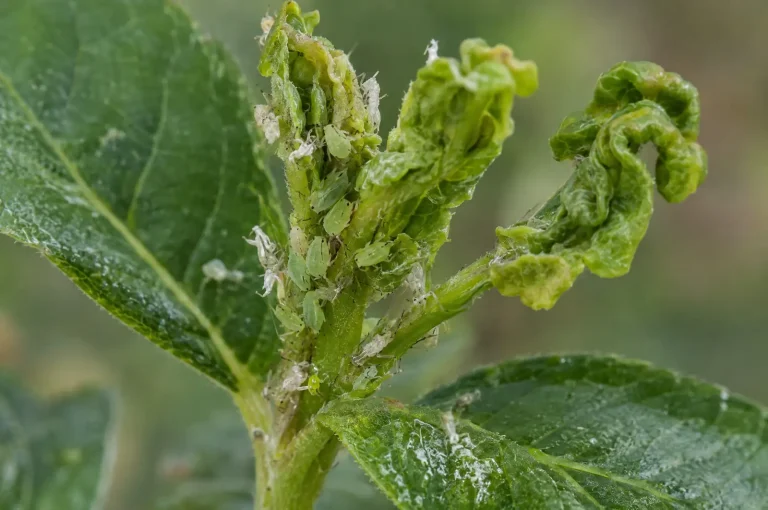
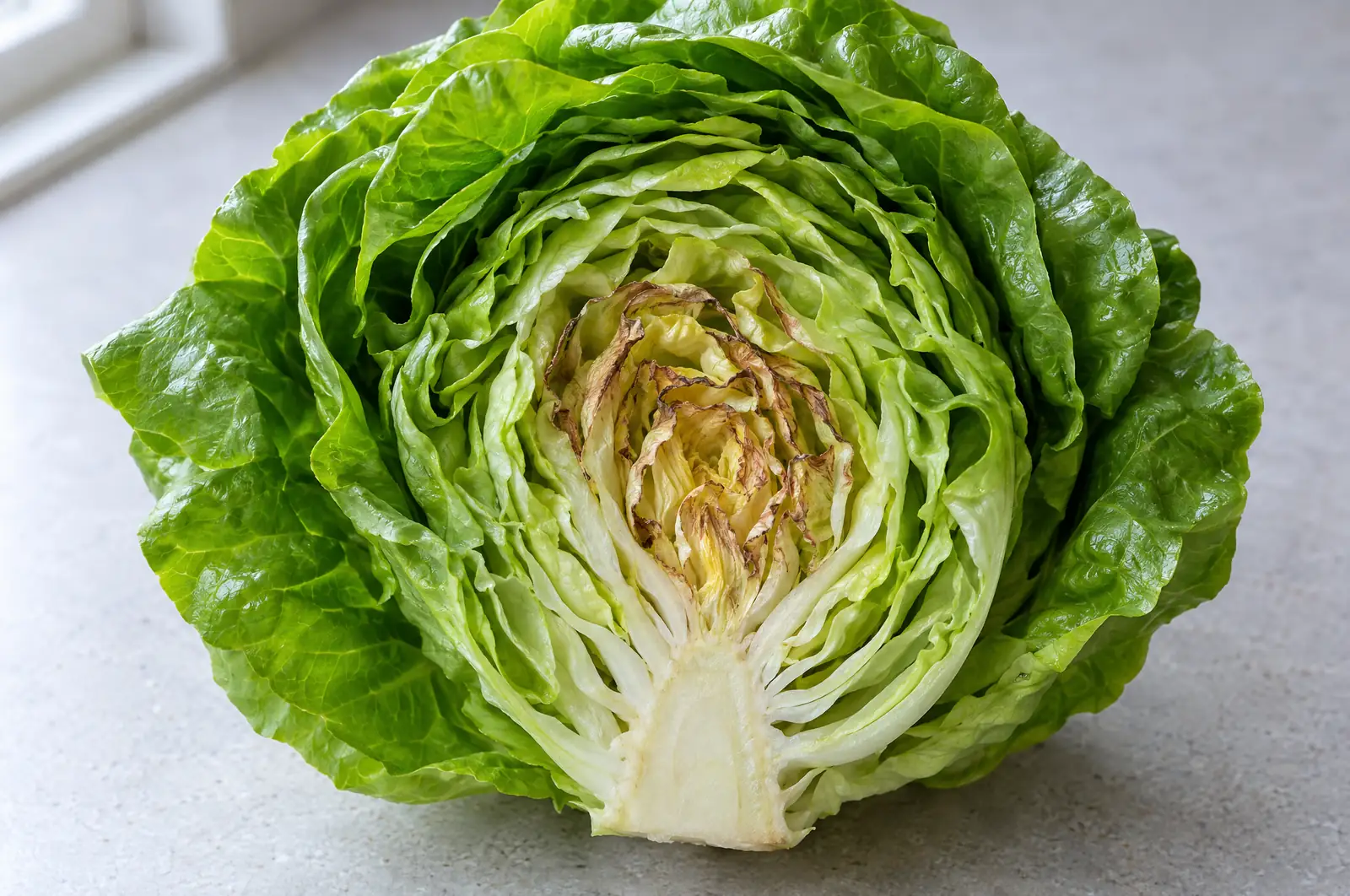
Lettuce that looks perfect from above can be ruined inside. You lift a head at harvest, open it up, and the young leaves at the centre have brown, dried, crumbling edges. Every search result says calcium deficiency, so you buy a calcium supplement, add it, and the next head does exactly the same thing. The diagnosis is right and the treatment is wrong, for a reason that is one of the more interesting bits of plant physiology a home grower will meet. The fix turns out to be a small fan rather than a bottle.
What it looks like, and where
The proper name is inner leaf tipburn, and the first two words are the ones that matter. The damage is necrosis along the margins of the young, emerging leaves at the centre of the head. It starts as a dry brown rim a millimetre or two wide, goes papery, and later can turn slimy as bacteria move into the dead tissue.
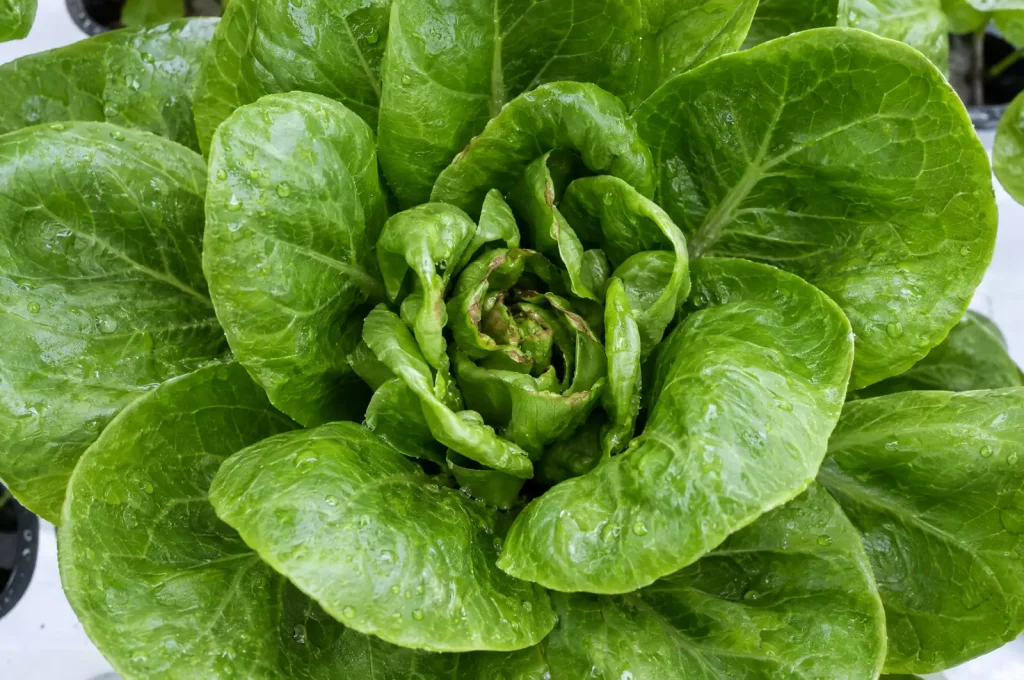
On a heading lettuce you will not see it until you cut, because the affected leaves are wrapped inside the ones you can see. On a loose leaf type it shows on the newest leaves at the centre while everything around them looks healthy. Either way the plant appears fine until the moment it matters.
The question that identifies it is which leaves, not what the damage looks like
This is the part that saves you from treating the wrong problem. Drought stress, high soluble salts and chemical damage all produce burnt leaf margins too, and they look broadly similar. What separates them is not the appearance of the damage but its position on the plant.
Damage from salts, drought or a chemical lands on the older, mature leaves, which have been transpiring hardest and longest and have accumulated the most of whatever is causing it. Inner leaf tipburn does the opposite and lands on the young, expanding leaves inside the head. So ask which leaves are affected before anything else.
| Which leaves | Symptom | Likely cause |
|---|---|---|
| Young, inner | Brown margin | Tipburn |
| Old, outer | Brown margin | Salts or dry |
| Old, outer | Yellow first | Feeding |
| All, sudden | Wilt, then brown | Root loss |
Position on the plant is the diagnosis. The damage itself looks much the same whatever caused it.
If your brown margins are on the big outer leaves, this article is not your answer. Go and check your meter against the PPM and EC chart instead. If the leaves yellowed before they browned, the article on lettuce turning yellow is the right one. If a plant wilted first and then browned at every margin at once, look at the roots and read about root rot, because a plant that has lost its roots cannot move water to anything.
Why the calcium never arrives
Calcium moves through a plant passively. It is not pushed to wherever it is needed. It is carried along with the flow of water, which means it goes where the water goes and nowhere else, and once it has been deposited in a leaf it stays there rather than being redistributed later.
The pump driving that flow is transpiration. A leaf losing water vapour pulls more up behind it and calcium rides along, so rapid transpiration promotes calcium uptake and distribution while low transpiration reduces both.
Now look at where a lettuce grows from. The growing tip sits at the centre, enclosed by the leaves already formed around it. That envelope blocks air movement and creates a very humid pocket around the growing point, and air that is already saturated cannot accept much more water vapour, so the young leaves in that pocket barely transpire.
That is the whole mechanism. Those leaves pull almost no water, so they receive almost no calcium, and this happens while the outer leaves transpire perfectly well and the reservoir below is full of calcium. As the young leaf expands, the margin, built short of calcium and weakest in the cell wall, collapses and dies.
So the deficiency is real, but it is local. The supply was never the problem. The delivery failed, which is why adding more calcium to a reservoir that already has enough changes very little.
Tomato growers know this disorder by a different name
If that still feels abstract, here is the same thing somewhere more familiar. Blossom end rot on a tomato is this exact disorder. Fruits transpire relatively little, and under rapid growth and swelling a localised calcium shortage develops at the base of the fruit, the tissue collapses, and it goes brown and sunken in a way that looks like rot without being one. Cucumbers, peppers and aubergines do it too.
The pattern is consistent. Whichever part transpires least, grows fastest and sits furthest from the moving water is the part that starves, whatever the tank holds. Anyone growing tomatoes and peppers alongside their greens is watching one disorder wearing two names.
The catch nobody mentions: more light makes it worse
This is where the advice on this site needs a qualification. The article on growing through winter argues for closing the light gap, because most indoor crops are badly underlit, and that is still true. But light drives growth, and conditions that promote rapid growth and leaf expansion promote tipburn, because a fast expanding leaf needs calcium faster than a sheltered growing point can pull it.
Cornell’s controlled environment programme put a number on this. Running lettuce towards a daily light integral of 17, they state that the target has to be matched with sufficient downward airflow to prevent tipburn, and that without the airflow they were not able to go above 12. Their fan blew vertically down onto the plants at 140 cubic feet per minute for every square foot of pond area, for exactly the reason above: the airflow increases transpiration, and that increase carries more calcium from the roots to the young, fast growing leaves.
| Airflow | Light ceiling | Growth |
|---|---|---|
| None | 12 | Slower |
| Downward fan | 17 | Full |
Daily light integral in moles per square metre per day, above which tipburn appeared in Cornell’s trial. They note that for some cultivars the ceiling is 15 or lower.
Read that table as a pair rather than as two options. Light and airflow go up together, and raising one without the other does not buy a faster crop, it buys tipburn. It does so most reliably in the setup that is trying hardest: a good lamp over a dense tray in a still room.
The fix is air, and it has to reach the middle
Everything useful follows from the mechanism. You are not trying to cool the room or stir the air in general. You are trying to make the most sheltered point on the plant transpire.
Affiliate disclosure: some links below are affiliate links. We may earn a commission if you buy through one, at no extra cost to you. As an Amazon Associate I earn from qualifying purchases. Full disclosure.
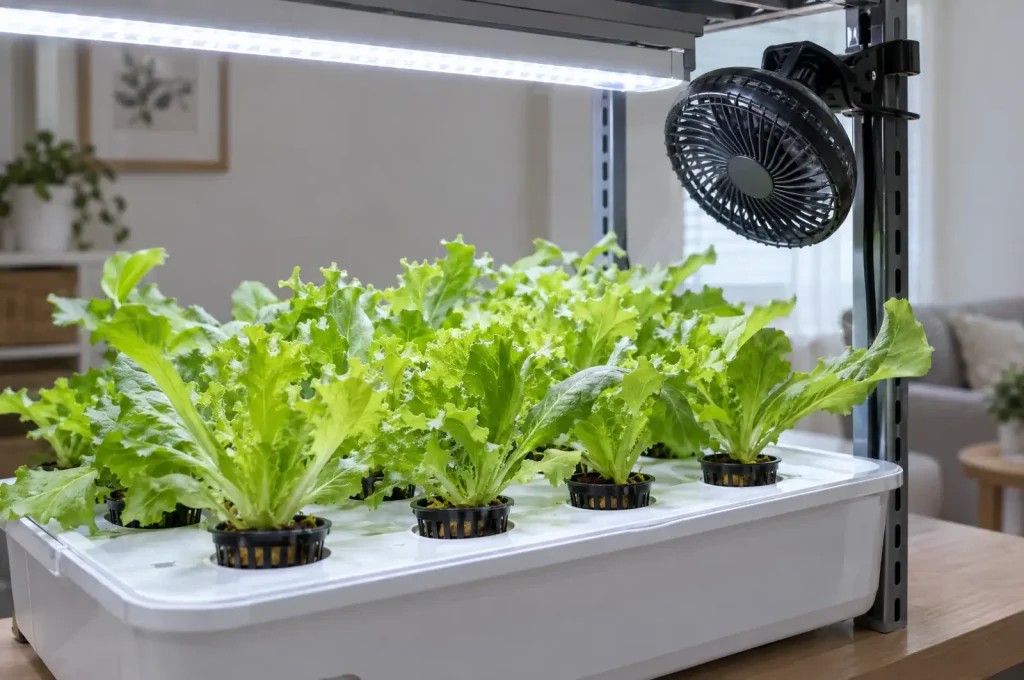
- Point the fan at the canopy, not across the room. Air sliding over the top of a tray does little for a growing point buried inside a head, which is why Cornell blew straight down. A small clip fan above and slightly to one side, running while the lights are on, is the home scale version.
- Set it so the leaves move, not thrash. Visible, steady movement in the outer leaves is the signal that air is being exchanged in the canopy rather than passing over it.
- Space the plants. Crowded lettuce shelters its own growing points, which is the same tension between a dense plant and good airflow that shows up with basil. Cornell’s own protocol moves plants to wider spacing partway through the crop.
- Bring the humidity down, especially when it is cool and cloudy. Low humidity and moving air both increase transpiration, so a cold, damp, still room is the worst combination available. That is a second reason a winter setup needs a fan running.
- If you cannot add airflow, use less light. That is Cornell’s own fallback, and it is an honest trade. The crop grows more slowly and it does not burn.
The nutrient side, which is smaller than you think
It is still worth confirming calcium is present, because if it is genuinely absent then none of the above will help. Extension guidance gives 40 to 50 ppm in the applied solution as a starting point, and your tap water may supply some of it. Any complete hydroponic nutrient contains calcium. A garden fertiliser does not, because it assumes soil will provide it, which is covered in the nutrient guide.
Beyond confirming it is there, three things are worth knowing and one is worth ignoring.
- Other nutrients compete with calcium at the root. High concentrations of ammonium nitrogen, potassium and magnesium all block calcium uptake. The published guardrails are to keep ammonium to about 15 percent of total nitrogen, calcium to potassium at roughly 1 to 2, and calcium to magnesium at roughly 2 to 1. For a home grower this mostly translates into one instruction: do not dose extra potassium or magnesium on top of a complete feed because something online suggested it.
- High salts make it worse. A strong solution reduces the plant’s ability to take up water at all, and calcium travels in that water. The guidance is to keep root zone conductivity below 2.0. Lettuce figures on this site sit well under that at every stage, so for most people reading this, strength is not the cause.
- Cultivar matters. Varieties differ in susceptibility, and seed suppliers can tell you which of theirs are bred for lower risk. Worth asking before you buy a season of seed.
- Foliar calcium sprays are not where to start. Weekly sprays at around 400 ppm calcium, mixed from calcium chloride rather than calcium nitrate, are documented, but they are laborious, they leave residues on leaves you meant to eat, and they are not commonly used commercially on lettuce. Listed for completeness, not as a recommendation.
None of it grows back
There is no way to salvage necrotic leaf tissue, so all of this is prevention rather than treatment, and the damage you find today was decided a week or two ago.
What you can do is find out sooner. Open one head partway through the crop rather than waiting for harvest to tell you. A sacrificial plant is cheap information, and it turns tipburn from something you discover at the end into something you still have two weeks to fix. The timings in the article on when to harvest give you a sensible point to look.
If you do find it, trim the dead margins out and eat the rest, but do not store a head with tipburn in it. Dead tissue inside a closed head is a starting point for soft rot, and a head that was merely scruffy when you cut it can be unpleasant three days later. For the crop behind it, the fan is the move, and the targets on the lettuce page and in the lighting guide still stand.
Where this comes from
The mechanism, the diagnostic rule about young leaves against old ones, the calcium figures, the nutrient antagonism ratios, the conductivity limit and the foliar spray rate are from the e-GRO Edibles Alert on inner leaf tipburn in lettuce by Ryan Dickson and Hannah Quick of the University of Arkansas, published in March 2019. The light and airflow numbers, the paddle fan rate and the statement that a 17 target requires downward airflow are from the Cornell University controlled environment agriculture lettuce handbook. That handbook is worth reading with its own caveats attached, which it supplies itself: it is dated 2013, its figures come from the cultivar Ostinata which is no longer available, it says the achievable light level is a function of cultivar, spacing and airflow rather than a universal number, and it states that no attempt was made to establish maximum and minimum airflow rates. The numbers above are therefore a worked example from one trial rather than a specification. The comparison with blossom end rot in tomato, cucumber, pepper and aubergine is drawn in the same e-GRO alert.
Found this useful? Tell Google to show you more of it.
Add to Preferred Sources