Hydroponic Basil, and the Disease That Decides How Long It Lasts
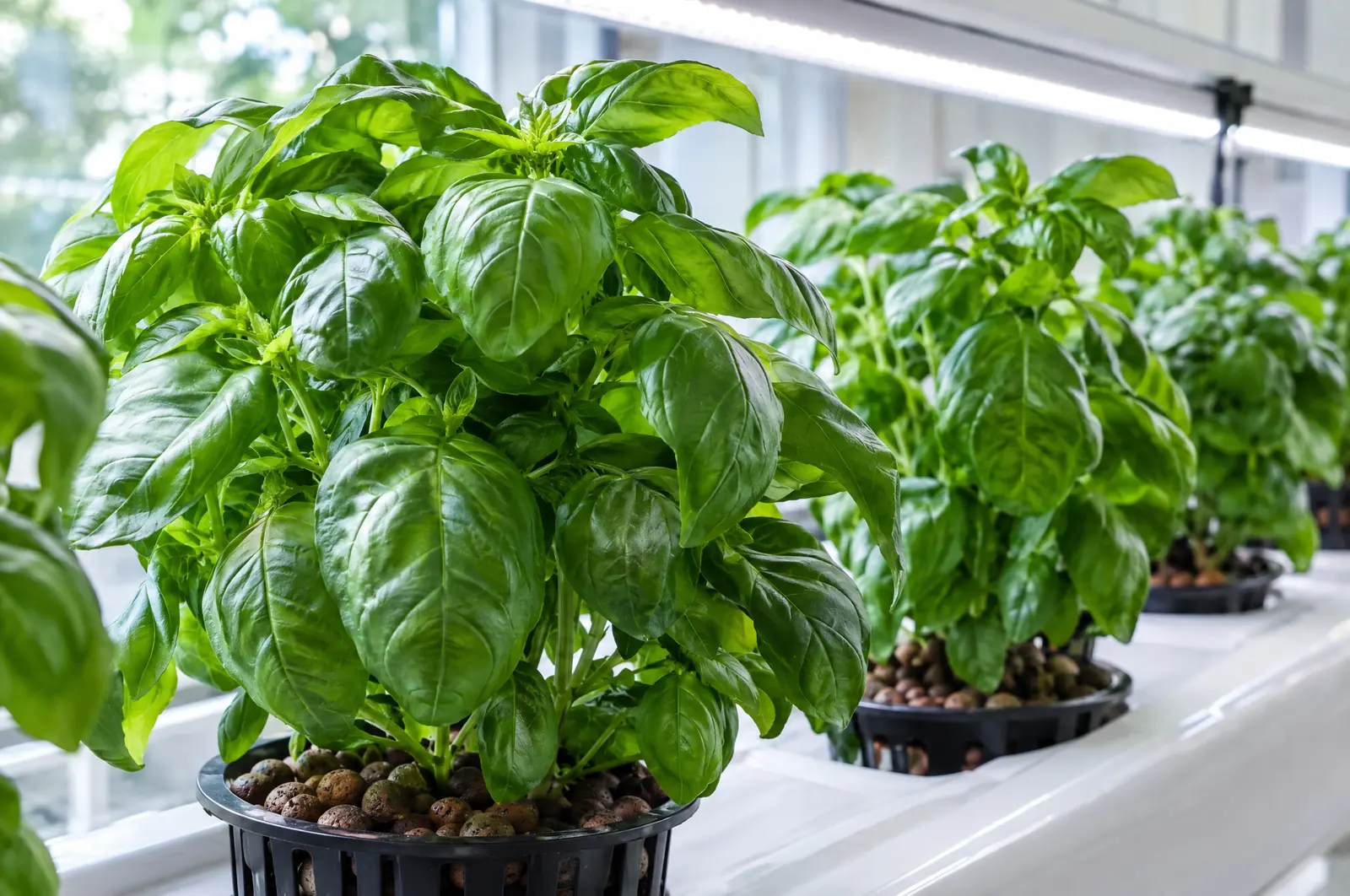
Basil is the crop that makes a small hydroponic system feel worth the trouble. It grows fast, it costs a fortune in shops for a plastic packet of leaves that rot in three days, and it takes to this method better than almost anything. It also has one specific enemy that arrived in the last couple of decades, spreads on the air, and is the reason a basil plant that looked magnificent on Monday can be finished by Friday. Almost nothing written for beginners mentions it.
Basil is not lettuce
Most beginner hydroponic advice is written with leafy greens in mind, and basil wants close to the opposite conditions in two important ways.
It wants warmth, and it is genuinely hurt by cold. Basil suffers below about 50F (10C), which is why it blackens in a fridge and why a windowsill against cold glass in winter is a poor home for it. Lettuce is the other way round and bolts when it gets warm. If you are running both in one system, you are compromising for one of them, and it is usually worth knowing which.
It wants more light. Basil grown dim does not just grow slowly, it grows thin and sparse with pale leaves that taste of very little, because the aromatic oils that are the entire point of the plant are produced in response to light. A plant that looks acceptable and tastes of nothing is almost always underlit.
Everything else is straightforward. It is not fussy about feed strength, it roots readily, and it is one of the few crops where the harvesting method makes the plant better rather than smaller, which is covered in the article on when to harvest.
The disease nobody warns you about
Basil downy mildew is caused by a water mould, and it is a relatively recent arrival that has been devastating basil crops worldwide. It is not the same thing as the powdery mildew people know from courgettes, and it does not behave like it.
Here is how you identify it, and the order matters because the first sign is misleading.
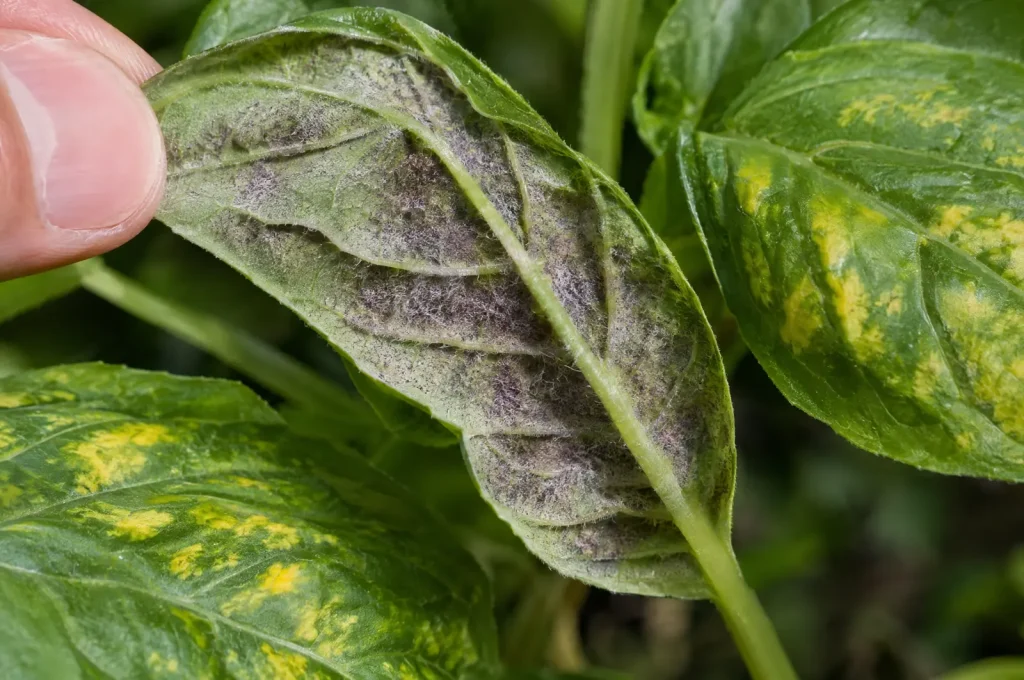
- Yellowing on the upper surface of the leaf, which looks like a feeding problem and gets treated as one. The giveaway is the shape. It is confined between the veins, so it comes out in angular blocks rather than the soft gradient of a nutrient deficiency.
- Turn the leaf over. This is the step that settles it. On the underside, in the same patches, you will find a fuzzy grey to purple growth. That is the pathogen producing spores, and nothing else on a basil leaf looks like it.
- Then it moves. Leaves yellow, brown and drop, and because the spores travel on air currents the rest of the plant and its neighbours follow.
The uncomfortable part for a hydroponic grower is that growing indoors does not protect you. This is an airborne disease, so clean water and a sterile medium are irrelevant to it. It arrives on infected seed, on a bought plant, or through an open window.
Resistant varieties, and the honest caveat
Plant breeders responded to all this, and there are now sweet basil varieties specifically bred to resist downy mildew while still tasting like Genovese basil rather than like a science project.
| Variety | Bred to resist | Sold as |
|---|---|---|
| Genovese | No | Seed |
| Prospera | Yes | Seed |
| Devotion | Yes | Seed |
| Obsession | Yes | Seed |
| Amazel | Yes | Cuttings |
Devotion and Obsession are Rutgers releases and are usually sold under that name. Amazel is sold as cuttings rather than seed because its seed is sterile.
Now the caveat, because this is where most articles would stop and leave you with a false sense of security. That resistance is not holding up as well as it did. Growers in the United States reported downy mildew appearing more severely on Prospera in 2021 and 2022, and Cornell researchers suggested the pathogen has evolved to overcome the resistance in these varieties. A race capable of defeating Prospera’s resistance had already been found in Israel. The same report named Devotion and Obsession.
Being straight about the limits of that: those reports are from 2021 and 2022, and I could not find more recent confirmation either way, so this is not a statement that resistant varieties no longer work. It is a reason to treat them as one layer rather than as the answer, and to check what your own regional extension service is currently reporting before you rely on a name.
Starting clean
Since the spores travel on air, you cannot seal the room. What you can do is avoid importing the thing deliberately, and there are only three routes in.
- Infected seed. A real route, and an awkward one to deal with. Basil seed cannot easily be hot water treated the way other seed is, because it turns gelatinous as soon as it gets wet, so some suppliers now steam treat instead and some have their seed lots tested. It is worth buying from a supplier that says something about this rather than the cheapest packet available.
- A bought plant. The supermarket pot of basil is the classic way this walks into a house. If you bring one in, keep it well away from your system for a fortnight and turn its leaves over before it goes anywhere near the others. Growing your own from seed sidesteps the problem entirely, which is one more argument for the method in starting your own seedlings.
- An open window. Nothing to be done about this one beyond knowing it is why your clean indoor system is not actually isolated.
Scout seedlings before they go in, and discard anything showing symptoms rather than planting it and hoping. That is the same discipline that keeps fungus gnats out on a bought plant, and the two inspections are the same thirty seconds.
What actually works at home
Since the variety cannot be trusted on its own, the environment is doing more of the work than you might expect, and the good news is that this is the part a home grower controls well.
The pathogen needs moisture on the leaf and humidity in the canopy to produce spores. Greenhouse guidance is consistent that minimising leaf wetness and keeping humidity down suppresses it. One specific finding is worth copying directly, which is that running fans at night suppressed the disease by holding humidity lower inside the plant canopy and stopping sporulation.
- Run a small fan, including overnight. This is the single most useful thing on the page. Night is when humidity peaks and when sporulation happens, so a fan that only runs with the lights is missing the window that matters.
- Do not mist basil. Misting is widely recommended for herbs and it is precisely the wrong thing here. Wet leaves are the requirement the disease has.
- Space the plants. Crowded basil holds a pocket of still humid air between the leaves whatever the room is doing. This is also why pinching for a bushy plant and spacing for airflow pull against each other slightly.
- Look underneath, weekly. Thirty seconds of turning a few leaves over catches this while it is one plant rather than all of them.
- Remove and bin affected leaves immediately, and take them out of the room rather than leaving them on the side. They are still shedding spores.
The problem below the waterline too
Basil is also one of the two crops Cornell singles out as susceptible to economically serious Pythium root infection in hydroponics, the other being spinach. So it is worth reading the article on root rot alongside this one, because basil gives you both problems to think about rather than one.
The specific trap is that the above-ground symptom of root rot in basil is yellowing leaves and a stunted plant, which is routinely mistaken for a nutrient deficiency. Between that, downy mildew and a genuine feeding problem, basil gives you three different causes of yellow leaves. Turning a leaf over and lifting the net pot takes a minute and distinguishes all three.
Keep the root zone in the 68 to 75F (20 to 24C) band and the solution properly aerated and you have dealt with most of that risk, which is the same advice that appears throughout this site for the same reason.
Getting more out of it
Three habits turn one basil plant into a steady supply.
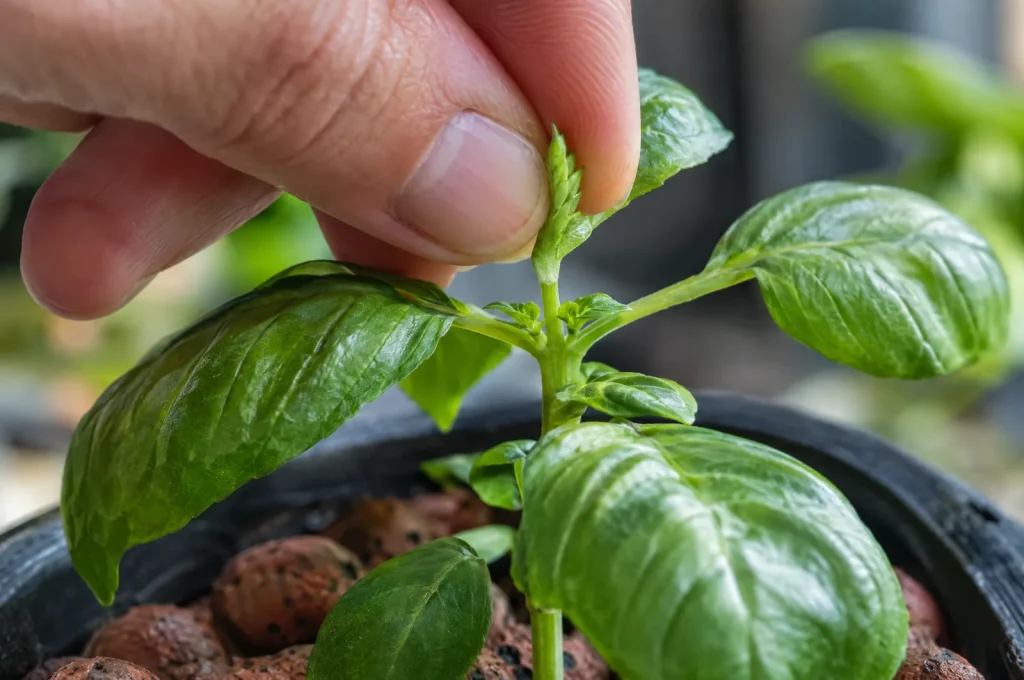
- Pinch the growing tip early and often. Every pinch above a leaf pair makes the plant branch into two from that point. Start when the plant has three or four pairs of leaves rather than waiting until it is tall.
- Never let it flower. Once flower spikes form the leaves lose much of their oil and the plant stops investing in new growth. Pinch the spikes out the moment you see them.
- Take cuttings from what you pinched. Basil roots in a glass of water in a fortnight, which gives you free replacement plants that are already proven in your conditions. That matters more here than for most crops, because downy mildew means you may want a replacement at short notice.
That last point is the practical conclusion of the whole article. Keep a cutting rooting on the windowsill at all times, treat each plant as something that will eventually be lost, and the disease becomes an inconvenience rather than the end of your basil.
Where this comes from
The symptoms, the airborne spread, the resistant variety names and the greenhouse management advice on leaf wetness and humidity are from Cornell’s basil downy mildew fact sheets and its guidance on managing the disease in greenhouses, from UConn Extension’s publication on downy mildew on basil in the greenhouse, and from the UMass Amherst fact sheets. The finding that fans run at night suppress sporulation by lowering humidity within the canopy comes from work in Israel cited in that guidance. The reports of the disease appearing on resistant varieties, and the suggestion that the pathogen has overcome their resistance, are from Cornell in 2021 and 2022, and are presented here with the date attached because I found no more recent confirmation either way. The susceptibility of hydroponic basil to Pythium, and the root zone temperature band, are from the e-GRO alert by Mattson at Cornell already cited in our root rot article.
Found this useful? Tell Google to show you more of it.
Add to Preferred Sources