Hydroponic Growing Media, How to Pick the Right One
Every build plan on this site tells you to fill the net pot with clay pebbles, and none of them stops to say why, or what else you could have used. That is a reasonable shortcut for a first build. It stops being reasonable the moment you try a system that waters on a timer, because the pebbles that worked perfectly in a bucket will leave a plant dry between floods. The medium is not a matter of taste. It follows from the system you built.
The medium has one job
Roots need water and they need oxygen, at the same time, continuously. In soil the soil does both. In hydroponics the system does one of them and the medium has to cover whatever is left over.
That is the whole decision. A medium is not better or worse in the abstract. It holds some ratio of water to air, and the right one is whichever ratio fills the gap your system leaves. Ask what your system already does for the roots, and buy the medium that does the rest.
Both ends of that ratio have a failure mode, and they look nothing alike. Too much water and not enough air and the roots suffocate, which is the warm stagnant condition that root rot waits for. Too much air and not enough water and the plant simply runs out between waterings, wilts in the afternoon, and recovers overnight looking fine. The second one is easy to misread as heat stress, and the giveaway is that it tracks your timer rather than the weather.
Start from your system
Affiliate disclosure: some links below are affiliate links. We may earn a commission if you buy through one, at no extra cost to you. As an Amazon Associate I earn from qualifying purchases. Full disclosure.
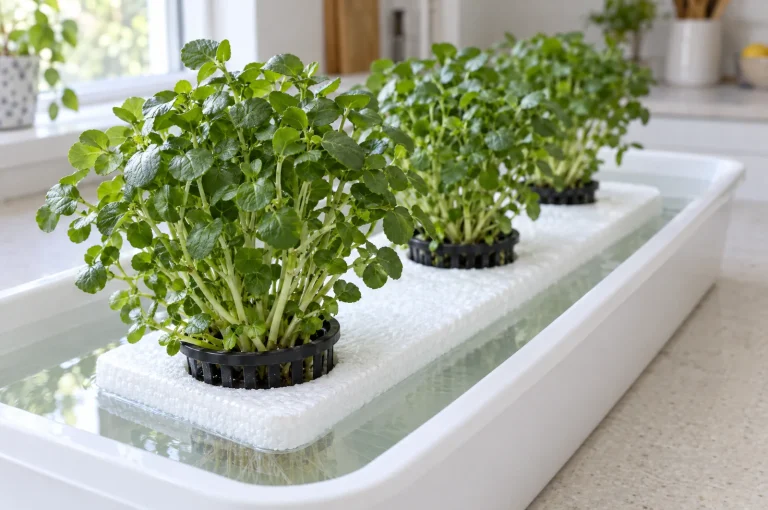
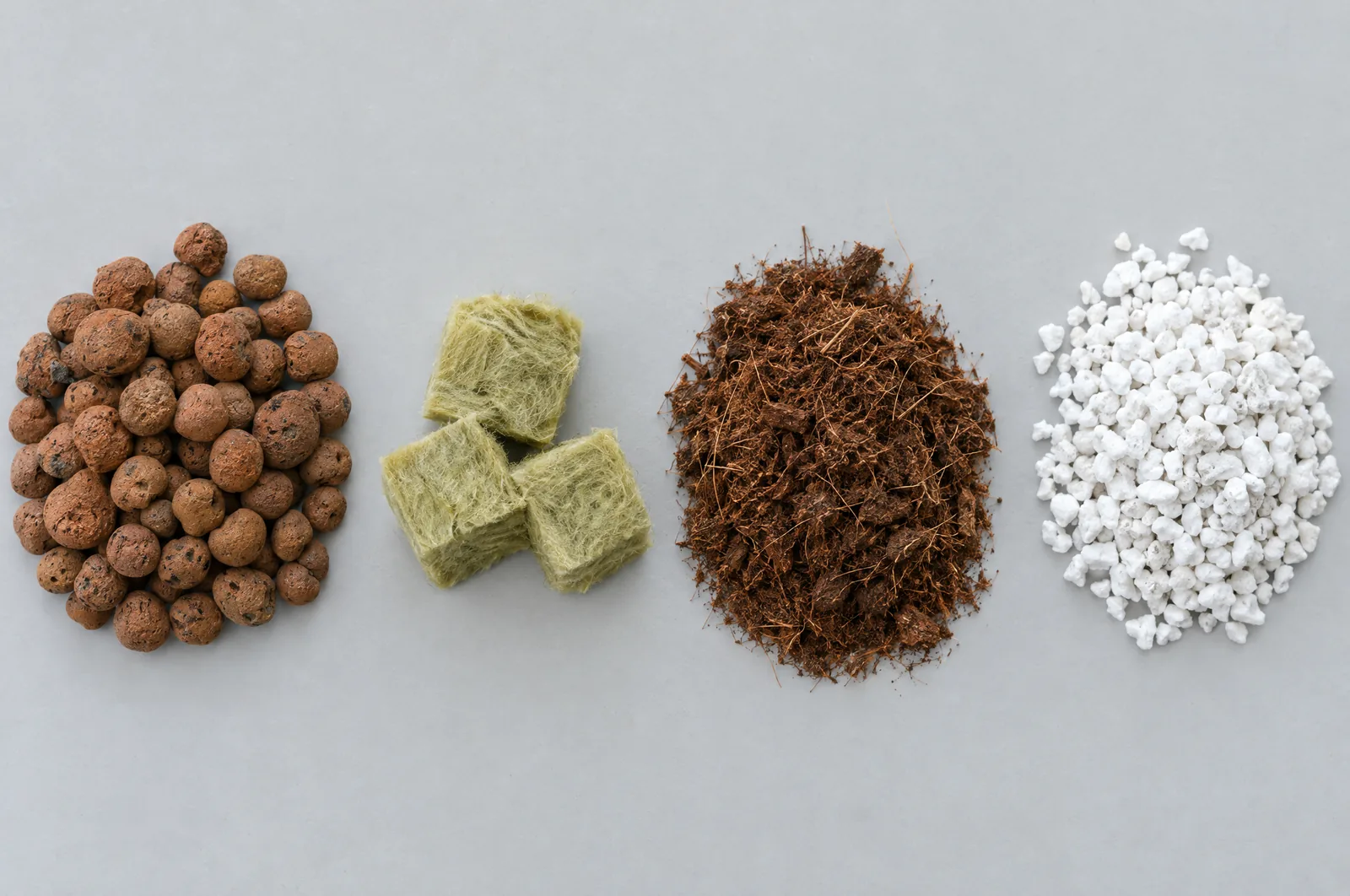
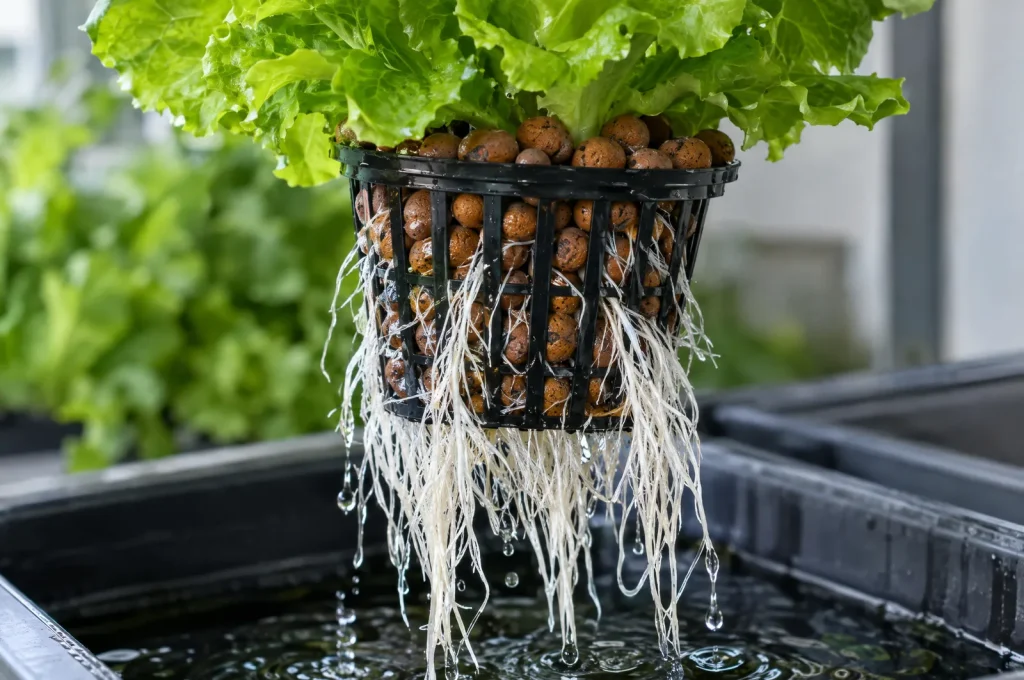
If the roots are always in water, which covers deep water culture, Kratky and NFT, the system has already solved water. The medium only has to hold the plant upright and keep a young seedling damp until its roots reach down into the solution on their own. You want the airiest, least absorbent thing you can find, and you want it never to rot. That is why every build plan here uses clay pebbles. They are close to the correct answer for this whole family of systems.
If the roots are watered on a timer, which covers ebb and flow and drip, the system solves water four or six times a day and the medium has to carry the plant through every gap in between. Now absorbency is the entire point. Clay pebbles on their own will drain in minutes and leave the roots in dry air until the next flood. This is where rockwool, coco coir, or a coco and perlite blend belong, and where a flood table earns its extra plumbing.
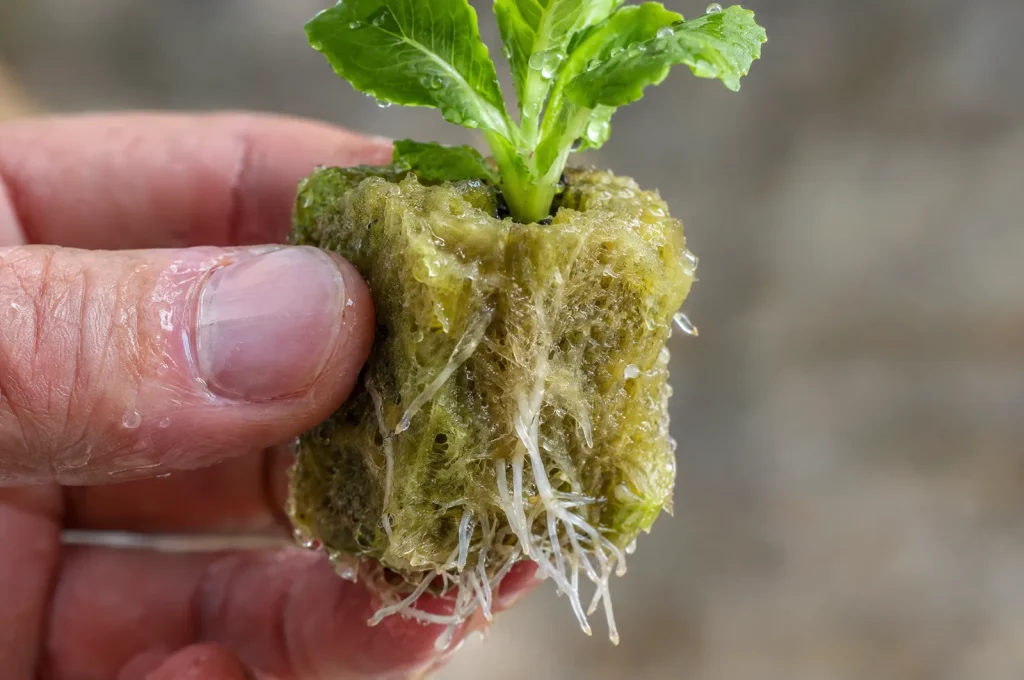
If you are germinating seeds, the job changes again. A seed needs steady moisture and close contact on every side, and it has no roots yet to go looking. Loose pebbles cannot do that at any scale. Use a small rockwool cube or a coir or peat plug, then move the whole plug into whatever the grown plant is going to live in. Nothing gets transplanted bare.
What each one actually does
| Medium | Water | Air |
|---|---|---|
| Clay pebbles | Low | High |
| Perlite | Low | Best |
| Rockwool | High | Good |
| Coco coir | High | Fair |
| Coco and perlite | Good | Good |
Relative, not absolute. Published figures for the same material disagree enough that exact numbers would be false precision, and the ones that matter are on the bag in front of you.
Some extension figures are worth having in your head anyway. Oklahoma State puts coir at 18 to 25 percent air once drained, and rockwool at no less than 18 percent, which is the floor generally taken as adequate for root growth. Perlite holds three to four times its own weight in water and still has about the best oxygen retention of anything on the shelf, which sounds contradictory until you remember that it weighs almost nothing to begin with. Expanded clay is the outlier. Published water figures for it vary so widely that the only honest summary is that nobody should be buying it for water retention.
Rockwool arrives alkaline
This is the one that quietly ruins first attempts. Rockwool is spun from melted rock and limestone, and it comes out of the bag at roughly pH 7 to 8. Drop a seed in it dry and the root zone sits well above the range where iron, manganese and phosphorus stay available. The plant goes pale between the veins and you go looking for a feeding problem that does not exist.
The fix takes an hour. Soak the cubes in plain water adjusted to about pH 5.5, with no nutrients in it, for an hour for small cubes and longer for slabs. Check the water afterwards. The rockwool pushes it upwards as it soaks, so if it has drifted well above 6, pour it away and soak again in fresh water. Then let the cubes drain on their own.
Do not squeeze them. Compressing a cube to get the water out crushes the structure that was holding the air, and you cannot put it back. A soaked cube should feel heavy and still springy. Rockwool is also a respiratory irritant as a dry dust, so wet it before you start cutting or handling it, and keep the dry block away from where you are working.
Our pH guide has the chart showing which elements lock out where, and it explains why the 5.5 figure is not arbitrary.
Coco takes your calcium first
Coco coir is the most forgiving medium here for a timed system, and it has a trap that catches almost everybody once.
Coir is a by-product of coconut processing, and coconuts grow in salty coastal ground. The fibre is covered in sites that hold charged nutrients, and on raw coir those sites arrive loaded with sodium and potassium. Coir grips calcium and magnesium harder than it grips either of those. So the first time you feed it, it trades: your calcium and magnesium go onto the fibre, and the sodium and potassium it was holding come off into your solution.
You mixed the solution correctly. The plant still gets a calcium deficiency, and now it is also dealing with surplus sodium and with potassium competing against what magnesium is left. New growth distorts and the tips die back, and nothing on your meter explains it.
Two separate steps prevent it, and doing one does not cover the other.
- Rinse, which washes out the loose salt. Raw coir can arrive at an EC several times higher than anything you would feed a plant. Run clean water through it until the runoff reads close to your tap water.
- Buffer, which deals with what rinsing cannot reach, because those ions are held on the fibre rather than floating loose. Soak the coir in a calcium and magnesium solution at around 150 to 250 ppm, pH around 6, for somewhere between eight hours and overnight, then let it drain. The sites fill with calcium and magnesium and stop stealing yours.
Buy coir sold as washed and buffered and you can skip both, which for a first grow is money well spent. Check the bag says buffered and not merely washed, because they are not the same claim and only one of them is about the fibre.
Perlite and clay pebbles, and how they annoy you
Neither needs conditioning, which is most of their appeal. Both have a habit worth knowing before it surprises you.
- Perlite floats. It is volcanic glass popped like corn to many times its original volume, so it is mostly trapped air. Flood a tray of neat perlite and a good deal of it lifts off and resettles somewhere else, which is why it is almost always blended rather than used alone. In a coco blend it is the component doing the aerating.
- Perlite is dusty, and the dust is silica. Wet the bag before you open it and keep it damp while you work. This is a real precaution and not a formality.
- Clay pebbles arrive filthy. New pebbles carry a fine red clay dust that will cloud a reservoir for days and settle in pump housings. Rinse them in a colander until the water runs clear, which takes longer than you expect, then soak them before first use so they are not drawing water away from a new transplant.
- Clay pebbles are the only one here you genuinely reuse. They are fired clay, so they survive being scrubbed and boiled. Between crops, pick out every root fragment, wash them, and sterilise them with boiling water or a dilute bleach soak followed by a thorough rinse. Decaying root matter left in the pebbles is exactly the organic matter that feeds root rot in your next crop.
Rockwool and coco are not realistically reusable at home. Rockwool is also awkward to dispose of, since it does not break down, and that cost and that disposal problem are why commercial growers in some regions moved away from it towards perlite.
The ones you can ignore for now
Four more turn up in every list of growing media, and none of them earns a place in a first system.
- Vermiculite holds a great deal more water than perlite and a great deal less air, and it compacts as it ages. It has its uses in a seed mix. On its own in a hydroponic container it tends towards the suffocating end of the ratio, which is the end that kills plants rather than merely disappointing them.
- Pumice behaves much like perlite but is heavier, so it stays where you put it and does not float. If you can buy it locally at a sensible price it is a good substitute. Most people cannot, which is the only reason it is not the default.
- Sand works, is free, and is miserable. It is heavy, it holds very little air, and it finds its way into every pump you own.
- Peat is the traditional base of seed starting mixes and will germinate seeds perfectly well. Coir does the same job from a waste stream rather than from a drained bog, which is why most of the industry moved across.
None of these is a mistake exactly. They are just answers to questions a beginner is not yet asking.
If you want one answer
Start seeds in rockwool cubes, soaked properly, and move the whole cube into clay pebbles in a net pot in a bucket system. That combination handles germination and growing, costs very little, reuses the expensive half, and it is what every build plan on this site already assumes.
Change it when you change systems. The day you build something on a timer, buy coco, or buy a bag already blended with perlite, and let the pebbles keep doing what they are good at somewhere else.
Where this comes from
Air and water figures for coir, rockwool and perlite are from the Oklahoma State Extension fact sheet on soilless growing mediums. The note on rockwool losing ground to perlite over cost and disposal is from the University of Florida IFAS handbook on hydroponic vegetable production, which is also where the perlite expansion figure comes from. The rockwool conditioning routine and the coir rinse and buffer figures are the settled practice across substrate suppliers rather than extension findings, and they are given here as practice rather than as research. Where published numbers conflict, as they badly do for expanded clay, that is said rather than averaged.
Found this useful? Tell Google to show you more of it.
Add to Preferred Sources