Hydroponic Strawberries, and the Two Decisions That Decide Whether You Get Fruit
Strawberries are the crop beginners most want to grow and the one that most often produces a healthy green plant and nothing else. That is almost never a nutrient problem or a light problem. It is one of two decisions made before the plant arrived, and both of them are easy to get right once somebody tells you they exist. One is which kind of strawberry you bought. The other is that nothing indoors is going to pollinate it for you.
Decision one, the kind you buy
Strawberries are sold in two useful categories and they behave completely differently indoors.
June-bearing plants are short-day plants. They form flower buds only in autumn, when the days shorten and the nights lengthen, and the buds then sit inside the crown all winter before coming out in spring for a single flush of about four to six weeks. Flower bud formation is driven by cold and short days together. That is why greenhouse production of June-bearers in cooler regions is limited to a few months of the year.
Put one under a steady indoor light schedule in a warm room and you have removed both of the signals it needs. It will grow leaves enthusiastically and may simply never flower. The plant is not failing. You asked it a question in a language it does not speak.
Day-neutral plants barely care about daylength. They initiate flowers whenever the temperature sits roughly between 40 and 85F (4 and 29C), which indoors is essentially always. They fruit in their first season rather than their second, they out-yield June-bearers over a year, and in field conditions they crop for something like fourteen weeks rather than four.
For anything indoors, buy day-neutral. Seascape, Albion and San Andreas are the names you will see most often. Everbearing is a third label you will encounter and in practice it behaves as a weaker day-neutral, cropping in two or three distinct flushes.
One thing to accept with day-neutrals is that they are an annual crop in practice. They can live longer, but they are most productive and healthiest in their first season, and commercial growers replant every year rather than nurse a second.
Decision two, pollination is now your job
A strawberry flower is pollinated by wind and by insects, and your spare room has neither. Research on greenhouse production is direct about it, that successful wind pollination of strawberry flowers is difficult under cover. No pollination means no fruit, however many flowers you are looking at.
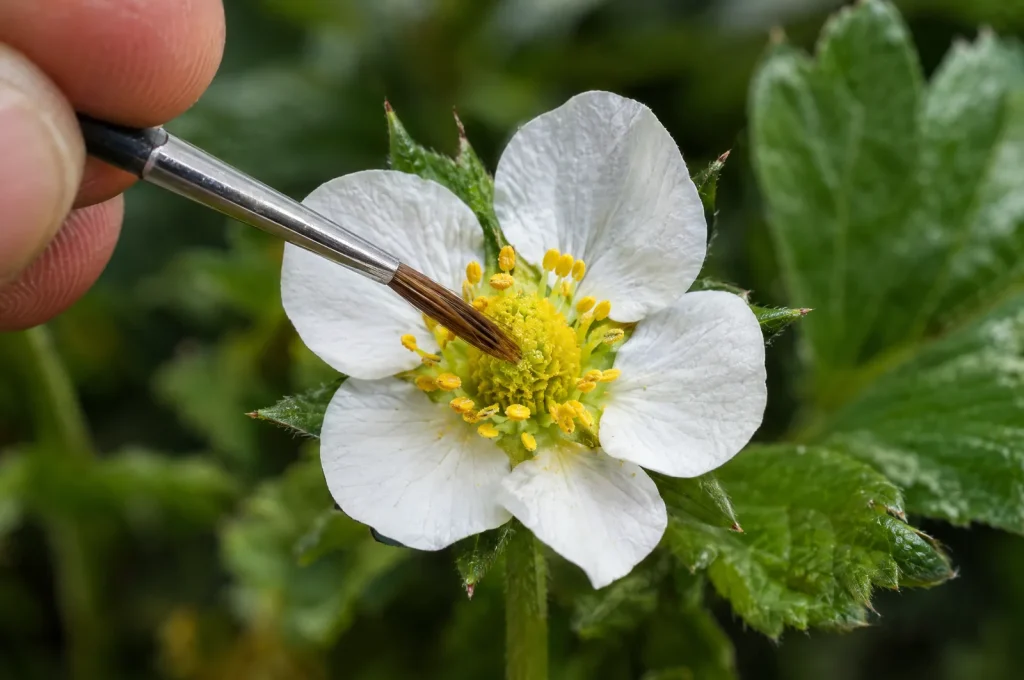
So you do it. A soft brush, a cotton bud, or a fingertip, dabbed into the centre of each open flower and moved between flowers. Every day or every other day while anything is in bloom, because an individual flower is only receptive for a couple of days. A small fan on a low setting for a few hours a day helps as well, and costs you nothing to run.
Set your expectations honestly, though, because this is where most guides stop. Hand pollination is not as good as the real thing. Published work reports that artificially pollinated strawberries tend to have lower fruit set and a higher rate of malformed fruit, while insect pollination significantly improves set, yield and quality. Commercial greenhouses do not hand pollinate acres of plants for fun. They buy bumblebees.
Practically, that means a proportion of lumpy, lopsided berries is normal and is not a deficiency. A strawberry is a cluster of tiny fruits on a swollen receptacle, and each one needs pollinating. Miss a patch and that part of the berry does not swell. If most of your fruit is misshapen, brush more thoroughly and more often rather than reaching for a supplement.
How long it takes
| Stage | Weeks |
|---|---|
| Crown to first flower | 4 to 6 |
| Flower to ripe berry | 4 to 5 |
| Planting to first pick | 8 to 12 |
| Then picking for | 12 to 14 |
Day-neutral plants from crowns, at normal indoor temperatures. Extension guidance puts first fruit within about ten weeks of planting, which the two stages above add up to.
Start from crowns or runners rather than seed. Strawberry seed is slow, erratic and will not come true from a supermarket berry, and it adds the better part of a year before you see anything. Everything in the article on starting seeds applies to most crops on this site, and this is the one where it does not.
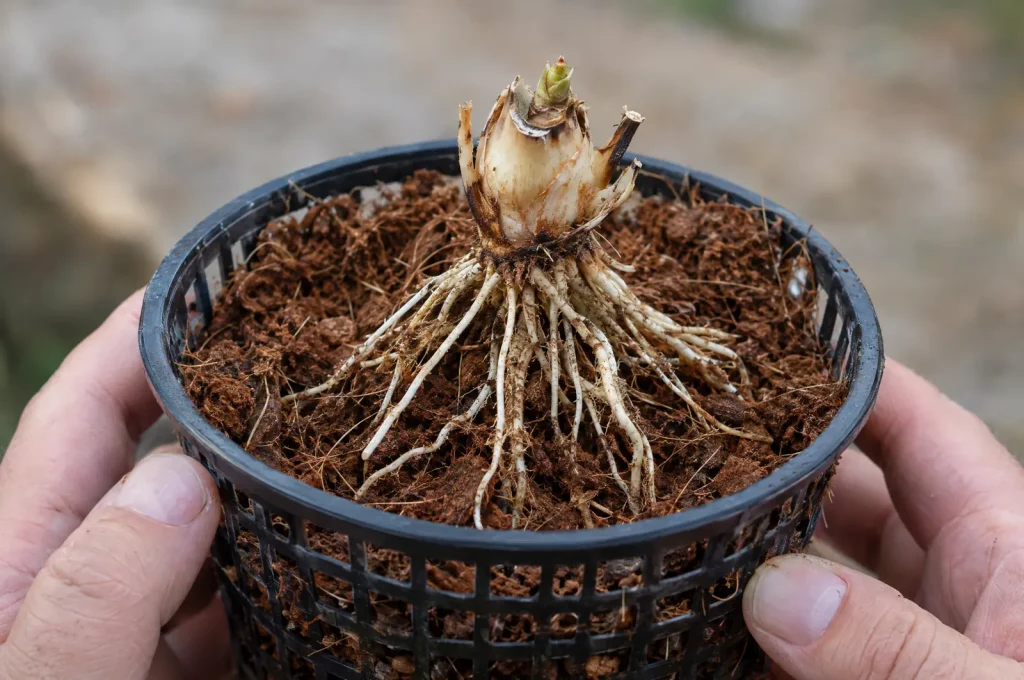
Planting the crown
One detail, and it kills more plants than anything else on this page.
The crown is the short woody stub where the leaves emerge from the roots, and it has to sit level with or slightly above the surface of the medium. Roots go down into the medium, crown stays up in the air. Bury it and it rots, which in a hydroponic system where the medium is permanently damp happens quickly and is not recoverable. Plant it too high and the roots dry out, which at least you can correct.
Use coir rather than clay pebbles for these. Strawberries are a long crop that fruits on and off for months, and the buffer a water holding medium provides is worth more here than the extra drainage pebbles give you. Commercial tabletop growers use coir almost universally for the same reason.
Train the trusses so the fruit hangs clear of the medium and clear of standing water. Berries resting on a wet surface go mouldy, and that is a two minute job you do once a week while you are pollinating anyway.
Feeding and conditions
Strawberries are fed more weakly than most people expect, and in particular more weakly than the fruiting crops they get mentally filed with. Check the figure on our PPM and EC chart and feed below where you would put tomatoes, because oversupplying them produces exactly the leafy plant with no fruit that this article opened with.
- Light. They want a lot of it, and day-neutrals do not need a particular daylength, so twelve to fourteen hours is a sensible setting rather than a requirement.
- Temperature. The 40 to 85F band is where flower initiation happens. Comfortable room temperature sits in the middle of it, and the top of that range in a hot summer room is where fruit set starts to suffer.
- Water temperature. The usual limits apply, and a long lived perennial crop in a warm room gives root rot months rather than weeks to find it.
- Runners. Day-neutrals throw them while trying to fruit. Snip them off unless you want new plants, because every runner is energy that was going into berries.
Which system suits them
Strawberries have one requirement that most crops on this site do not, which is that the fruit has to hang somewhere dry. That quietly rules some systems in and others out.
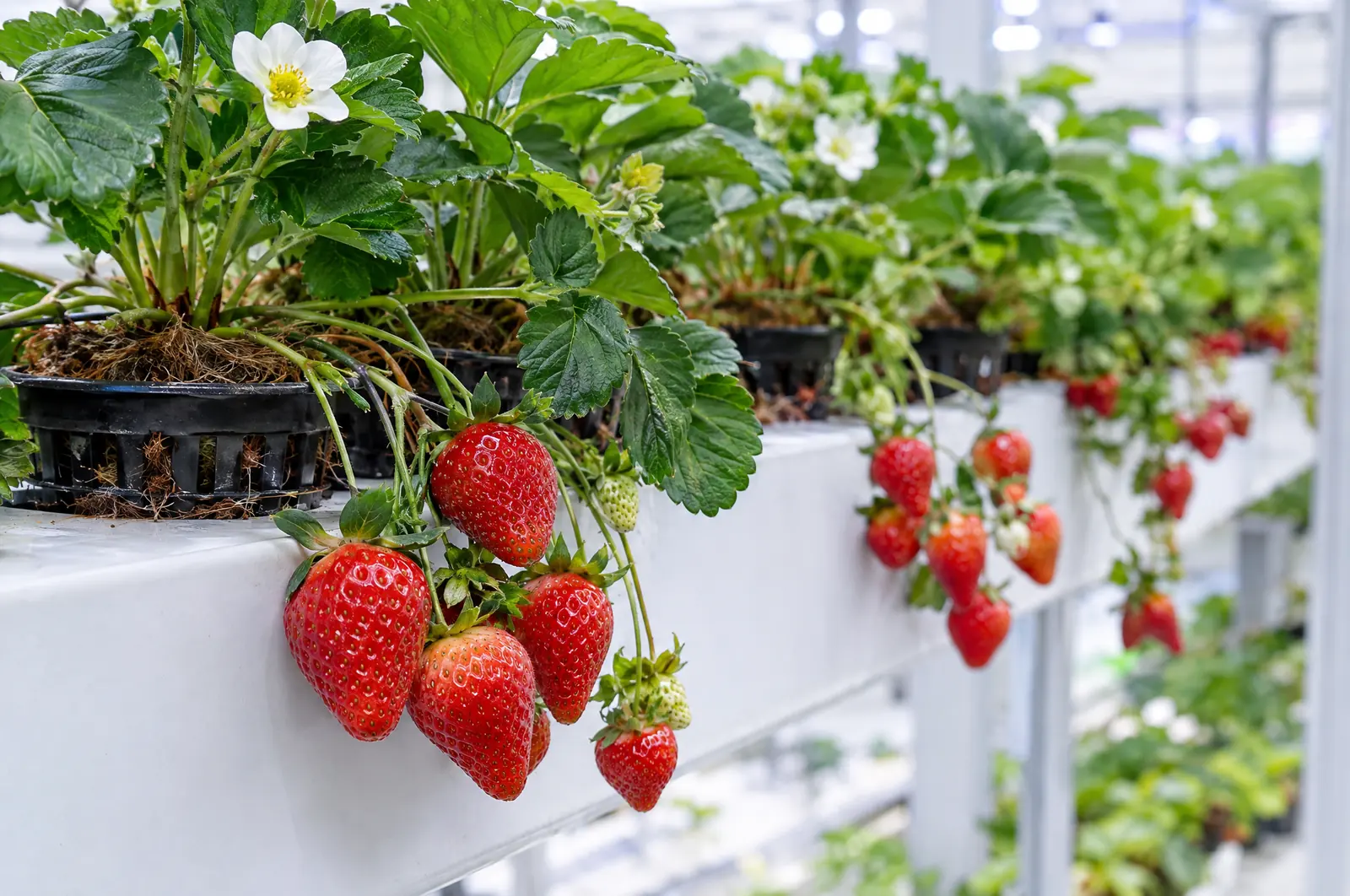
- Drip into coir is the standard commercial answer and the best home one. The medium buffers a long crop, the plants sit at the edge of a trough or gutter, and the trusses hang over the side into open air.
- NFT works well for the same reason, with the added benefit that a channel at waist height puts the fruit where you can see and pick it without crouching.
- A flood table is a reasonable fit, since every plant gets its own pot of medium and the tray drains dry between cycles. Train the trusses over the pot rim rather than letting them lie on the tray floor.
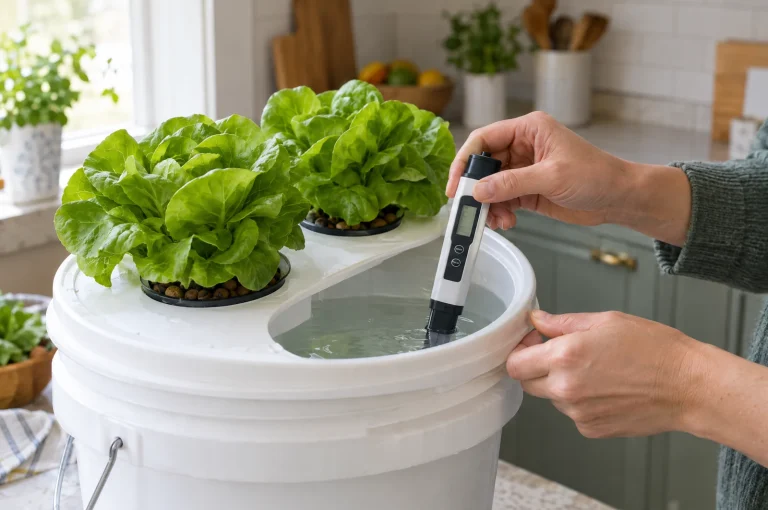
- Deep water culture is the awkward one. It can be done, but a crown sitting over open water for months, in a system with no medium to hold it clear, is asking for exactly the rot this article keeps warning about. If a bucket is what you have, raise the crown well proud of the lid.
Free plants for next season
Since day-neutrals are best treated as an annual crop, the obvious question is whether you have to buy new plants every year. You do not, and the runners you were snipping off are the reason.
Late in the season, when you have had the bulk of the fruit and are no longer protecting the harvest, let a few runners develop instead of cutting them. Each one produces a daughter plant at its tip. Peg that daughter into a net pot of damp coir beside the parent, leave it attached while it roots, which takes two or three weeks, and then cut the runner. You now have a new plant with its own root system and no transplant shock, raised in the same clean system rather than arriving with somebody else’s soil and somebody else’s fungus gnats.
Take daughters from your best plants rather than whichever runner is nearest, and keep it to one generation at a time. Strawberries accumulate virus over successive generations, which is the reason commercial growers buy certified stock rather than propagating indefinitely from their own.
If you are getting leaves and nothing else
Work down this list in order, because it is roughly the order of likelihood.
- Check what you bought. If it is June-bearing, no amount of adjustment indoors will produce flowers out of season. This is the commonest answer by a distance.
- Check the feed strength. Too strong and the plant invests in foliage. Drop towards the lower end of the range and wait a fortnight.
- Check you have not buried the crown. A plant putting energy into surviving a rotting crown is not going to fruit.
- Count the runners. A plant throwing runners constantly is spending its budget on daughters rather than berries.
And if you have flowers but no fruit, or fruit that sets and then stays tiny and lopsided, that is not on this list at all. That is pollination, and it is the section above.
Where this comes from
The photoperiod and chilling behaviour of June-bearing plants, the temperature band for day-neutral flower initiation, the first-season fruiting and the fourteen week cropping figure are from University of Minnesota Extension’s guidance on day-neutral strawberries and on choosing a production system, and from University of New Hampshire Extension’s day-neutral growing guide. The cultivar names are from Penn State Extension’s strawberry production guidance, which describes them in field plasticulture rather than hydroponics. The difficulty of wind pollination under cover, and the finding that hand pollination gives lower fruit set and more malformed fruit than insect pollination, are from published greenhouse pollination research. The week figures in the table are typical rather than measured, and are given as ranges for that reason.
Found this useful? Tell Google to show you more of it.
Add to Preferred Sources