Starting Seeds for Hydroponics, How to Get Past the First Two Weeks
The beginner guide on this site opens at the point where you build something, and the build plans all start with a seedling you already have. That skips a fortnight in which most of the things that go wrong, go wrong. Seeds are not difficult, but they are unforgiving of three specific mistakes, and almost every failed first attempt is one of them. Here is the whole process, and where each of those three sits waiting.
What you are sowing into
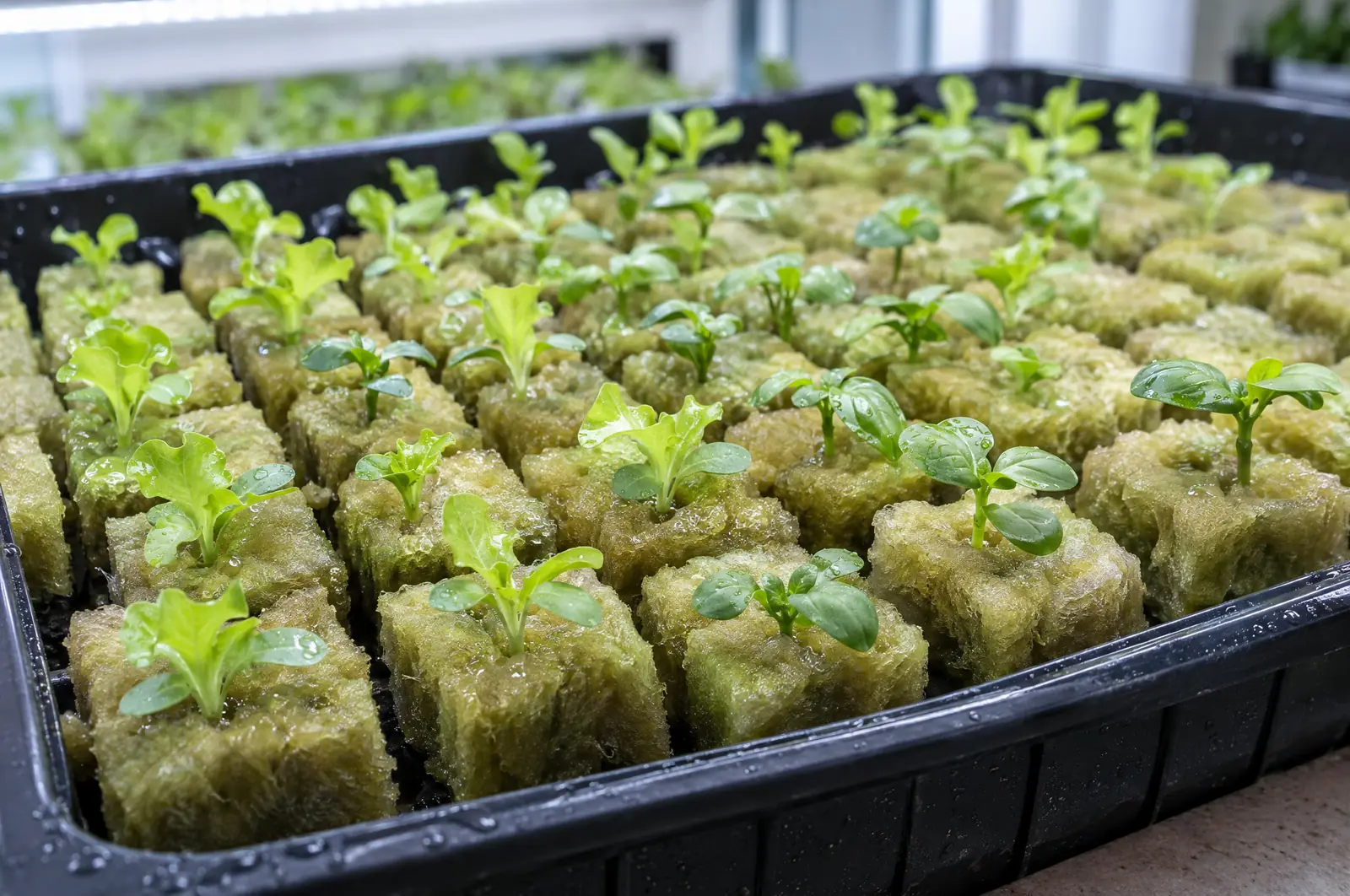
Not loose medium. A seed needs steady moisture pressing on it from every side, and clay pebbles cannot do that at any size. You want a cube or a plug that holds together, so the whole thing can be lifted later without the roots ever being disturbed.
Affiliate disclosure: some links below are affiliate links. We may earn a commission if you buy through one, at no extra cost to you. As an Amazon Associate I earn from qualifying purchases. Full disclosure.
- Rockwool cubes are the standard. They hold a lot of water, they hold their shape, and they come with a hole already in the top. They also arrive alkaline and have to be soaked in pH adjusted water before a seed goes anywhere near them, which is covered in the guide to growing media along with why skipping it causes a deficiency that is not a deficiency.
- Coir or peat plugs need no conditioning, which makes them the easier first choice. They hold slightly less water and they are a little more fragile when wet.
Either is fine. The thing that matters more than the choice is that it stays damp without ever being waterlogged, and that you never squeeze it to find out. That holds for every crop in the table below except spinach, whose seed will not finish germinating until it has dried out once.
Sowing
Two or three seeds per cube, not one. Germination is never 100 out of 100 and an empty cube costs you a fortnight, and the arithmetic behind that number is set out separately along with how to test a packet you are unsure of. When they are up, snip the extras off at the surface with scissors. Do not pull them out, because pulling disturbs the roots of the one you are keeping.
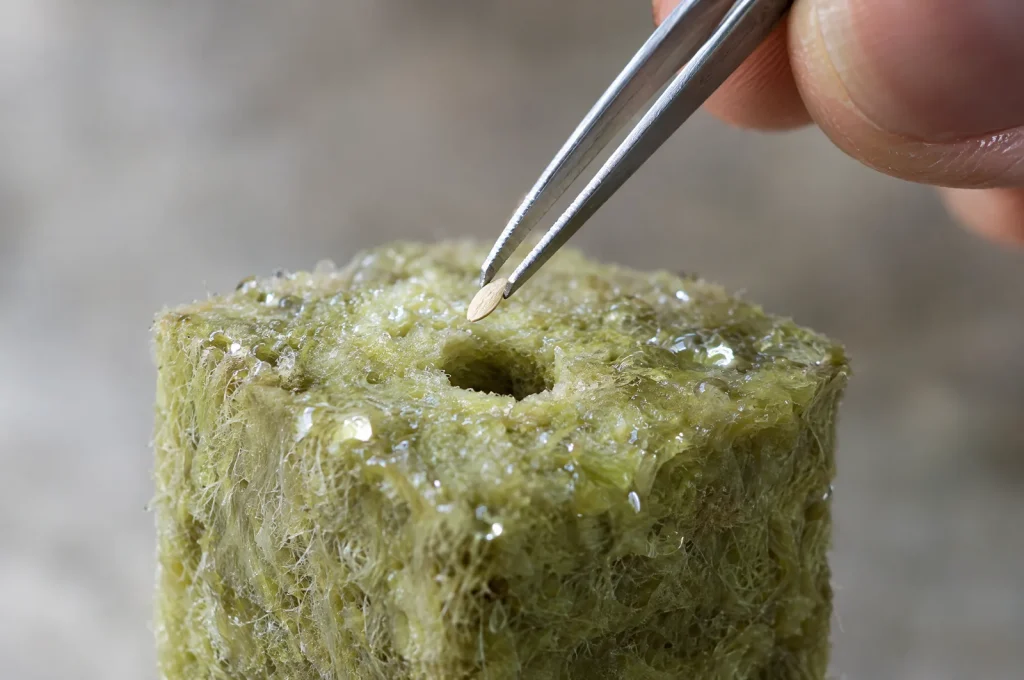
Do not bury them. Drop the seed into the hole that is already in the cube and pinch the top of the hole gently closed over it. That is the whole operation. A seed buried under extra medium has to spend reserves it does not have reaching the surface, and the smaller the seed the less it has to spend.
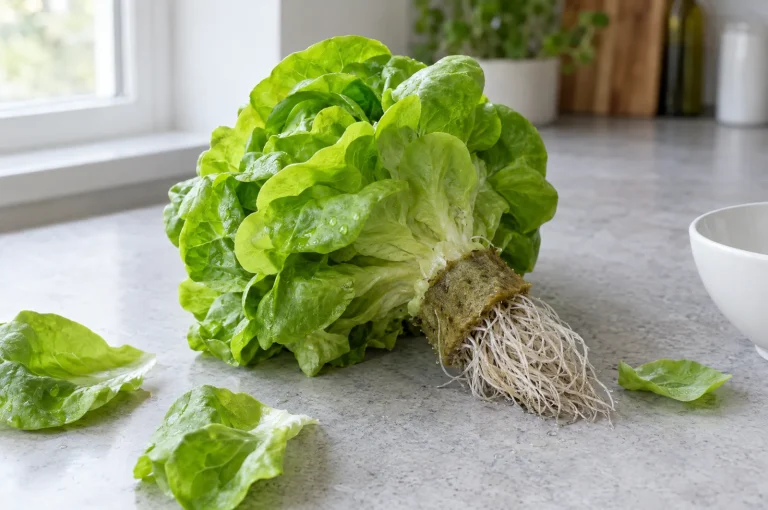
Lettuce deserves a note of its own here, because it is the crop most beginners start with and it behaves differently. Lettuce is one of the standard laboratory examples of a seed whose germination responds to light, which is why every gardening guide tells you to sow it shallow. Two honest caveats come with that. The requirement varies between cultivars, some of which do not need light at all, and it is stronger in fresh seed than in old. The practical answer does not change either way. Leave lettuce sitting in the dimple at the top of the cube rather than pinching it closed, and keep the surface damp.
Temperature decides almost everything
This is the first of the three. Seeds germinate on temperature far more than on anything you do, and the usual indoor room is colder than people assume, particularly on a windowsill at night.
| Crop | Sprouts (days) | Ready (weeks) |
|---|---|---|
| Lettuce | 2 to 7 | 3 to 4 |
| Cucumber | 3 to 7 | 2 to 3 |
| Kale | 4 to 7 | 4 to 5 |
| Basil | 5 to 10 | 4 to 6 |
| Tomatoes | 5 to 10 | 5 to 7 |
| Spinach | 7 to 14 | 3 to 4 |
| Peppers | 10 to 21 | 6 to 8 |
Typical figures at around 70F (21C), and ready means ready to move rather than ready to eat. Every one of them stretches a long way when the cube is cold.
Aim to keep the cubes at about 70 to 75F (21 to 24C) until they are up. A cheap seedling heat mat does this better than anything else in the house, and extension guidance for indoor plant production suggests exactly that range.
Heat in the other direction is a real and underappreciated problem, and lettuce is where it bites. Published optimum ranges disagree, from 55 to 65F at one end of the advice to 68 to 77F at the other, so there is no single number worth quoting. What is not in dispute is how sharply it collapses. In a study across 304 lettuce varieties, average germination was about 88 out of 100 at 70F (21C), fell to roughly 43 at 82F (28C), and reached 1 at 95F (35C).
Worth knowing that this has two forms. Seed that simply will not start while it is too hot begins again when it cools, which is the common case. Seed held hot and damp for a long stretch can instead drop into a deeper dormancy that cooling does not immediately undo. So if a summer tray of lettuce does nothing, move it somewhere cool early rather than waiting it out.
Light, the moment anything shows
This is the second mistake and it is the one almost everybody makes. The seed does not need light to come up. The seedling needs it the instant it does, and the gap between those two facts is where leggy seedlings come from.
A seedling short of light stretches looking for it. The stem goes long, thin and pale, and it will not recover. It cannot thicken a stem it has already made, so a stretched seedling stays weak for the rest of its life, falls over in the net pot, and gives you a disappointing plant two months later for a reason you have long since forgotten.
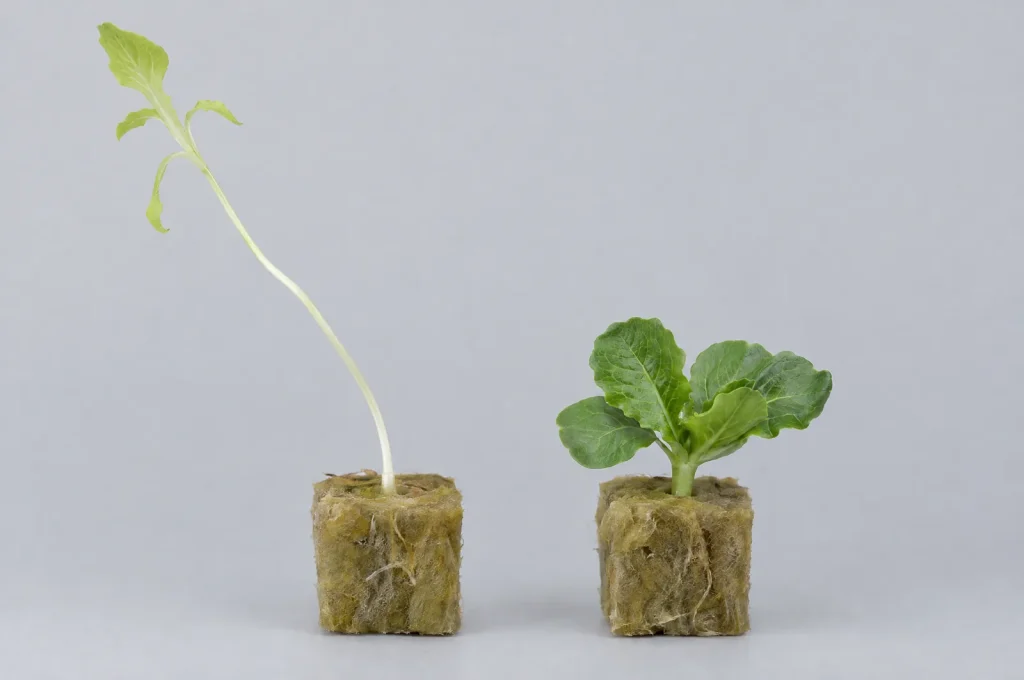
Three things prevent it, and none of them costs anything.
- Light on day one of emergence, not day three. Check the tray twice a day once you are near the expected date.
- Close enough. A windowsill in winter is not bright light, whatever it looks like to your eye, which adjusts and lies to you. A small LED a few inches above the tray beats the best window in the house.
- Take the dome off as soon as the first seedlings are up. It did its job holding humidity for germination, and leaving it on now gives you soft, stretched growth in air that never dries.
There is a sting in the tail here that ties the whole article together. Stretched seedlings are measurably more susceptible to damping off, which is the next section. The light mistake and the disease are the same mistake twice.
Do not feed them yet
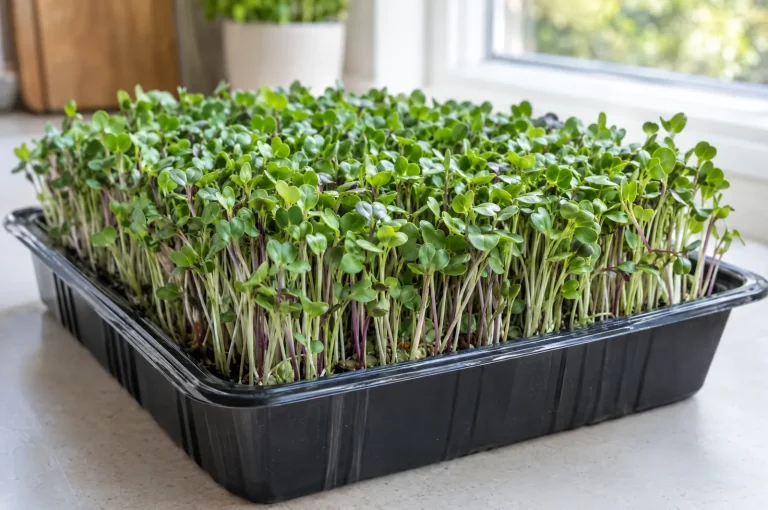
The third mistake, and the most tempting. A seed is a packed lunch, which is the entire basis of growing microgreens. It carries everything the plant needs to get its first leaves open, and until those leaves are working there is nothing in the plant capable of using a nutrient solution.
Plain pH adjusted water until the first true leaves appear. The two rounded leaves that come up first are seed leaves and are part of the packed lunch. The true leaves are the ones that look like the plant. When you see those, start feeding at about a quarter of the strength on the bottle and work up over a fortnight. Our nutrients guide covers what the strengths mean, and the dosing calculator will do the arithmetic for a container as small as a propagation tray.
Full strength solution on a seedling does not feed it faster. It draws water back out of roots that have barely any, which looks exactly like underwatering and gets treated with more solution.
Damping off, and why it is not bad luck
A tray that was fine yesterday has seedlings lying flat this morning, each one pinched and brown right at the base. That is damping off, and it is not bad luck. It is the same family of water moulds behind root rot, operating on plants too small to survive it.
Two different organisms, and which one you have is readable from the timing. Pythium tends to rot the seed before anything appears, so you blame the seed. Rhizoctonia tends to collapse the seedling at the surface after it is up, which is the toppling you can actually watch happen.
Penn State’s conditions for it are specific and worth having in front of you, because three of the four are things you control: too much moisture, seed sown too densely, cubes cooler than 68F before germination, and warmer than 77F after emergence. That last pair is why one fixed temperature all the way through is not the right routine. Warm to get them up, then ease off.
- Damp, never sodden. The commonest cause by a distance is simply too much water.
- Water in the morning rather than at night, so the surface is not wet for twelve dark hours.
- Use room temperature water. Cold water slows the seedling down and widens the window in which it can be infected.
- Sow into fresh medium every time, and sanitise reused trays. Half an hour in a 10 percent bleach solution, then a thorough rinse.
- Keep hose and watering can ends off the floor. That is the documented way these organisms get into a clean tray.
- Thin crowded seedlings early, and keep the air moving gently once the dome is off.
There is no cure once a seedling is down. Remove the affected ones and the medium around them, fix the moisture, and accept the losses.
When to move them
Two signals, and you want both. White roots showing through the sides or the base of the cube, and two or three true leaves open. Roots alone can mean a plant that went looking for water too early. Leaves alone can mean a plant with nothing under it yet.
Then move the whole cube. Never a bare root. Set it into the net pot and pack clay pebbles around it so the base of the cube sits where the water or the solution will reach it, which for a bucket system means just touching the surface at the start, and for a Kratky jar means touching it on the day you plant and never again.
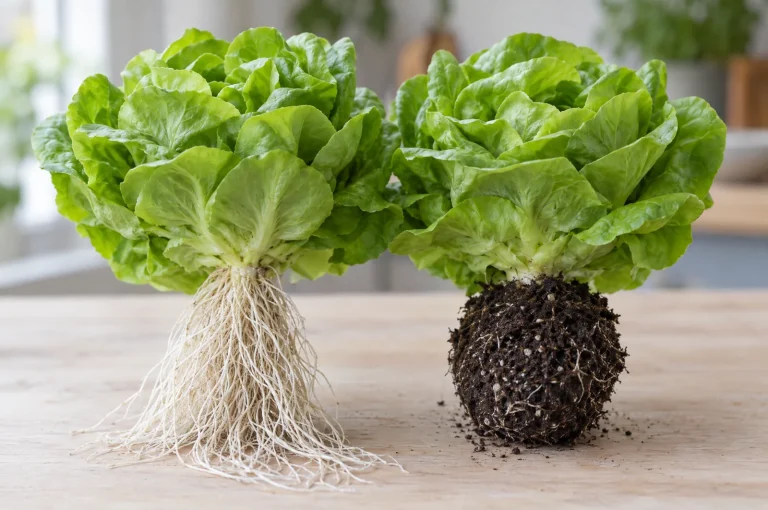
A transplant that disturbs no roots has nothing to recover from, and a tray sown a few cells at a time keeps a steady rotation going rather than one crop arriving all at once. That is the entire reason for starting in a cube rather than in anything loose, and it is why nobody in hydroponics starts seeds in soil and washes them off afterwards.
It will still sit and do nothing for a few days, and that is not a sign anything went wrong. A seedling that stalls after transplanting is adjusting to four changes at once, and each of them runs on its own clock.
Where this comes from
The damping off conditions, the Pythium and Rhizoctonia distinction and the sanitation routine are from the Penn State, University of Minnesota, UMass and Michigan State extension fact sheets on damping off, and the observation that stretched seedlings are more susceptible to it is Minnesota’s. The 70 to 75F germination range for indoor production is also Minnesota’s. The lettuce germination figures across 304 varieties are from published research on thermal stress in lettuce seed, and the conflicting optimum ranges are from UC guidance, which is quoted here as conflicting rather than resolved because it is. Days to germinate are typical published figures rather than a measured trial, which is why they are given as ranges.
Found this useful? Tell Google to show you more of it.
Add to Preferred Sources