How to Get a Lettuce a Week Instead of Six at Once
The first crop is a triumph and it is also the problem. You sowed a tray, everything came up together, everything grew together, and now there are six lettuces ready in the same week and you can eat perhaps one. Two go soft in the fridge. Then the system sits empty for a month while the next batch catches up, and you are buying salad again. Almost everybody does this, the fix is not a bigger system, and the obstacle in the way of the fix is not space but the fact that seedlings and mature plants want different things from the same tank.
The arithmetic, which is friendlier than it sounds
A crop has two stages and they are worth counting separately, because only the second one occupies your system. Our own figures for the common crops look like this.
| Crop | Nursery | In system |
|---|---|---|
| Lettuce | 3 to 4 | 3 to 5 |
| Basil | 4 to 6 | 2 to 4 |
| Spinach | 3 to 4 | 4 to 6 |
| Kale | 4 to 5 | 5 to 7 |
Weeks in each stage, from our articles on starting seeds and on when to harvest.
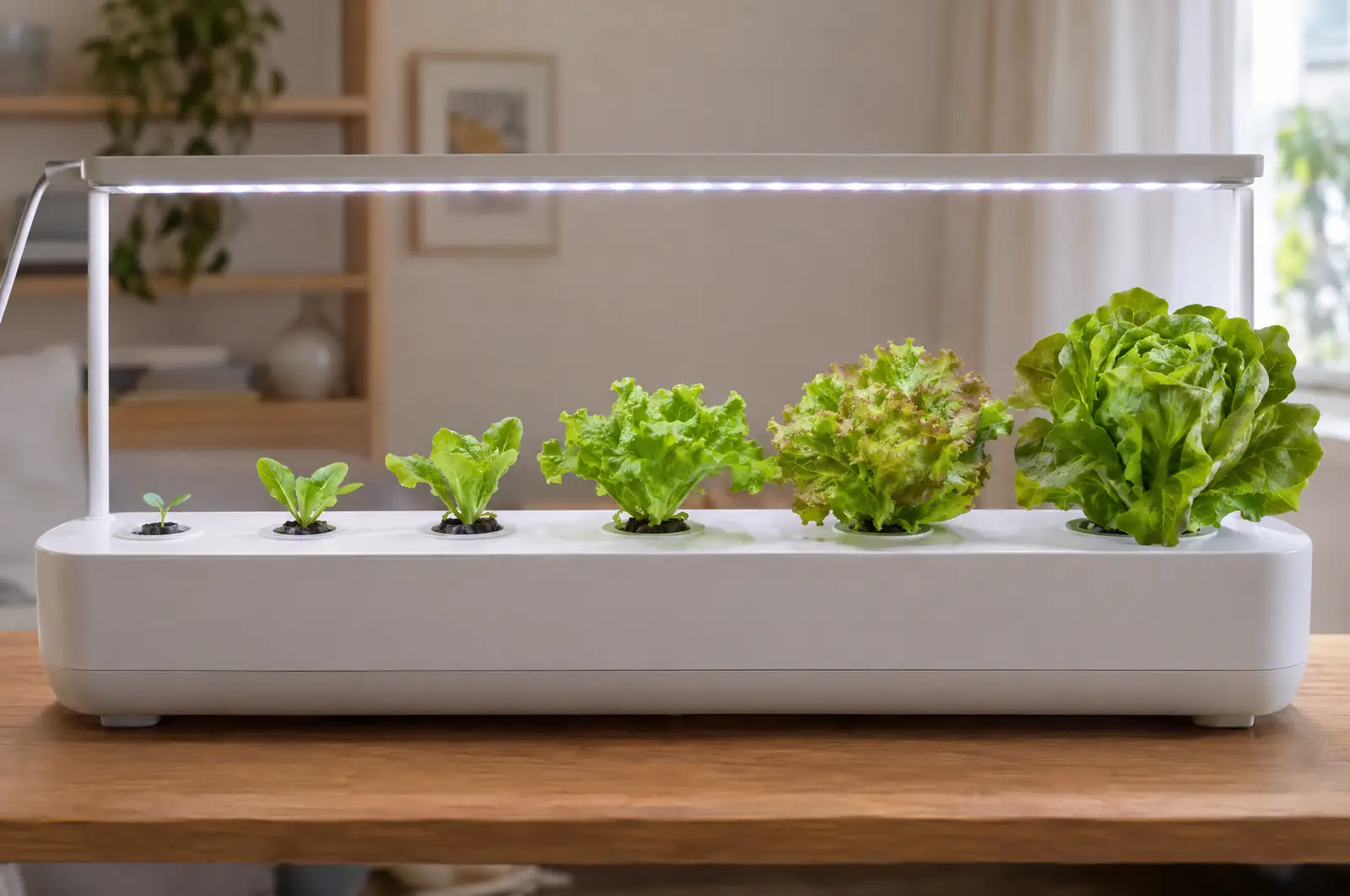
Take lettuce at four weeks in the system. If you want one head a week, you need one finishing every week, which means four plants at four different ages occupying four places. That is the whole idea. The number of slots you need is the length of the growing stage, counted in harvest intervals, and not a number you have to be clever about.
Worked through on a six slot system, that means four slots carrying lettuce at one, two, three and four weeks in, and two spare for whatever else you fancy. Every week the oldest comes out, everything shuffles along, and a four week old seedling goes into the hole. Nothing about that requires more space than you already have, only that the slots hold different ages.
What makes it feel harder is the nursery stage sitting in front of it. Those three or four weeks have to be happening continuously and somewhere else, which is the part most people never set up.
Cornell solves this with a pipeline, not a bigger tank
It is worth looking at how a commercial operation that has to produce every single day arranges itself, because the shape of the answer transfers even though the scale does not. Cornell’s controlled environment handbook is written around a daily output of five ounce heads of leaf lettuce, and the way it gets there is by splitting the crop across two separate areas and moving plants between them on a schedule.
| Day | Where | What |
|---|---|---|
| 0 to 11 | Nursery | Germinate |
| 11 | Pond | Transplant |
| 21 | Pond | Spread out |
| 35 | Pond | Harvest |
The Cornell lettuce schedule. Every stage is happening at once, on different plants, in different places.
Two details in that schedule are worth stealing. The first is that germination happens somewhere else entirely for the first eleven days, so the expensive growing area never holds a seedling. The second is the spreading out on day 21, where the plants go from 97 to the square metre down to 38. Young plants are packed tight because they are small, and the space is only given to them when they need it.
Being fair about the comparison: Cornell gets from seed to a finished head in 35 days, and the home figures in the table above add up to more like six to nine weeks. That gap is not a contradiction, it is what a 17 mole light budget and complete climate control buy you. Use the home numbers for your own planning and treat the Cornell schedule as the shape rather than the timings.
Why you cannot simply stagger inside one tank
The obvious move is to pull one plant out and drop a fresh seedling into the empty net pot. It works better than nothing and it has a real cost, which comes down to the same problem as putting different crops in one reservoir. Mixed ages want different conditions.
- Strength. The PPM and EC chart puts leafy seedlings at 0.5 to 1.2 and growing lettuce at 1.4 to 1.8. Those bands do overlap, but only at the very top of one and the very bottom of the other, so a tank holding both is running one of them near the edge of its range permanently. A fresh seedling dropped into a mature tank is being fed at roughly double what it wants.
- Light. A seedling under the intensity a finishing plant needs stretches or scorches, and it is sitting several inches lower than the canopy around it, which makes the mismatch worse rather than better.
- Disturbance. Lifting out a mature plant with a full root mass pulls at the roots of its neighbours, which is the one thing a careful transplant was trying to avoid.
So you can stagger within a tank, and the plants will survive it, but you are accepting a compromise on every new arrival. The alternative costs almost nothing and removes the compromise entirely.
There is also a system that sidesteps the problem rather than managing it. A row of Kratky jars gives every plant its own reservoir, so a seedling can sit at seedling strength beside a finishing lettuce at full strength with no compromise between them at all. For a rotation specifically, independent containers are worth more than a single larger tank.
The nursery, which is a tray on a windowsill
Affiliate disclosure: some links below are affiliate links. We may earn a commission if you buy through one, at no extra cost to you. As an Amazon Associate I earn from qualifying purchases. Full disclosure.
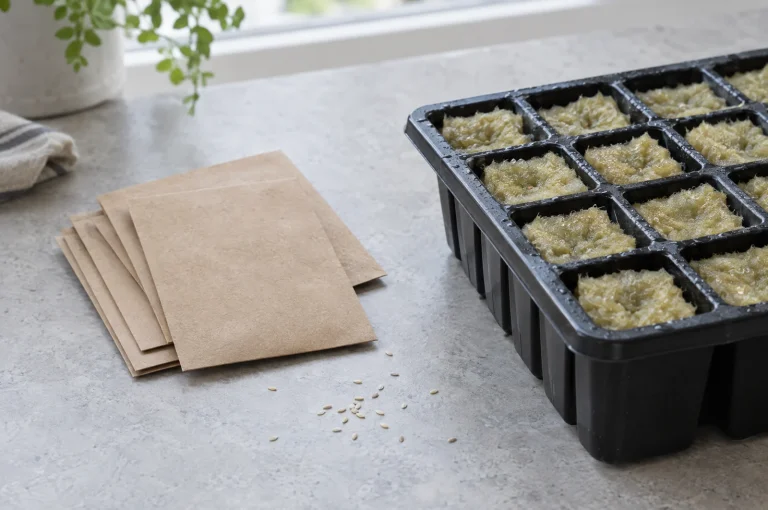
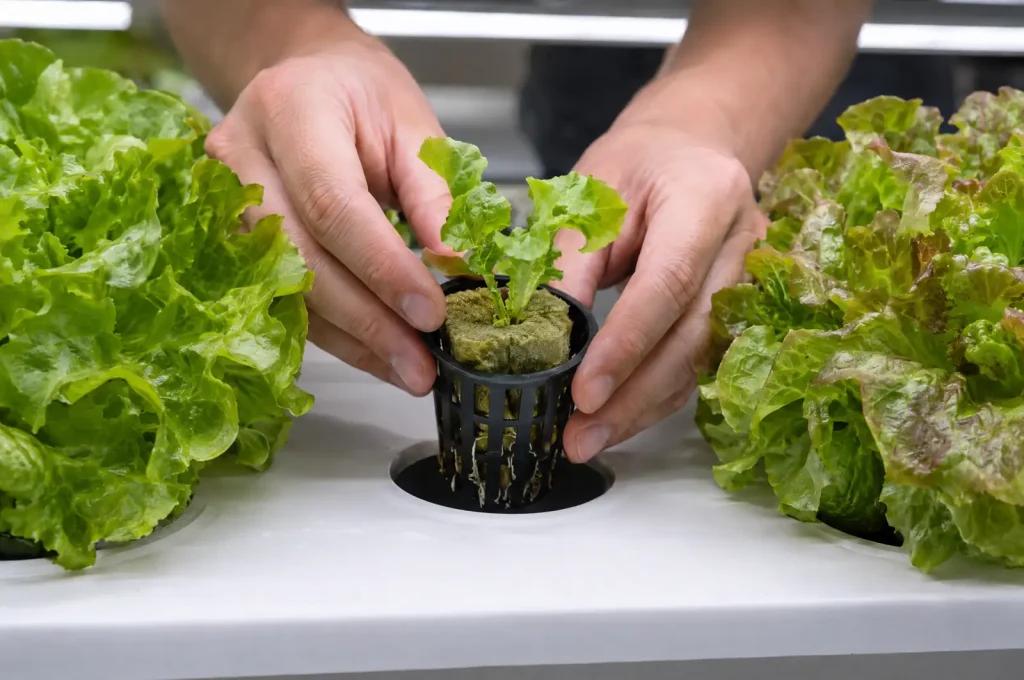
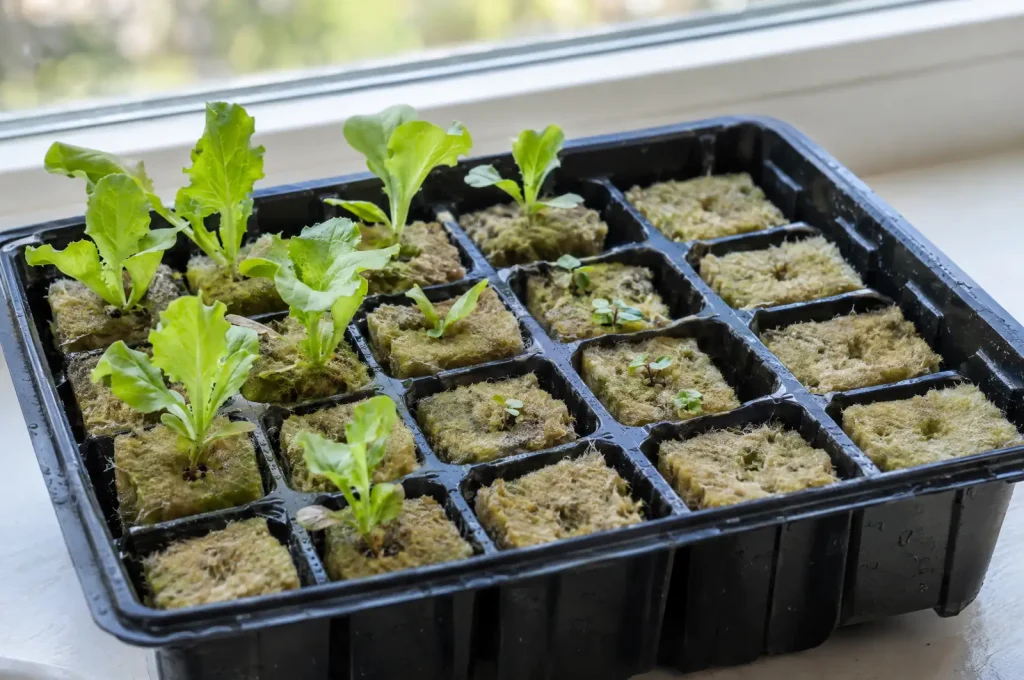
This is the structural fix and it is unglamorous. Seedlings do not need your system. They need a damp cube, warmth, light once they are up, and almost no feed, and all of that fits in a seed tray that costs a couple of pounds and lives somewhere else.
- Sow into cubes, not into the system. A cube moves as one piece into a net pot later with nothing disturbed, which is the whole argument in the article on starting seeds.
- Keep them on plain water at first. A seed carries its own food until the first true leaves appear, so feed only becomes a question after that, and then at the seedling strength rather than the tank strength.
- Sow a few every week or two, not a tray every two months. Six cells sown weekly is the entire technique. It feels pointless for the first month and then it never stops working.
- Keep the nursery where you can see it. The failure mode of a separate nursery is forgetting it exists.
With that running, your system stops being a thing you fill and empty and becomes a thing you feed from one end and harvest from the other.
Harvesting is also a scheduling tool
Before you add any plants at all, there is a free way to spread a crop out, which is to stop harvesting whole plants.
Taking the outer leaves and leaving the growing centre turns one plant into a supply over several weeks rather than a single event, and the method is in the article on when to harvest. Six lettuces picked that way do not all arrive at once, because you are taking what you need each time instead of taking everything. It also buys you time at the other end, since a plant being picked over is not sitting there going bitter while it waits.
Basil works the same way from the other direction. Pinching the tip makes the plant branch rather than finish, so the harvest is spread across weeks by design, which is covered in the basil article.
Filling a gap you have already created
If you are reading this with an empty system and a nursery you have not started, the gap in front of you is four to six weeks and there are fast crops that fit inside it.
- Microgreens. Five to twelve days for most of them, no nursery stage, and they occupy a tray rather than your net pots. The article on microgreens covers which ones are quickest.
- Arugula and cilantro. Three to four weeks according to our beginner crop list, which lands exactly in the hole while your lettuce nursery catches up.
- Cuttings rather than seed. A basil cutting roots in a fortnight and skips most of the nursery stage, so it is the fastest way to refill a herb slot.
Start the nursery in the same week you plant the gap filler, and the two finish in roughly the right order.
What this looks like once it is running
A working rotation for one small system and one person is less elaborate than it sounds. Sow a few cells each weekend. Move whatever is ready into the gaps left by last week’s harvest. Pick outer leaves through the week rather than pulling plants. Change the reservoir on its own schedule regardless of what is growing in it, which the reservoir article sets out, because that interval has nothing to do with the plants’ ages.
The one thing that takes discipline is sowing on weeks when the system is full and the idea feels unnecessary. That is exactly when it matters, because the seedlings you start today are the ones filling a gap you cannot see yet. A rotation is always being set up four weeks in advance, which is also why it feels like it is not working until suddenly it is.
Where this comes from
The stage lengths in the first table are our own published figures, taken from the article on starting seeds for the nursery column and the article on when to harvest for the growing column, both of which carry their own sources. The seedling and growing strength bands are from our PPM and EC chart. The commercial schedule is from the Cornell University controlled environment agriculture lettuce handbook, which states that it is directed toward a daily production of five ounce heads, that seeds are started in a separate germination area for eleven days, that plants are transplanted into the pond on day 11 and harvested on day 35, and that they are re-spaced on day 21 from 97 plants per square metre to 38. That handbook is dated 2013 and its figures come from a cultivar no longer available, which matters less here than usual because what is being borrowed is the structure rather than the numbers. The difference between its 35 day cycle and the longer home figures is a difference in light and climate control rather than a disagreement about lettuce.
Found this useful? Tell Google to show you more of it.
Add to Preferred Sources