Does Silica Do Anything in Hydroponics?
On the shelf next to the bloom booster there is a bottle labelled silica, and our nutrient buying guide lists it among the things a beginner can safely ignore, with the words real effects in some conditions. That is the most honest sentence anybody has written about silica and the least useful one, because it never says which conditions. They are nameable, and a reservoir running properly has already removed most of them.
Soil gives it away free, and your reservoir has none
Silicon is the second most abundant element in soil, and the water held in soil carries it as silicic acid at 0.1 to 0.6 millimolar. Emanuel Epstein, writing in the Proceedings of the National Academy of Sciences in 1994, points out what that means in context. Those are concentrations on the order of potassium and calcium, well in excess of phosphate. Plants take it up readily, ending up with anywhere from a fraction of one percent of their dry matter to ten percent or more.
And yet silicon is not counted among the elements defined as essential for any land plant except the horsetails. For that reason, Epstein writes, it is not included in the formulation of any of the commonly used nutrient solutions.
That sentence is about us. Our nutrient guide opens with the seventeen elements a complete feed contains, and seventeen is a count of the essential ones rather than an inventory of what a plant uses. Silicon sits outside the list by definition, so it is left out of the bottle by definition. Epstein was blunter. Solution grown plants hold only the silicon that reaches them as a contaminant of their surroundings, which makes them to an extent experimental artifacts. Most complaints aimed at this method turn out softer than they sound, as our comparison of hydroponics against soil keeps finding. This one is literally true.
Getting it into the plant takes two pumps
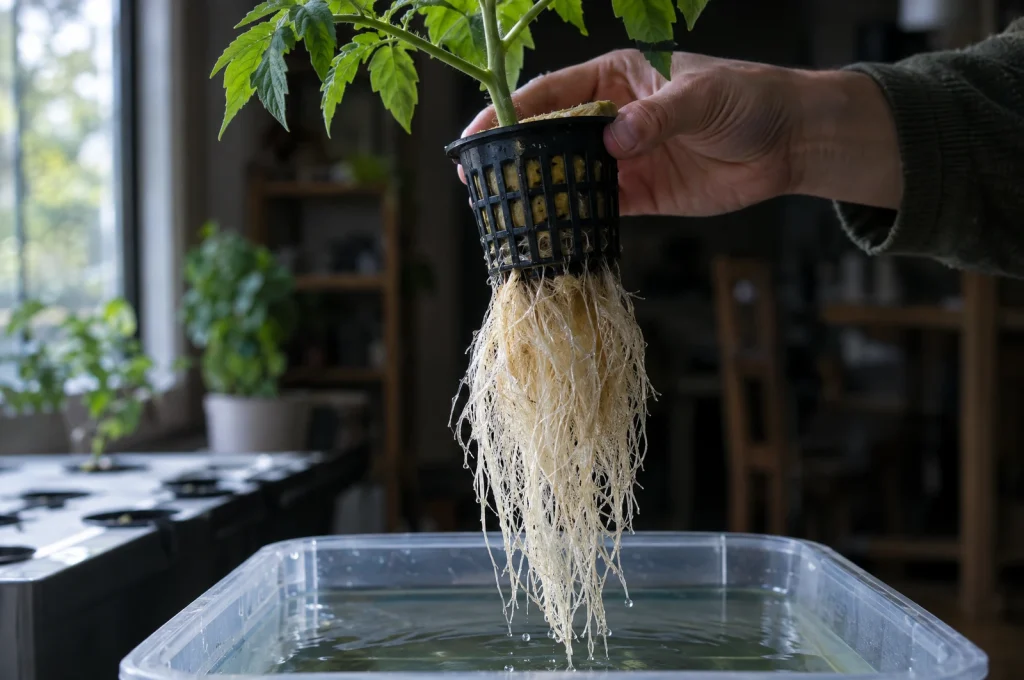
Before worrying about a missing element, ask whether the crop in front of you could use it. Mitani and Ma put that question to rice, cucumber and tomato in the Journal of Experimental Botany in 2005. All three move silicon across the root with a transporter of the same affinity. What differs is the maximum rate, in the order rice, then cucumber, then tomato.
Sun and colleagues finished the picture in Plant, Cell and Environment in 2020. Tomato has a working transporter for getting silicon into the root and no working one for getting it out again. Overexpressing the entry gene raised silicon in the roots and changed the shoots not at all. Put cucumber’s exit gene into a tomato and leaf silicon rises, and so does the plant’s tolerance of water shortage and heat.
| Crop | Silicon reaching the leaves |
|---|---|
| Rice | Most of it |
| Cucumber | Some |
| Tomato | Almost none |
Same transporter affinity in all three, different maximum rates, and in tomato a missing second step. The difference is in the root rather than in the bottle.
So a tomato draws silicon in and leaves it in the root. Everything our page on tomatoes and peppers asks of you happens in the shoot, which is the part the silicon never reaches. The accumulators are grasses, and nobody grows rice in a kitchen.
The explanation everyone repeats is the one under dispute
Ask why silica is supposed to help and the answer comes back word for word off every product page. It builds stronger cell walls. That has a real pedigree: Ma and Yamaji, reviewing the field in Trends in Plant Science in 2006, attributed the benefits mainly to silicon’s high deposition in plant tissues, enhancing their strength and rigidity.
Coskun and colleagues went back through it for New Phytologist in 2019, and their summary is not gentle. Much of the evidence, they write, in particular that from recent functional genomics, is at odds with many of the mechanistic assertions surrounding silicon’s role, and the data do not support reports that it affects a wide range of molecular, biochemical and physiological processes. What is needed, in their words, is a major reinterpretation.
Their replacement, which they call the apoplastic obstruction hypothesis, puts silicon outside the cell rather than inside it, as an extracellular prophylactic agent rather than an active cellular agent. Whether that model survives is for plant physiologists. The practical reading is immediate. A prophylactic has to be in place before the trouble arrives. Our page on root rot makes the same point about biological fungicides, which are preventative rather than curative and no use once a reservoir smells swampy. Reaching for silica after the damage shows is the same mistake in a different container.
The one trial that tried to repeat the good news
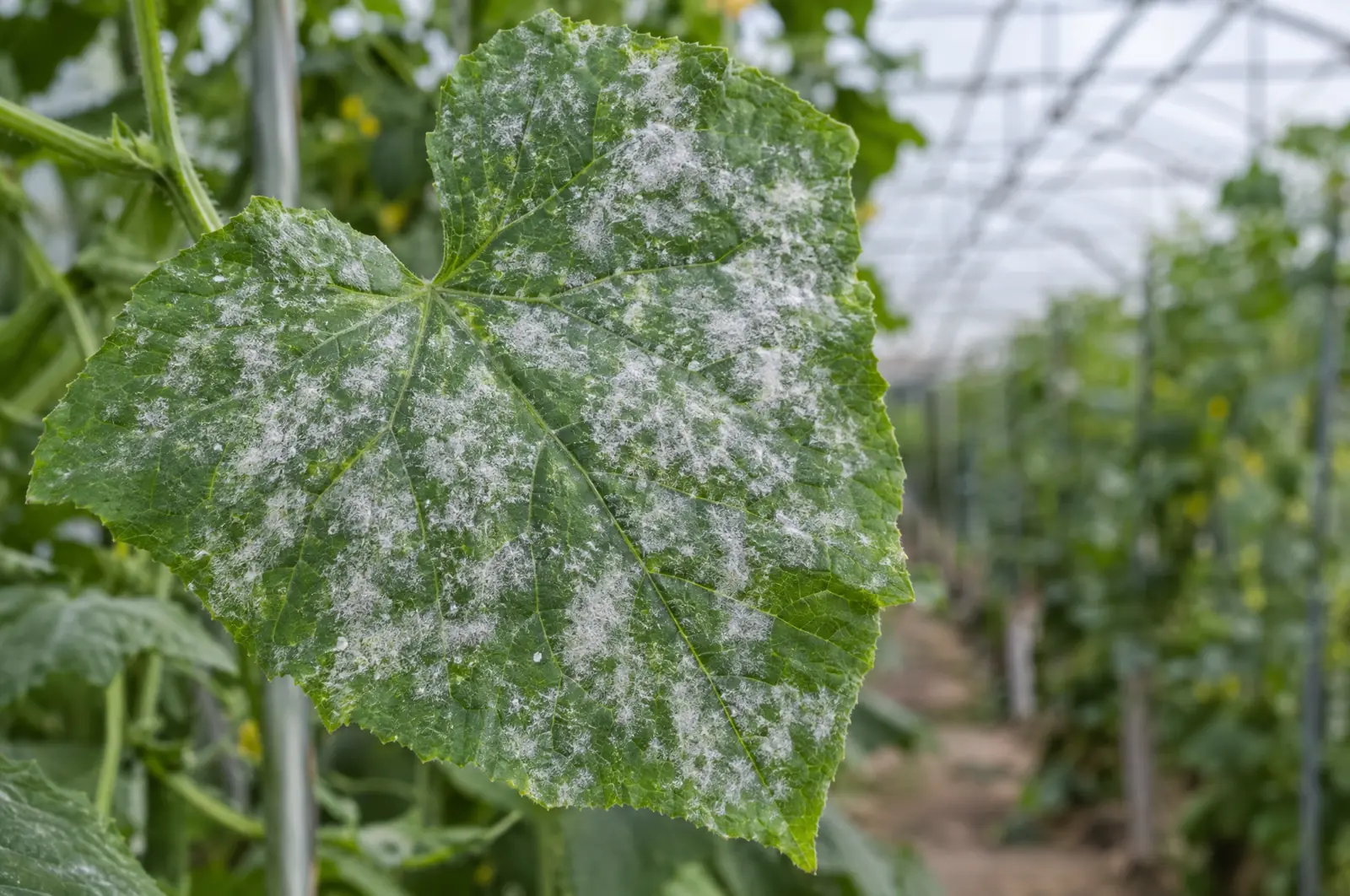
The strongest claim for silicon in water culture is the Canadian work on greenhouse cucumber, where adding it to the nutrient solution suppressed powdery mildew. Florida growers could not reproduce it, and Schuerger and Hammer set out in Plant Disease in 2003 to find why, varying cultivar, nutrient formula, rooting medium, light intensity and temperature.
Susceptible cultivars fed potassium silicate at 100, 150 or 200 milligrams per litre showed what the authors call a slight but statistically significant reduction in mildew across a 49 day trial. Then comes the sentence that decides the matter. The suppression, they write, was not commercially useful because it failed to increase fruit yields.
Nutrient formula, rooting medium and light intensity made no difference. Temperature made all of it. The effect was largest at 68F (20C) and significantly weaker at 77F (25C) and 86F (30C), which is the explanation they offer for the two countries. The Canadian houses had averaged 68 to 77F (20 to 25C) and theirs in Florida 75 to 90F (24 to 32C). A warm room is the one most likely to have a mildew problem and the least likely to get help from this.
One more line is worth lifting out. With no silicon in the solution at all, one of their five cultivars was simply resistant and four were susceptible, which is the argument our guide to choosing seed makes about every other input.
On the crops this site actually grows
Lettuce has been tested properly and recently. Simko, Zhao and Peng ran three cultivars through a growth chamber for Plants in 2025, applying silicon dioxide to the leaves. At 3.66 millimolar it raised biomass at 59F (15C), at 68F (20C) and under salt stress, where the effect was largest. They then ran the dose from zero to 29.30 millimolar. The best result sat at 3.66 every time, higher rates lost the benefit, and the top rate reduced growth and yellowed the leaves.
The second lettuce study found its effect by taking water away. Villa e Vila and colleagues, also in Plants, in 2024, crossed three irrigation levels with silicon. Lettuce on 80 percent of its water need plus silicon matched lettuce on full water without it, and in a second cycle 60 percent did. Silicon stood in for water that was not there.
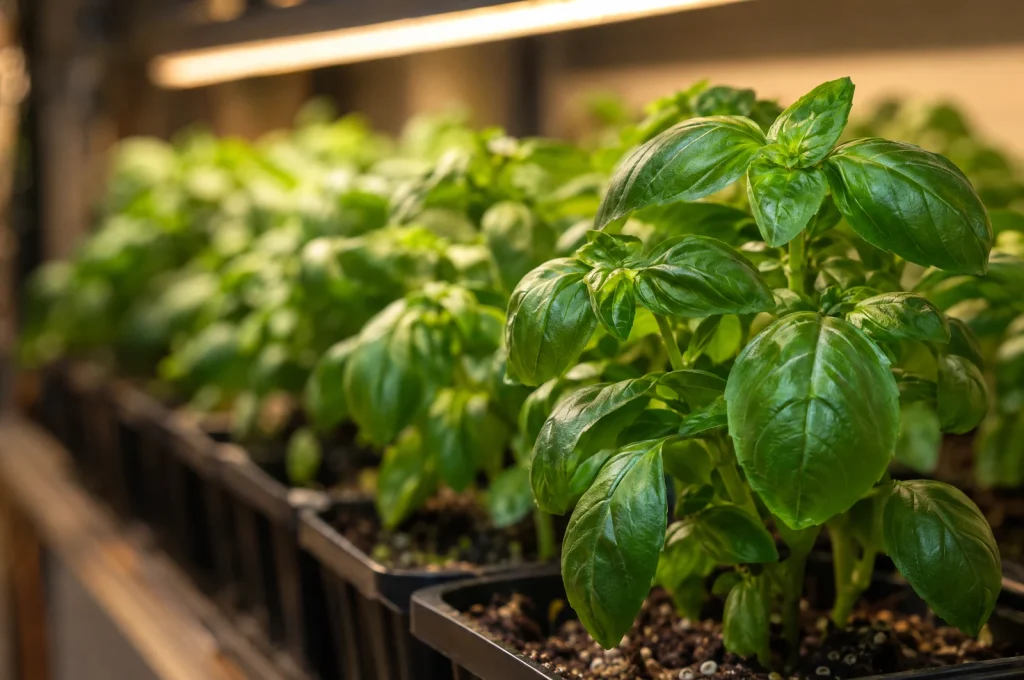
Basil is the closest test to a home system and it came back empty. Ly and Zheng, in Plants in 2026, ran four trials with potassium silicate or monosilicic acid at zero, 50, 100, 150 and 200 milligrams of silicon per litre, through either routine root zone fertigation or a weekly foliar spray. There were no significant improvements in growth at harvest, and none in shelf life in cold storage at 39F (4C). Their own candid suggestion is that drought stress may have hardened the untreated plants against chilling without any silicon at all, which is this article arriving from an unexpected direction.
A second basil paper the same year went the other way. Awan, Gaffney and Walsh drenched glasshouse basil with two commercial silicon products and improved most of what they measured, with the low rates clearly best and the highest rate reducing leaf size. They call some of their own results paradoxical. The two papers disagree about the headline and agree about the dose, and the top of the range is where the harm is, as our page on growing basil finds for every other lever.
The pattern is the answer, and it is deflating
Line the findings up and the conditions name themselves. Salinity, drought, heat and metal toxicity. Every result above sits in one of those four boxes, from the 100 millimolar sodium chloride in the lettuce chamber to the irrigation withheld in the other lettuce trial, and a 2026 paper in Biometals fills the last one by finding silicon helping lettuce in soil carrying too much aluminium.
A reservoir is a machine for removing that list. The plant is never short of water, which is the first thing anyone notices about the method. Salinity is a number you chose, and our PPM and EC chart says where to keep it. Aluminium toxicity belongs to acid soil. The element soil hands over free turns out to be the element whose benefits a working system has already made unnecessary.
The exceptions are real and they are specific. A room that runs hot through summer. A cucumber under genuine mildew pressure in a cool house, with the Florida yield line read first. A reservoir you have let get warm, which the root rot page would much rather you fixed at the cause. And hard tap water, where our page on tap water matters more than any additive.
If you are going to add it anyway
Bruce Bugbee’s Crop Physiology Laboratory at Utah State University took the practical problem to the American Society for Horticultural Science in 2021. Fatzinger and Bugbee open with both halves of it. Consistent delivery of up to 1 millimolar silicon to the root zone is beneficial for plant health, and the maximum solubility of silicon is only 1.7 millimolar between pH 4 and 8. There is almost no headroom, so a strong concentrate at a normal pH is not available. Their answer was a tank held at pH 11, where turbidity reached zero, diluted one part in fifty at every watering to deliver 0.3 millimolar silicon.
Two findings from that work matter in a kitchen. The order is not negotiable, because raising the pH after adding the silicon did not dissolve it. And the calcium in tap water promoted precipitation at every pH they tested, which is why they moved to reverse osmosis water. Anyone who has read our page on whether nutrients go off will recognise that. Same white sludge, same route.
What goes into your tank is therefore a strongly alkaline liquid, so read the pH after dosing rather than before, the way our guide to pH management asks you to with everything else. The potassium that rides along with potassium silicate is a rounding error against what a lettuce solution already carries. The pH is not.
And keep the dose small. The figure a research laboratory settled on is 0.3 millimolar, at the bottom of the range soil supplies rather than above it. Both dose series here punished the top end, and our tipburn page already asks you not to stack extra elements onto a complete feed. If you want the money to do something measurable, our budget gear list is the better place to put it.
Where this comes from
The soil solution figures, the accumulation range, the exclusion of silicon from standard nutrient solutions and the experimental artifacts remark are from Emanuel Epstein, The anomaly of silicon in plant biology, Proceedings of the National Academy of Sciences, 1994. The transporter rates are Mitani and Ma, Journal of Experimental Botany, 2005, and the missing second step in tomato is Sun and colleagues, Plant, Cell and Environment, 2020. The cell wall account is Ma and Yamaji, Trends in Plant Science, 2006, and the challenge to it is Coskun and colleagues, The controversies of silicon’s role in plant biology, New Phytologist, 2019. The cucumber trial is Schuerger and Hammer, Plant Disease, 2003. The lettuce work is Simko, Zhao and Peng, Plants, 2025, and Villa e Vila and colleagues, Plants, 2024, and the basil trials are Ly and Zheng and, separately, Awan, Gaffney and Walsh, both in Plants in 2026. The solubility findings are Fatzinger and Bugbee, American Society for Horticultural Science, 2021. Several of these are stress trials in soil or a growth chamber, and the paragraphs above say so rather than carrying their conditions into a reservoir.
Found this useful? Tell Google to show you more of it.
Add to Preferred Sources