Why Indoor Tomatoes Set No Fruit
Our page on growing tomatoes and peppers says that indoors nothing shakes the pollen loose, so flowers drop without setting fruit, and that this is the single most common reason indoor tomatoes produce nothing. Our nutrient troubleshooting page gives the same instruction in a line. Both are right. What neither says is that the ten second job they hand you is a shortened version of something the greenhouse industry spent thirty years perfecting, abandoned, and in one country has recently gone back to. The measurements from that history tell you what your flicking is worth.
A tomato flower keeps its pollen inside
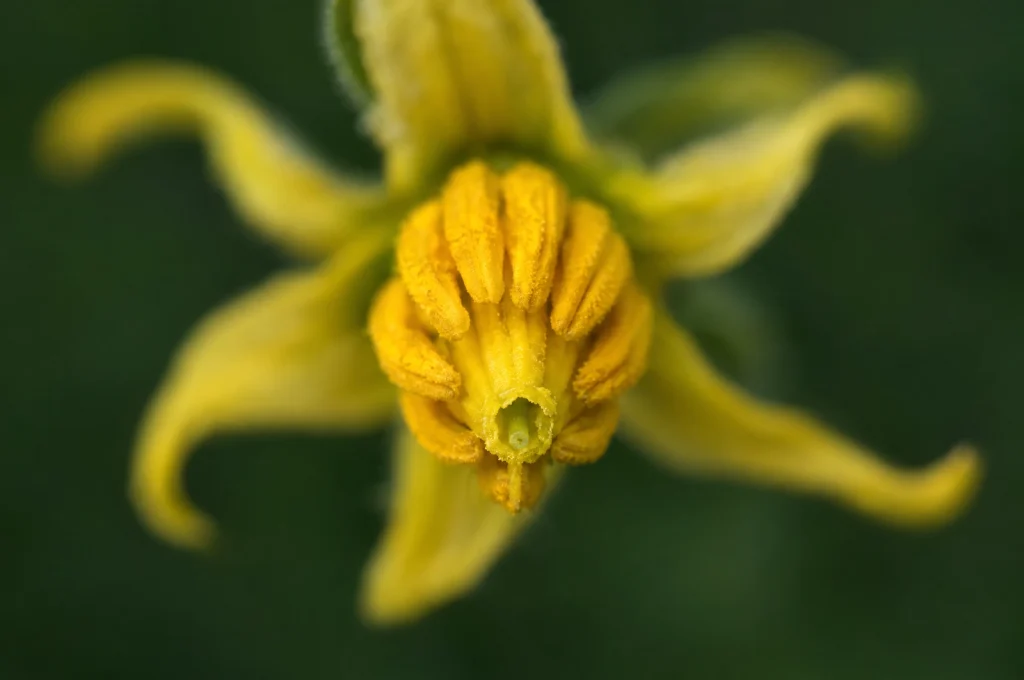
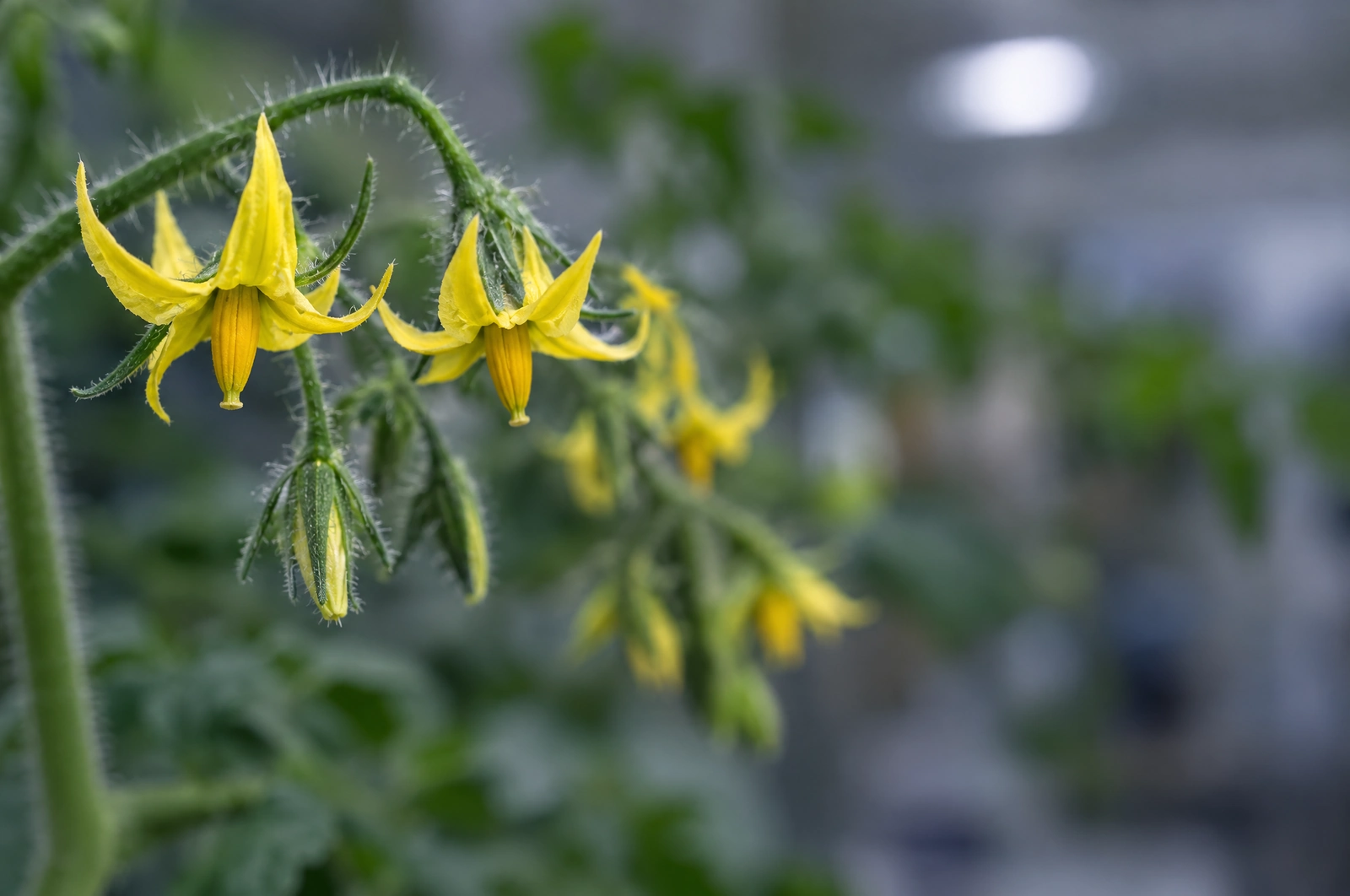
Most flowers present their pollen on open anthers, where a breeze or a passing insect can take it. A tomato does not. Its anthers are fused into a short cone around the centre of the flower, and the pollen sits inside that cone with only a small pore or slit at the tip to leave by. The botanical term is poricidal anther dehiscence, and it means pollen does not fall out. It has to be shaken out.
The animals that do this properly are bees that vibrate. More than fifty genera grip a flower, disconnect their wings and contract their flight muscles against the anther, and the pollen comes out of the pore in a cloud. The behaviour is called buzz pollination, and tomato is one of the textbook examples of a crop that needs it.
Two things save the home grower here. A tomato flower is self fertile, so the pollen only has to travel a few millimetres onto its own stigma rather than to another plant. And the cone is a mechanical system, which means anything that shakes it hard enough will do some of the job. That is the whole basis of flicking a truss with a finger.
What doing nothing actually gets you
A 2004 trial in two greenhouses in subtropical Mexico ran the comparison properly. Three areas, three treatments: a colony of stingless bees, mechanical vibration applied to the trusses, and no pollination at all. Fruit set was counted for each.
| Pollination | Fruit set |
|---|---|
| Stingless bees | 83 percent |
| Vibration | 79 percent |
| Nothing at all | 53 percent |
Percentage of flowers setting fruit in a greenhouse trial in Mexico. Doing nothing is a long way from zero, and the vibrator is close to the bees on this measure.
Both pollinated treatments beat doing nothing significantly, and the gap between them is not the interesting part. The bottom row is. More than half the flowers set fruit with no intervention at all, because a greenhouse is not perfectly still and a self fertile flower does not need much. Anyone telling you an unpollinated indoor tomato produces nothing is overstating it.
Which raises the question. If fifty three becomes seventy nine for the price of touching each truss, why did an entire industry change its mind about this?
Fruit set is the wrong number to chase
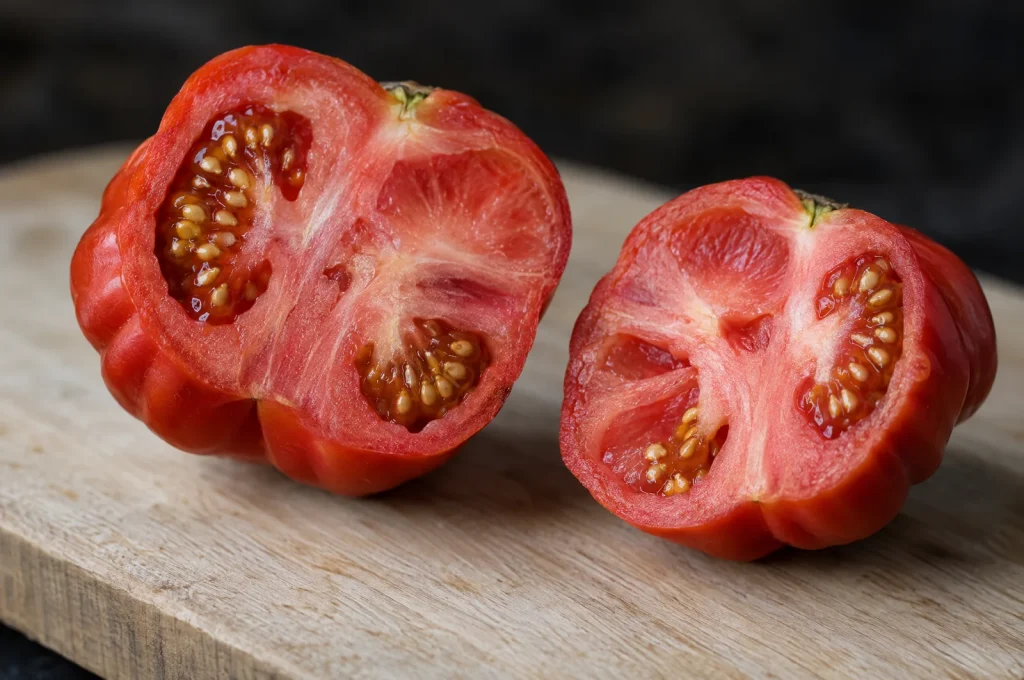
Because a tomato that sets is not the same thing as a tomato worth eating, and the difference is seeds.
A fruit swells in proportion to how many of its ovules were fertilised, and it swells unevenly if they were fertilised unevenly. Too little pollen and you get a small fruit. Pollen on one side of the flower and not the other and you get a lopsided one, ribbed and flat faced where the seeds are missing.
Our article on growing hydroponic strawberries already works this through for a different fruit, where every one of the tiny seeds on the outside needs pollinating and missing some gives you a berry with a flat side. The tomato version is the same mechanism with the seeds on the inside, which is why you cannot see the problem until you cut one open.
A 2008 study put numbers on it. Working in greenhouses of about a thousand plants, a group compared a colony of the bumblebee Bombus impatiens against a colony of stingless bees against mechanical vibration. On fruit set the bumblebees came out ahead and the stingless bees performed about the same as the vibrator. On fruit weight and seed number the order was different and the gaps were significant: bumblebees first, stingless bees second, mechanical vibration last.
So the vibrator is good at making fruit appear and worst of the three at making it big. That is the trade a home grower is actually making, and it is not the one the ten second instruction implies.
The industry did this before you, twice
Before bumblebees, commercial tomato growing ran on exactly the methods a beginner invents. The published history of the British crop describes growers spraying plants with water or hitting the crop wires with a stout stick, and says the most effective method required each flowering truss to be touched with an electric vibrating wand.
It worked, and it was miserable. The same account calls the wand extremely labour intensive and notes that it could damage existing fruit. All the physical techniques, it says, were imperfect because it was difficult to time the activity to coincide with the optimum condition of the flowers. The result was many growers achieving less than eighty percent of the crop’s potential, and set fruit commonly misshapen due to uneven seed development, which cost them money at grading.
Bumblebee pollination was pioneered in Belgium in the mid 1980s, reached Britain in 1989, and by 1992 was being used on virtually all long season tomato crops in the country. An entire manual operation disappeared in about half a decade.
Then it partly came back. Permission to use non native bumblebees in unscreened British glasshouses was withdrawn at the end of 2014. The native subspecies that replaced them proved less reliable and higher maintenance, and in a grower survey eighty percent of respondents were less than happy with them and rated their performance at sixty percent of the non native bees. Several growers reverted to the labour intensive manual methods that had not been used since bumblebees arrived.
So you are not doing a crude imitation of what professionals do. You are doing what some professionals went back to doing. Outdoors the wind and the insects handle it, which our comparison of hydroponics against soil would file under the jobs you quietly took over.
There is no magic frequency
Search for this and you will be told that a bee buzzes at a particular number of hertz and that your device should match it. The research says otherwise, and it was tested directly on tomato.
A 2020 study played artificial vibrations across a wide range of frequencies and amplitudes into tomato flowers and measured the pollen released, then recorded the natural buzzes of bees visiting the same plants. Frequency did affect release, but no optimal frequency existed. The recorded bees varied by genus, did not tune themselves to any value, and their frequency did not track their body size. Neither the bees nor the plants, the authors conclude, are tuned to an optimum.
What does matter, and is well described, is amplitude and duration. How hard, and how long. So the useful instruction is not to find the right note. It is to give each truss a firm, brief burst rather than a long gentle hum, and to touch the stem behind the flowers rather than the flowers themselves, which is where a bee’s vibration is transmitted from.
If you do it and still get nothing, look at the heat
There is a failure that looks exactly like a pollination failure and is not, and it is the one most likely to be happening in a warm room.
Tomato cultivars able to set viable fruit when night temperature stays above 70F (21C) are specifically classed as heat tolerant, which tells you where the line sits for everything else. An ordinary variety in a heated room that does not cool at night is already working against itself before anyone touches a flower.
The timing is the part that catches people. A 2002 experiment moved tomato plants between a mild regime and a warmer one of 90F by day and 79F by night, and found that under the warmer regime fruit set was prevented entirely unless the plants got more than five days of relief before the flower opened. The same heat applied immediately after the flower opened did not significantly reduce fruit set. The damage is done to the pollen while the bud is still closed.
Which means that by the time you are standing there flicking an open flower, the outcome was decided about a week earlier. Our winter article recommends a small fan for three other reasons and this is a fourth, because moving air both shakes trusses and takes heat off a canopy sitting under a lamp.
What to do with a plant in a bucket
Pollinate, because fifty three percent to seventy nine percent is a real difference and it costs nothing. Touch the stem behind each open truss with a finger or an electric toothbrush, briefly and firmly, around the middle of the day, every day or every other day while anything is in flower. That is the same instruction our beginners guide gives, with a reason attached to it now.
Run a fan on the plant. It is the only thing here that works while you are out, and the only one that addresses the heat as well as the shaking.
Let the room drop at night if you possibly can. The published threshold is a night figure, so an unheated room in a cool month is doing you a favour rather than a disservice.
And expect some ugly fruit, because the measurements say you should. A lopsided tomato off a hand pollinated plant is not a nutrient problem and there is nothing to correct. If it bothers you, pollinate more often rather than harder.
Two things to rule out first, because neither is pollination. A plant that is enormous and leafy with almost nothing on it has a feeding problem, and the switch away from high nitrogen at flowering is on the tomato page with the strengths in our PPM and EC chart. Fruit that sets and then goes black and sunken at the base is blossom end rot, which our article on lettuce tipburn shows is the same calcium delivery disorder under another name.
The system matters less than any of this, with one exception. A tomato belongs in a bucket of its own, built to the deep water culture plan or run on drip, and it does not belong in a nutrient film channel, for reasons of root mat and top heaviness rather than anything to do with flowers. None of which makes it a first project, and our beginner crop rankings are honest about where it sits.
Where this comes from
The three way comparison of stingless bees, mechanical vibration and no pollination is Cauich and colleagues, Behavior and pollination efficiency of Nannotrigona perilampoides on greenhouse tomatoes in subtropical Mexico, Journal of Economic Entomology, 2004. The fruit weight and seed number results are Palma and colleagues, Production of greenhouse tomatoes using Nannotrigona perilampoides, Bombus impatiens and mechanical vibration, Journal of Applied Entomology, 2008. The frequency work is Rosi-Denadai and colleagues, Buzz-pollination in Neotropical bees, genus-dependent frequencies and lack of optimal frequency for pollen release, Insect Science, 2020. The account of wands, sticks, the Belgian origin, the 1992 figure and the 2015 reversal is Dr Rob Jacobson’s history of biological pollination in UK tomato crops, published by the Agriculture and Horticulture Development Board. The night temperature classification is from an overview of heat stress in tomato in the Saudi Journal of Biological Sciences, 2021, and the pre-anthesis timing result from Determining critical pre- and post-anthesis periods in Lycopersicon esculentum exposed to moderately elevated temperatures, Journal of Experimental Botany, 2002.
Found this useful? Tell Google to show you more of it.
Add to Preferred Sources