Do You Need CO2 Indoors, and When the Air Runs Short
Your plant is built mostly out of air. Our page on what hydroponics is lists carbon dioxide among the handful of things a plant actually needs, and then the subject disappears from this site entirely apart from two entries telling you not to buy a CO2 kit. Those entries are right and nothing here is going to contradict them. But there is a version of this question that involves buying nothing at all, and in a genuinely closed space it is a real limit with a larger number attached than almost anybody expects.
The one ingredient you do not supply
Everything else on the list is something you hand the plant deliberately.
You mix the nutrients. You choose the light and pay for the hours. You fill the reservoir and top it up. Carbon dioxide is the exception. It arrives on its own or it does not arrive, there is no bottle of it in the cupboard, and because it is invisible and free it never enters the list of things anybody checks when a plant is growing more slowly than it should.
That is fine almost everywhere, which is why this article ends up being mostly reassurance. It stops being fine in exactly one situation, and that situation is becoming more common as people move systems into tents and cupboards.
What a closed space does to it
Greenhouse growers have measured this properly, because for them it is a yield question with money attached.
Oklahoma State Extension sets the baseline. The ambient level of about 400 parts per million can occur in a properly vented greenhouse, but in a sealed one the concentration is much lower than ambient during the day and much higher at night, the night rise coming from plant respiration and microbial activity. During daylight hours in a sealed house they give the figure as dropping to 150 to 200 parts per million.
Ontario’s agriculture ministry puts it in a single sentence that is worth reading twice. Any actively growing crop in a tightly clad greenhouse with little or no ventilation can readily reduce the carbon dioxide level during the day, down to around two hundred.
| Space | Daytime CO2 |
|---|---|
| Outside | About 400 ppm |
| Vented greenhouse | Near ambient |
| Sealed greenhouse | 150 to 200 ppm |
Daytime figures from the Oklahoma State and Ontario guidance. The level in a sealed space reverses at night, when respiration pushes it the other way.
The crop does this to itself. Nothing has gone wrong, no equipment has failed, and the better the plants are growing the faster they draw the number down. That is the part that makes it hard to spot: the symptom of a healthy crop in a sealed box is a crop that slows down.
Why two hundred is a bigger number than it looks
A drop from four hundred to two hundred sounds like a modest shortfall of something there is plenty of. The Ontario guidance frames it in a way that makes the size of it obvious.
The decrease in photosynthesis when the level drops from 340 parts per million to 200 is similar in size to the increase you get by raising it from 340 up to around 1,300. In other words the loss from letting a space go stale is comparable to the entire gain commercial growers chase when they pipe in bottled gas. The same source notes that a drop below ambient has a stronger effect than supplementation above ambient does.
Not going short is worth more than topping up, and not going short is free. That is the whole argument of this article, and it is the reason the subject deserves a page even on a site that tells you to ignore CO2 equipment.
Oklahoma State adds the detail that makes it worth acting on rather than filing away. Exposure of plants to lower levels even for a short period can reduce the rate of photosynthesis and growth. This is not a condition that has to persist for weeks before it costs you anything.
Ventilation helps, and does not fully fix it
The obvious response is to open something, and that is the right response, but the guidance is honest about its limits in a way worth repeating.
Ventilation during the day raises the level closer to ambient, Ontario says, but never back to ambient. A space with a crop in it that is actively consuming carbon dioxide will always sit somewhere below the air outside, because the plants are removing it faster than a vent can replace it.
For a commercial grower that gap is the entire justification for supplementation. For somebody with four lettuces in a cupboard it is close to irrelevant, because the gap scales with how much crop is drawing on how little air, and at household scale that ratio is tiny. The point of quoting it is not to alarm you. It is that the fix is directional rather than absolute, so more air exchange is always a little better and there is no threshold beyond which you have solved it.
Whether any of this is you
Now the reassurance, because for most readers of this site the honest answer is that it is not.
A kitchen is not a tightly clad greenhouse. Doors open, people come and go, and crucially people are themselves a source of the gas. ASHRAE’s position document on indoor carbon dioxide rests on exactly that: the difference between indoor and outdoor concentrations is what gets used to evaluate how much outdoor air a building is getting, because the occupants are producing it indoors. A room with somebody in it tends to sit above outdoor air rather than below it, which is the opposite of the greenhouse problem.
So the short list of situations where it is worth a thought:
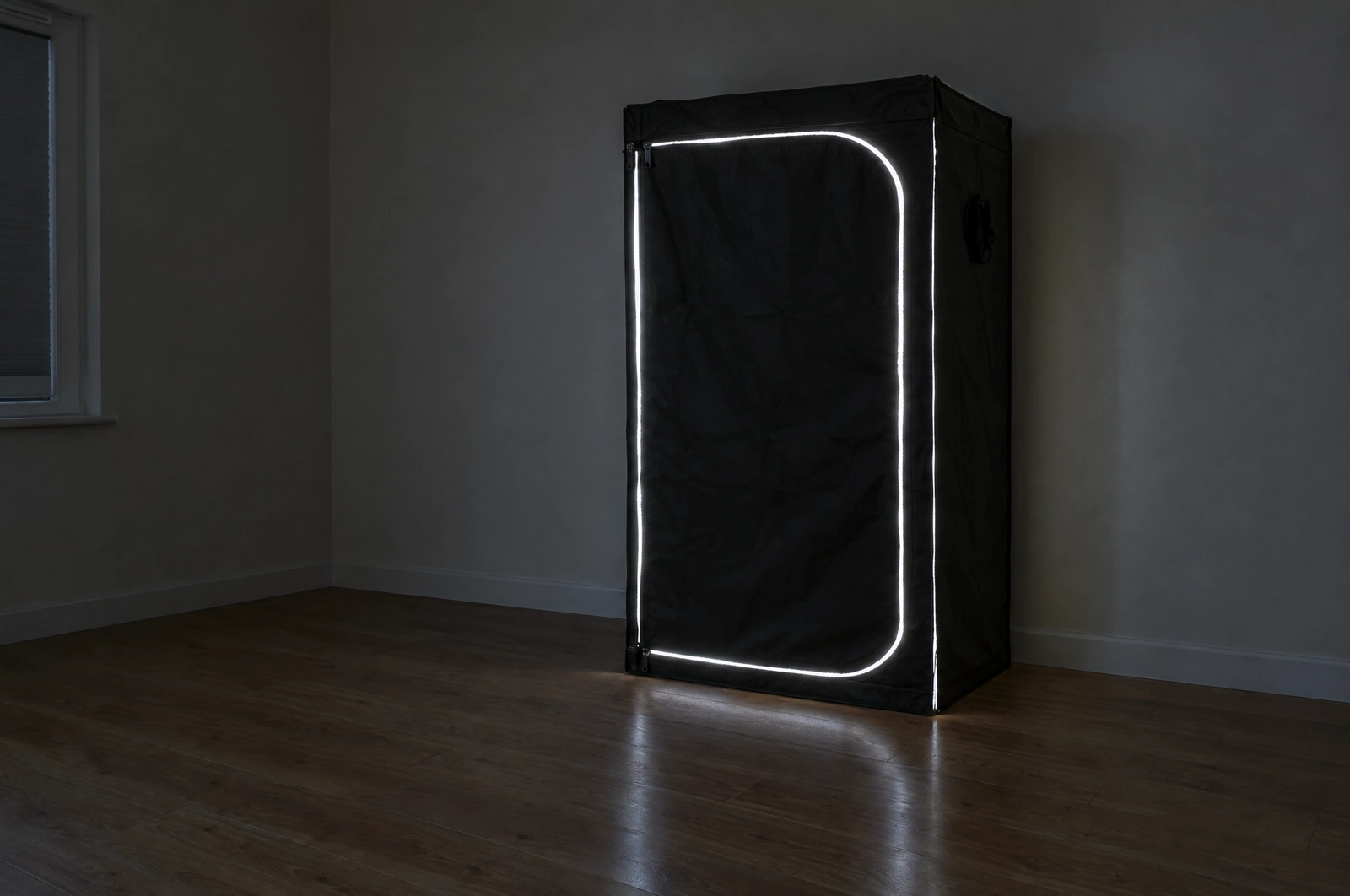
- A zipped grow tent with no extraction running, which is the closest thing in a house to a tightly clad greenhouse.
- A cupboard or wardrobe with the door shut while the light is on, which is the same thing with worse air exchange.
- A spare room nobody enters, where the door stays closed all day and nobody is breathing in it.
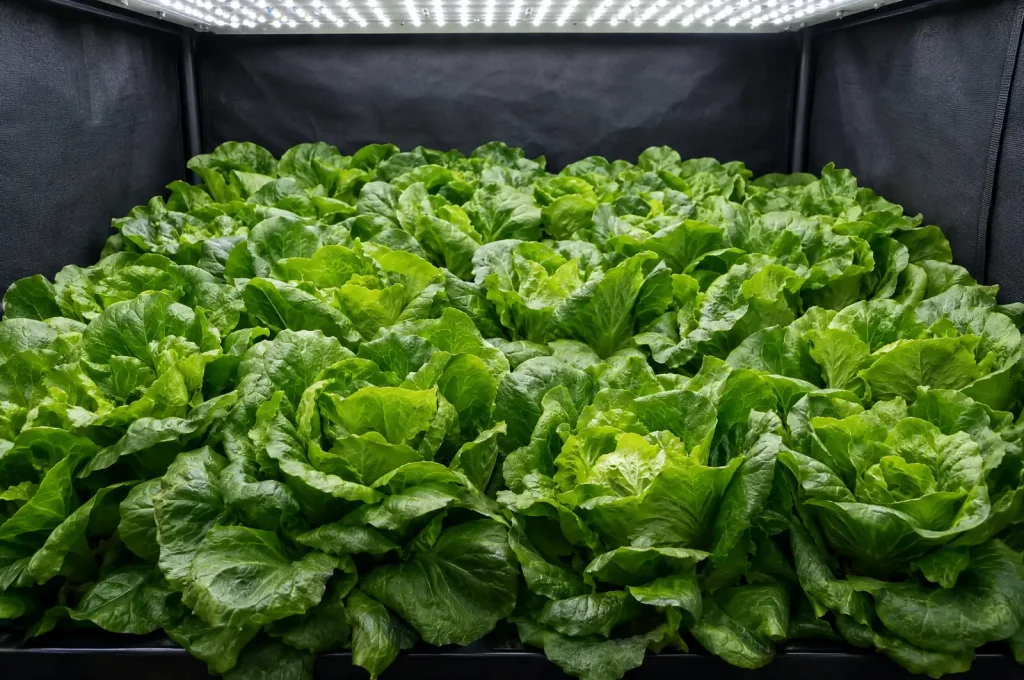
- A dense canopy relative to the air volume. Four plants in a kitchen is nothing. A full tray under a strong light in a sealed box is a different ratio entirely.
And one thing that narrows it further. This is a lights on problem only. In the dark the plants respire and the number goes back up, which is why Oklahoma State describes sealed greenhouses as running higher than ambient at night. You are not fighting it around the clock.
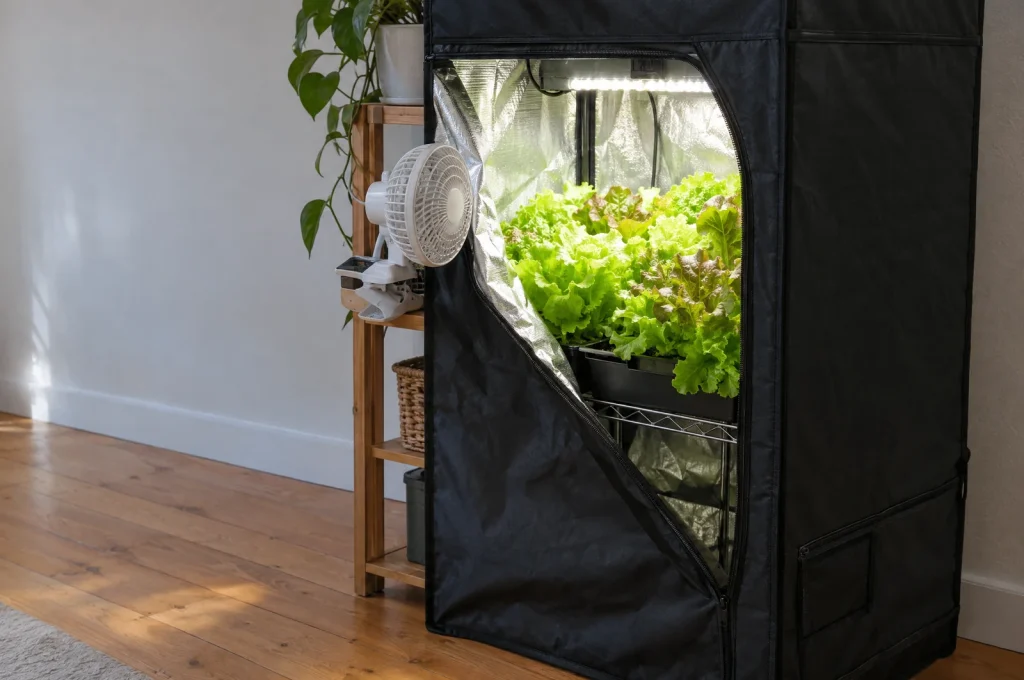
The fix is a gap, and it pays three times
If you are in one of those four situations, the entire remedy is to stop the space being sealed while the light is on. Unzip a corner of the tent. Leave the cupboard door ajar. Open the window of the spare room for part of the day, or put the small fan you probably already own where it moves air between the growing space and the rest of the house.
That last one is worth doing regardless, because it is the same fan this site recommends for two entirely different problems. The winter article wants it because a sealed room plus an open reservoir puts moisture on the coldest surface available, and the articles on tipburn and basil want it because still humid air between crowded leaves is what downy mildew needs.
One habit, three problems, no purchase. If you take nothing else from this page, take that moving air is doing more jobs than you were crediting it with.
Why the kit is still the wrong purchase
Having spent an article on why carbon dioxide matters, here is why we are not about to recommend buying any.
Our equipment checklist and the budget gear list both put CO2 equipment in the category of things that only matter in a sealed, high intensity grow room, and that remains true. The enrichment figures quoted by Oklahoma State come with a condition attached, which is that every other input is already at an optimum. That is the condition a commercial greenhouse satisfies and a windowsill does not.
The specific reason it is the wrong purchase for most readers here is light. The daily light integral numbers on this site show indoor growing running at a fraction of what a lettuce wants for a good part of the year. A plant short of light cannot use extra carbon dioxide, so buying gas to feed a crop that is already waiting on photons is paying to lift a ceiling you are nowhere near. Fix the light first, open a gap for free, and leave the cylinder to people running rooms where light stopped being the limit a long time ago.
Where this comes from
The sealed greenhouse figures, the ambient baseline of about 400 parts per million in a properly vented house, the night time reversal from respiration and the note that even short exposure to low levels reduces photosynthesis are from “Greenhouse Carbon Dioxide Supplementation”, Oklahoma Cooperative Extension Service fact sheet HLA-6723 by Bruce Dunn and Megha Poudel, published in September 2023.
The sentence about an actively growing crop in a tightly clad greenhouse, the comparison between losing ground from 340 down to 200 and gaining it from 340 up to 1,300, the statement that a drop below ambient outweighs supplementation above it, and the limit on what ventilation recovers are from “Supplemental carbon dioxide in greenhouses”, published by the Ontario Ministry of Agriculture, Food and Agribusiness. One thing to note when reading it: that page uses 340 parts per million as ambient, which was roughly correct when the figure was first written and is now low, since outside air has since risen past 400. A higher starting point makes the depletion story slightly less severe rather than more, so the direction of the correction is in your favour.
The point about occupied rooms is from the ASHRAE Position Document on Indoor Carbon Dioxide, approved in February 2025, which sets out that the difference between indoor and outdoor concentrations is used to evaluate outdoor air ventilation rates. We have used it only for that, which is that people in a room are a source of the gas rather than a drain on it. It is a document about building ventilation and human health, not about plants, and it says nothing whatever about growing lettuce.
Found this useful? Tell Google to show you more of it.
Add to Preferred Sources