Do Hydroponic Nutrients Go Off, and What the Crystals Mean
There is a bottle of nutrient in the cupboard that you opened last spring, and you are about to mix a reservoir with it. Something has settled in the bottom. Nobody prints a useful date on these, the forums will tell you anything from six months to forever, and the honest answer is that a mineral concentrate does not spoil the way food does. It fails in three specific physical ways instead, all three visible if you know what you are looking at, and only one of them beyond saving.
It does not rot, because there is nothing in it to rot
A synthetic hydroponic concentrate is mineral salts dissolved in water. There is no sugar in it, no protein, and nothing a microbe would consider food. Salts do not decompose while sitting on a shelf, and the seventeen elements that were in the bottle when you bought it are still in the bottle a year later.
So expiry is the wrong frame. The question worth asking is narrower: is everything that was dissolved still dissolved, and is it still in a form the plant can take up. Those can stop being true without a single element leaving the bottle, in three ways. The concentrate got cold and the salts came out of solution. Two things inside it reacted and formed a solid. Or light broke down the molecule holding the iron.
One exception before the rest of this applies. Organic and part organic products contain material that can ferment, and they do have a real shelf life in the way mineral salts do not. If yours smells of anything when new, treat it as perishable.
Crystals in the bottom are usually cold damage
Every liquid fertiliser has a temperature at which the salts dissolved in it start to crystallise and drop out. The trade calls it salting out. It is not one number for all products, because it depends on what is dissolved and how much of it there is, which is why there is published horticultural work on the crystallisation temperature of liquid fertilisers at all.
The important part for a home grower is that this temperature is not the freezing point of water. For some agricultural liquids it sits comfortably above it. Ammonium thiosulfate, a common sulfur source, carries a recommended minimum storage temperature of 46F (8C) on the manufacturer’s own data sheet. A bottle does not need to freeze to be damaged by cold.
It is worse than a simple threshold. These solutions supercool, so they sit below the temperature at which they should crystallise with nothing happening, then form crystals slowly over weeks at a few degrees above the figure anyone quotes. The bottle does not have to have frozen, and it does not have to have been very cold for very long.
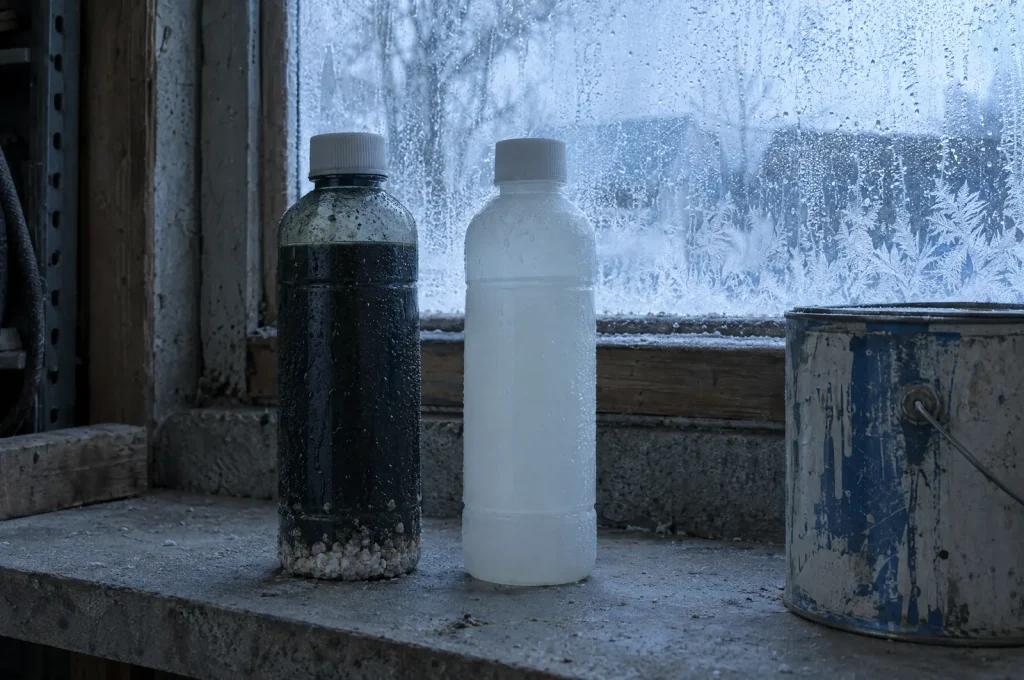
Which comes down to one rule. The unheated garage, the shed and the back porch are where bottles die over winter, and they die quietly, at the bottom of an opaque bottle in a cold room nobody goes into. Everything in the article on growing through winter is about keeping the system warm enough. The concentrate needs the same courtesy.
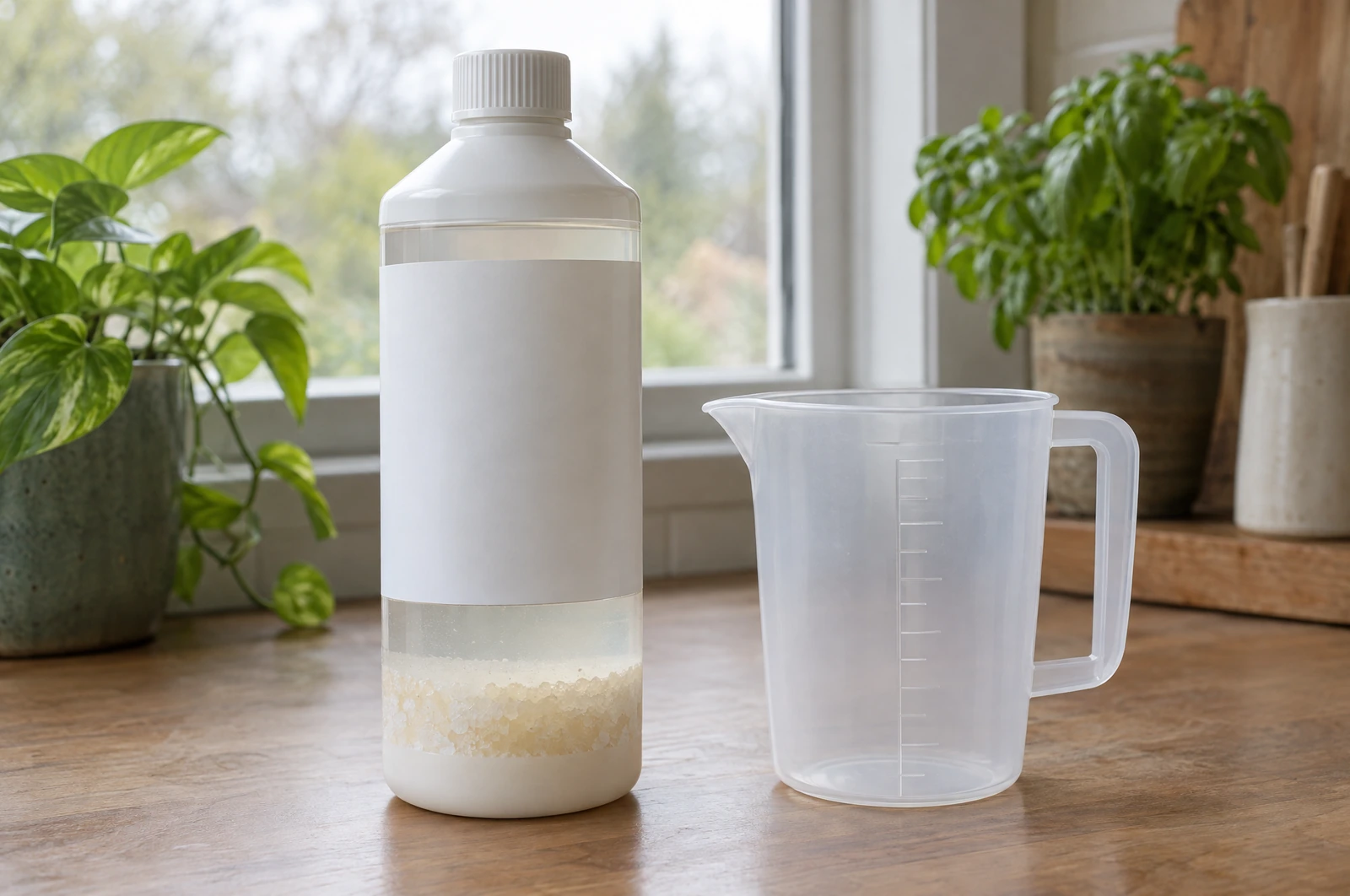
The good news is that cold damage is often completely reversible, because nothing has reacted. Bring the bottle indoors, give it a day or two at room temperature rather than an hour, and then shake it properly. If the liquid clears and the bottom is clean, you have lost nothing at all. Everything was still in there the whole time, just not in solution.
A cloudy bottle that will not clear is a different problem
If warming and shaking does not clear it, stop. What you are looking at is probably a chemical reaction rather than a physical one, and those do not reverse.
Calcium is the awkward element in every nutrient recipe. The University of Arizona’s controlled environment agriculture chapter on fertigation puts the rule plainly: calcium compounds are kept apart from the phosphate and sulfate compounds because, above roughly fifty times working strength, calcium combines with them to form insoluble precipitates. Commercial growers answer this by running two or three separate stock tanks.
That is the entire reason your nutrient arrives as two bottles. Part A and part B are not a marketing decision or a way to sell you more plastic. They are two groups of salts that cannot be stored together at concentration without destroying each other, and which are perfectly happy once diluted into a reservoir.
Once calcium phosphate or calcium sulfate has formed, it is a solid and shaking will not undo it. The calcium is still in the bottle. It is simply no longer available to anything with roots.
The home version of this mistake happens at mixing time rather than in storage. Measuring both parts into the same cup does it, and so does pouring one concentrate into the other before the water goes in. The common mistakes list has it as its own entry for good reason. Each part goes into the full volume of water on its own, with a stir in between.
Light is the failure that does not look like one
Iron cannot simply be dissolved and left. At the pH we grow at it precipitates out on its own, so it is supplied as a chelate: a molecule wrapped around the iron atom, holding it in solution and handing it to the root.
The wrapper is the fragile part and it has two enemies. The first is pH: iron held by EDTA starts losing stability above pH 6.5, and iron held by DTPA above pH 7.0. Both sit inside the range a neglected reservoir drifts into, which is one more argument for reading the pH guide early.
The second is light. Work on nutrient solutions held under lighting found chelate loss, an iron rich precipitate forming and the pH rising, with the rate increasing as the light got brighter and the solution got warmer. Filtering out the blue and ultraviolet wavelengths stopped it. A translucent bottle on a sunny windowsill is losing iron while looking entirely normal.
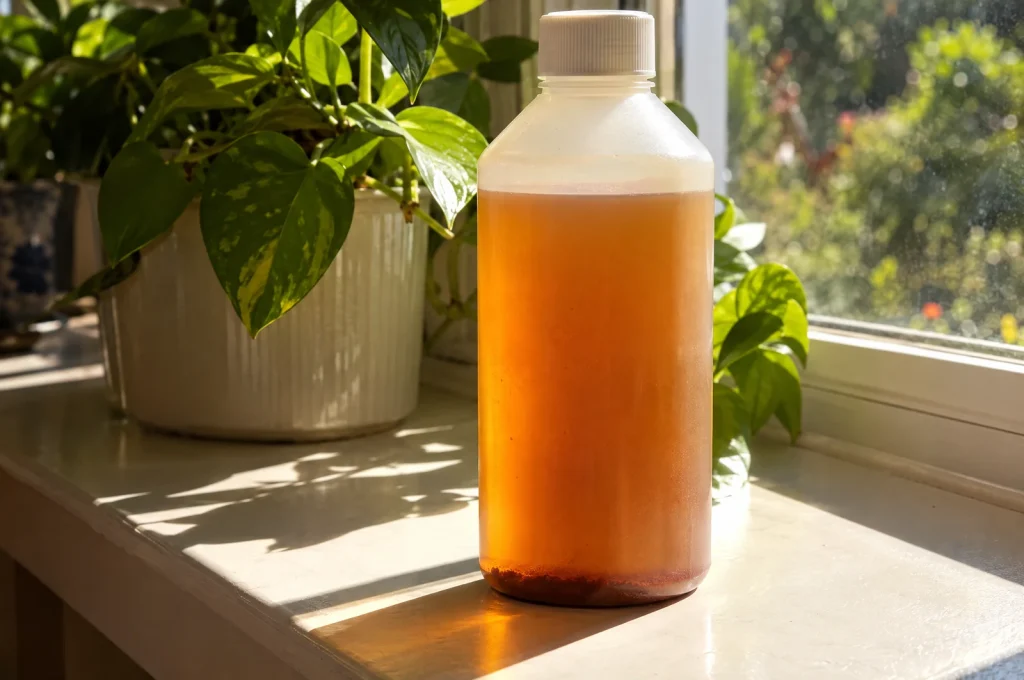
Iron deficiency shows in the newest growth first, as pale young leaves with veins that stay green, and the article on reading deficiency symptoms covers telling it apart from the nitrogen version. It is also a second reason to keep light off the reservoir, which the algae article argues from an entirely different direction. Two unrelated problems, one answer, which is an opaque container.
The easiest way to ruin a bottle is to dip into it
Pour out of the bottle. Never dip into it, and never tip anything back.
A cup that has been in the reservoir carries dilute solution, root debris and whatever is living in your tank, and dipping it introduces all three. Full strength concentrate is hostile to most life, which is why mineral products survive it, but it is exactly how a part organic bottle acquires a smell, a surface film or a slow stream of bubbles. Any of those means something is growing in there and the bottle is finished.
It is the same mistake, in the same handwriting, as dipping a probe into the buffer bottle and quietly ruining the reference everything else is measured against. The fix costs nothing: one dedicated cup or syringe per part, rinsed and dried, that never goes near the tank.
How to test a bottle you are not sure about
Four steps, in order of how much trouble they are.
- Hold it to a light. Clear liquid with nothing on the bottom needs no further investigation.
- Warm it and shake it. A day or two indoors, then shake hard. If it goes clear, the problem was cold and it is solved.
- Smell it. A mineral concentrate smells of almost nothing. Anything sour, yeasty or sulfurous in a product that did not start that way means it has been colonised.
- Measure it. This is the only step that gives you a number rather than an impression.
Affiliate disclosure: some links below are affiliate links. We may earn a commission if you buy through one, at no extra cost to you. As an Amazon Associate I earn from qualifying purchases. Full disclosure.
The measurement is simple. Read the EC of your plain water, mix a known dose into a known volume, and read it again. The rise is what the fertiliser contributed. Compare it against what the same dose gave when the bottle was new, or against our PPM and EC chart. Conductivity measures dissolved salts, so if something has dropped out of solution and is sitting in the bottom of the bottle, the rise comes in short. The reading is worth exactly what the meter is worth, so use a pH and EC meter you have calibrated recently.
Be clear about what the test cannot do. EC is one number for everything dissolved together and cannot say which element went missing. That is the limitation the article on changing the reservoir sets out at length, where a tank held at a perfect EC for three weeks ran a crop into nitrogen deficiency without the meter ever noticing.
| Sign | Cause | Verdict |
|---|---|---|
| Crystals, clear liquid | Cold | Warm and use |
| Cloudy, stays cloudy | Calcium | Do not use |
| Sludge that stays | Cold | Check the EC |
| Rusty tinge | Light | Check the EC |
| Smell or film | Microbes | Do not use |
What the bottle is telling you, and whether it is worth saving.
If the rise is close to expected and the liquid is clear, use it. If it is well short, buy a fresh bottle rather than inventing a correction, because topping up a deficit you cannot identify is guesswork.
Storing it so none of this happens
Indoors, at room temperature, out of the light, sealed, and standing upright. That is the whole of it, and a kitchen cupboard satisfies all five.
| Where | What it risks |
|---|---|
| Kitchen cupboard | Nothing |
| Unheated garage | Crystals |
| Sunny windowsill | Iron |
| Beside a radiator | Heat |
Heat matters because it speeds up the light driven reaction, so bright and warm is the worst pairing.
One thing is worth deciding when you buy rather than when you worry, which is dry against liquid. A liquid concentrate is mostly water, which is what makes it heavy to ship and vulnerable to cold. Dry salts keep far longer in a sealed tub, and their failure mode is clumping as they take up moisture from the air, which is a nuisance rather than a loss. Buy roughly what a season uses, since a commercial sized bottle will still be two thirds full three years from now.
Then write the date you opened it on the bottle in marker. It costs two seconds and it turns next spring’s guess into a fact.
Where this comes from
The rule that calcium is kept apart from phosphates and sulfates, and the fifty times working strength above which they form insoluble precipitates, are from the University of Arizona Controlled Environment Agriculture Center’s chapter on fertigation systems and nutrient solutions. That crystallisation temperature is a property of a particular fertiliser rather than a universal number is the subject of a Florida State Horticultural Society proceedings paper by Obreza, Ontermaa and Boman, in volume 105. The 46F (8C) minimum storage figure is a manufacturer’s data sheet for ammonium thiosulfate, and the supercooling behaviour comes from the patent literature on low crystallisation temperature fertilisers. The chelate limits of pH 6.5 for EDTA and pH 7.0 for DTPA, and the finding that light drives chelate loss with an iron rich precipitate and a rising pH until blue and ultraviolet wavelengths are filtered out, are from peer reviewed work on the fate of chelates in hydroponic media.
Two honest limits on that. The agricultural products those storage temperatures come from are not the two part concentrate on your shelf, so treat the figures as the shape of the problem rather than numbers for your bottle. And the EC test here is reasoning from what a conductivity meter measures rather than a published protocol, which is why it is offered as a way to catch a bottle that has lost something, not a way to certify one that has not.
Found this useful? Tell Google to show you more of it.
Add to Preferred Sources