Calibrating a pH Pen, and the Habit That Quietly Kills Them
Nearly every piece of advice on this site rests on a number you read off a meter. Check pH first, every time, before you change anything else. That is good advice and it is worth exactly as much as the reading is. The trouble with a pH pen is that it does not fail the way a torch fails. It never goes blank. It carries on producing a confident number with a decimal point in it, and a pen that says 6.0 while the reservoir is actually at 5.2 does not look broken at all. It looks like good news, and you act on it.
How a pH pen actually fails
The sensing part of a pH pen is a thin glass bulb with a hydrated layer on its surface. That layer is what responds to the solution, and the whole instrument depends on it staying wet and intact. Inside, a reference cell filled with a strong potassium chloride solution provides the stable voltage that the reading is measured against.
Both of those degrade, slowly, and the result is drift rather than failure. Two numbers describe how far gone a probe is. The offset is where it thinks neutral sits, and the slope is how strongly it responds as the solution changes. A healthy electrode has an offset within about plus or minus 30 millivolts and a slope between 85 and 105 percent of theoretical. Most inexpensive pens never show you either number, which is precisely why the problem is invisible until a crop tells you.
What a wrong reading actually costs
It is worth being concrete about this, because a half point error sounds like nothing and is not.
- Reading high means you are running acidic without knowing. A pen that says 6.0 at a true 5.2 has you sitting below the band where iron and several other elements stay available, and the result arrives a week later as the pale new growth traced in the article on lettuce turning yellow.
- Reading low means you keep correcting a solution that was fine. Every adjustment adds something to a reservoir that did not need it, and the drift that follows is the subject of changing your reservoir.
- It hides which kind of problem you have. A reservoir whose pH will not hold steady is usually a biological problem rather than a chemical one, which is how root rot announces itself before the roots look wrong. You cannot read that signal through an instrument you do not trust.
- It spoils your starting point. Mixing from a dosing calculation assumes you know what the water you started with was doing, and that assumption is a meter reading too.
The habit that quietly kills them
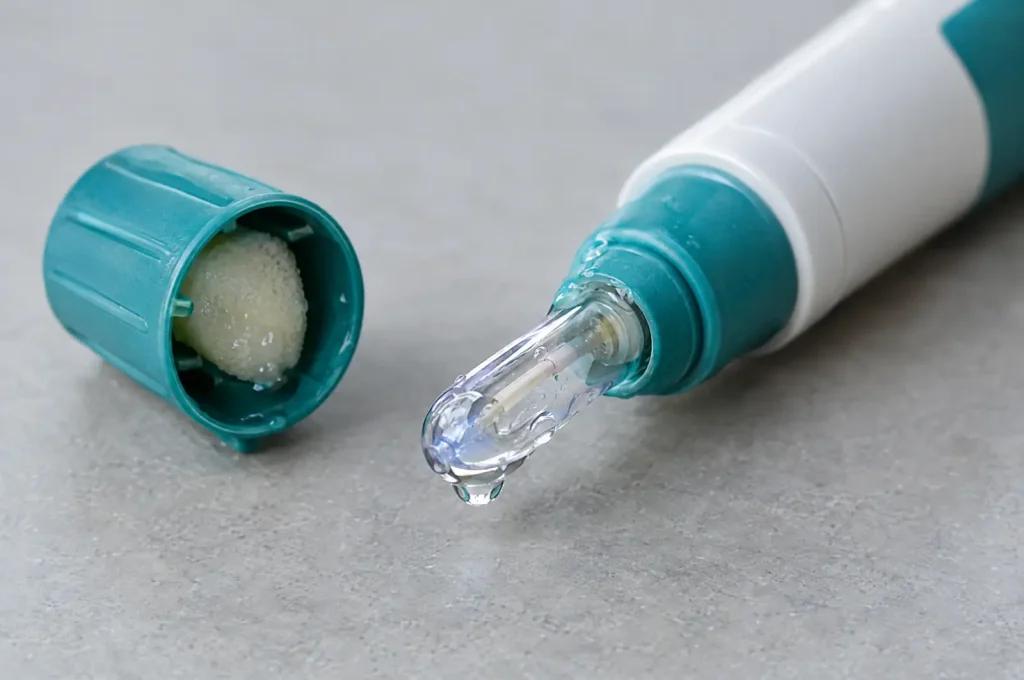
Here is the one worth knowing even if you read nothing else. Distilled or reverse osmosis water is the correct thing to rinse a probe with and close to the worst thing you can store it in. Same bottle, opposite outcome, and nothing on the packaging tells you.
The manufacturer guidance is unusually direct about it. Never store a pH electrode in deionised, distilled, reverse osmosis or pure water. The reason is that the reference cell inside holds a concentrated salt solution, and pure water outside it sets up a gradient across the junction. Water moves inward by osmosis and electrolyte diffuses outward, both of which change the concentration in the reference cell and therefore shift the voltage everything is measured against. On top of that, prolonged storage in pure water breaks down the sensing glass itself and brings forward the day you replace the probe.
| Task | DI water | Storage fluid |
|---|---|---|
| Rinsing | Correct | Wasteful |
| Storing | Ruins it | Correct |
| Reviving | No | Yes |
Distilled, reverse osmosis and deionised water all behave the same way here.
Affiliate disclosure: some links below are affiliate links. We may earn a commission if you buy through one, at no extra cost to you. As an Amazon Associate I earn from qualifying purchases. Full disclosure.
So store the probe in proper storage solution, with the junction covered rather than just the tip wetted. If you have none, pH 4.01 or 7.01 buffer will do, and nothing above 7.01. Never put it away dry.
If yours has already dried out, it is often recoverable. Soak the bulb and the junction in storage solution for at least an hour, and overnight is better. Then calibrate before you trust it, because a probe that has been dry has almost certainly drifted as well.
Two points, and which one goes first
Calibrate against two buffers rather than one. The order is not arbitrary. Do pH 7.01 first, because that is the point that sets the offset, and then the second buffer, which sets the slope.
The buffers should bracket the reading you actually care about. For hydroponics that is settled for you: your target sits somewhere between 5.5 and 6.5, so 4.01 and 7.01 sit either side of it, which is exactly why that pair is the one sold together. If you ever calibrate a meter for something alkaline instead, the correct pair is 7.01 and 10.01.
Let the buffers and the solution come to the same temperature before you start. A pH reading is temperature dependent, and calibrating with a cold bottle straight out of a cupboard against a warm reservoir introduces an error at the very moment you are trying to remove one.
Your buffer is a consumable, and you are probably contaminating it
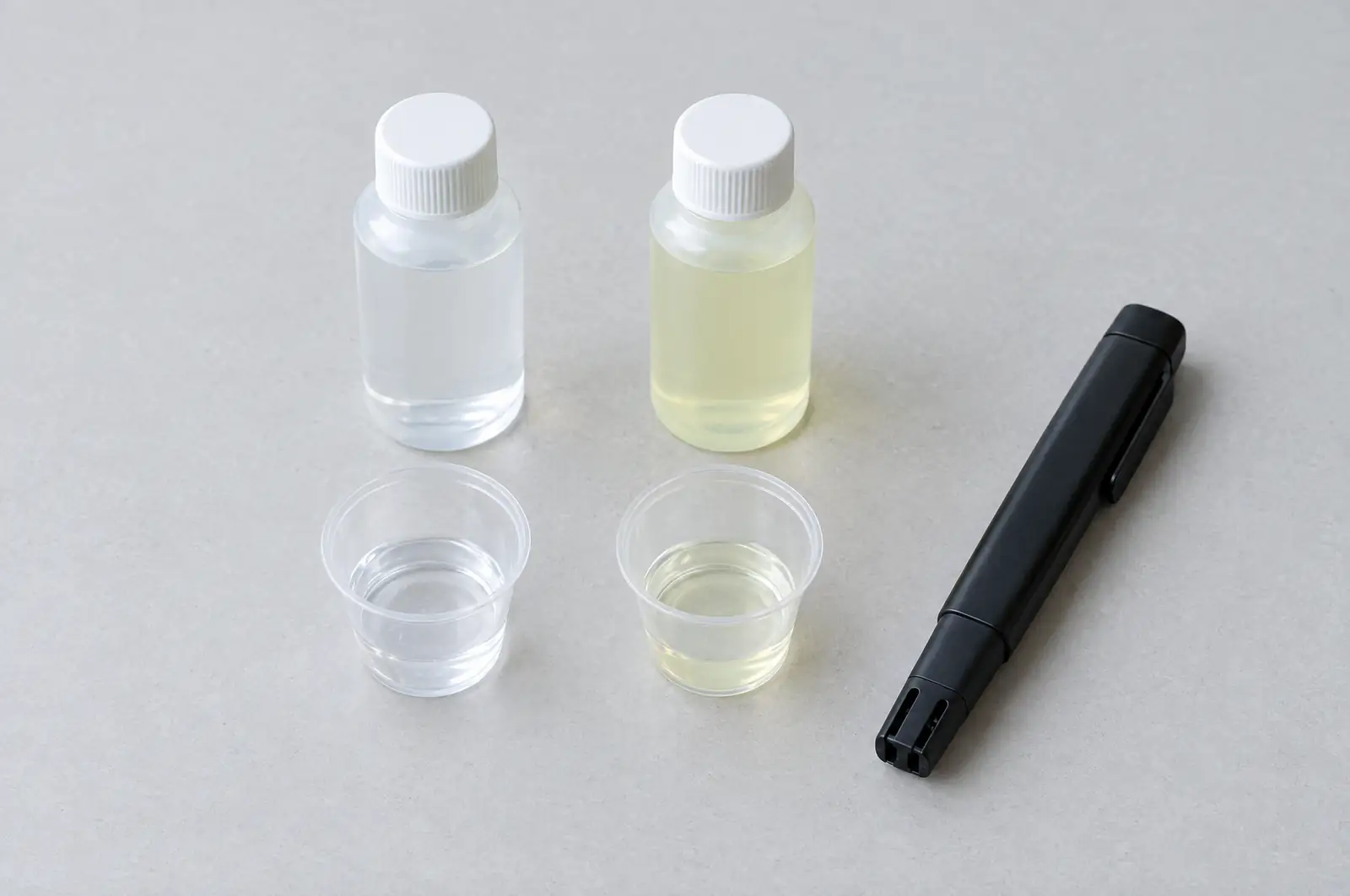
This is the part almost everybody gets wrong, because the obvious thing to do is the damaging one. Do not put the probe into the bottle of buffer, and never pour used buffer back in. A probe that has just been in a nutrient reservoir carries some of it with it, and one dip contaminates the whole bottle for every calibration you do afterwards.
Pour a small amount into a separate container with a lid, use that, and change it often. Buffer also has a shelf life once opened, and the two you are using do not have the same one.
| Buffer | Use within | Why |
|---|---|---|
| pH 4.01 | 3 to 6 months | More stable |
| pH 10.01 | 1 to 3 months | Less stable |
Months from opening the bottle. Alkaline buffers absorb carbon dioxide from the air and drift, so they expire faster.
The pH 7.01 bottle sits between the two and is the one you open most often, so treat it as the shorter life of the pair rather than the longer. A bottle that has been open on a shelf for two years is not a reference any more, and calibrating against it means carefully teaching your meter to be wrong.
Before you blame the meter, clean it
The manufacturer guidance names a dirty or improperly cleaned electrode as the most common cause of inaccurate measurement, ahead of everything else. That is worth sitting with, because it means the most likely fault is not the instrument, the calibration or the buffer, but a film on the glass.
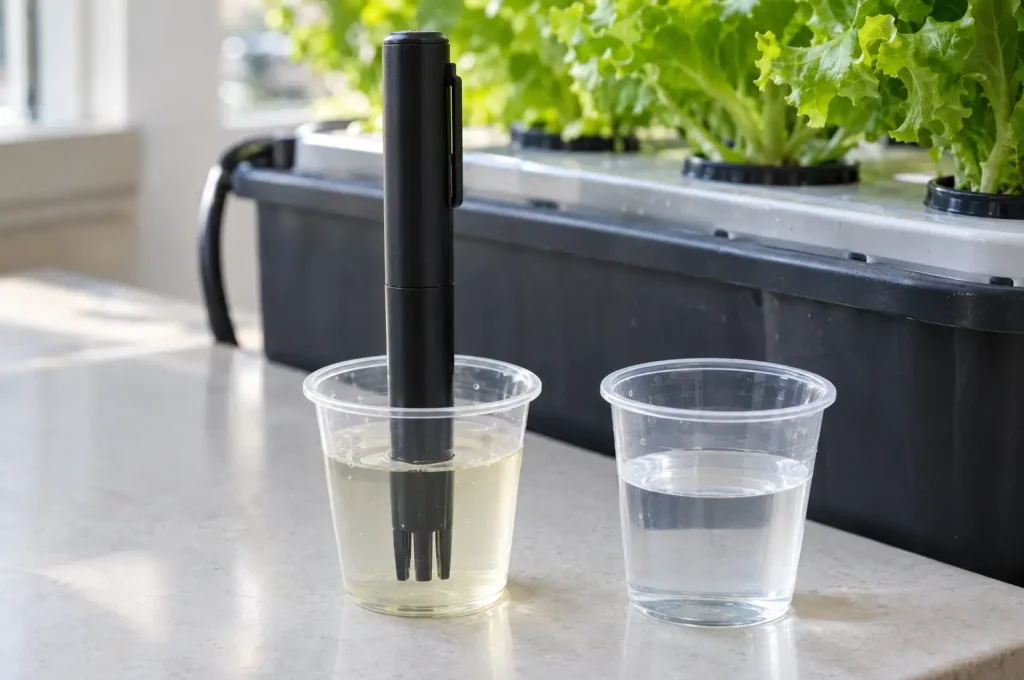
A hydroponic reservoir is a concentrated salt solution with organic material in it, and a probe dipped into one repeatedly without rinsing accumulates deposits on exactly the surface that does the sensing. Rinse before and after every solution, including between the two buffers, and the single commonest cause of a bad reading never happens.
How often, and what to do with no buffers at all
Monthly is the usual rule of thumb and a reasonable default, but there is no universal interval, because it depends on how much work the probe is doing and how it has been kept. A pen used weekly and stored properly holds calibration far longer than one used daily and left in a drawer. Calibrate when you first get it, after any period of neglect, after a dry out, and whenever a reading surprises you. The equipment page puts a digital pen at the point where it is worth owning one, and buffer and storage solution belong on that list beside it rather than as an afterthought.
That last one is the useful trigger, and it needs a reference to work against. You already have one. The article on PPM and EC tells you to measure your tap water before mixing anything, and tap water from the same supply is reasonably consistent from week to week. A tap reading that has moved a long way since last month is far more likely to be the meter than the water.
- Cross check against a liquid drop kit. The pH guide rates those at around plus or minus 0.2, which is poor as a measurement and perfectly good as a second opinion. If the pen and the drops disagree by more than about half a point, stop trusting the pen.
- Check it against a known. A fresh nutrient mix at the label rate lands in a predictable place, so a reading far outside it is suspect. Pure water should not read wildly acidic. A solution you have just adjusted with a known quantity of acid should move in the direction you pushed it.
- Watch for slow response. A probe that used to settle in a few seconds and now wanders for a minute is telling you the junction is clogging, which is the same message as a failed calibration.
EC meters need the same discipline
Conductivity meters are more robust than pH probes, because they have no fragile glass bulb and no reference cell to go wrong. They still drift, they still need calibrating against a standard solution rather than assumed to be right, and they still need rinsing.
Two further things matter on the conductivity side. Temperature compensation is one, because conductivity rises with temperature and a reading taken in a cold reservoir is not comparable with one taken in a warm one unless the meter is correcting for it. The other is the scale question, which trips up more people than calibration ever does, and which the PPM and EC chart deals with in full. Quote EC rather than PPM and most of that problem disappears.
None of this makes a cheap meter into a laboratory instrument. It makes it into something whose errors you know the size of, which is the whole of what you need when the decision in front of you is whether to add a few drops of acid to a bucket.
Where this comes from
The electrode maintenance detail here comes from manufacturer technical documentation rather than from extension services, because instrument care is the one subject where the people who build the thing are the authority. The instruction never to store an electrode in deionised, distilled or reverse osmosis water, the osmotic explanation involving the reference cell and its potassium chloride fill solution, the breakdown of the sensing glass over time, the conditioning soak of at least an hour with overnight preferred, the order of a two point calibration with 7.01 setting the offset and the second buffer setting the slope, the healthy ranges of plus or minus 30 millivolts and 85 to 105 percent, the buffer shelf lives of three to six months for acidic and one to three months for alkaline, the instruction never to dip the probe in the bottle or return used buffer to it, and the statement that a dirty electrode is the most common cause of inaccurate measurement are all from the Hanna Instruments pH electrode maintenance guide. The accuracy figure for liquid drop kits is from our own pH guide. The temperature compensation and scale points on conductivity meters are general instrument behaviour rather than a claim from that document, which covers pH electrodes only.
Found this useful? Tell Google to show you more of it.
Add to Preferred Sources