
Ebb and flow (flood and drain) hydroponics explained
A tray floods with solution on a timer, then drains completely. Feeding and oxygenation alternate, which suits a wider range of crops than anything else on this site.
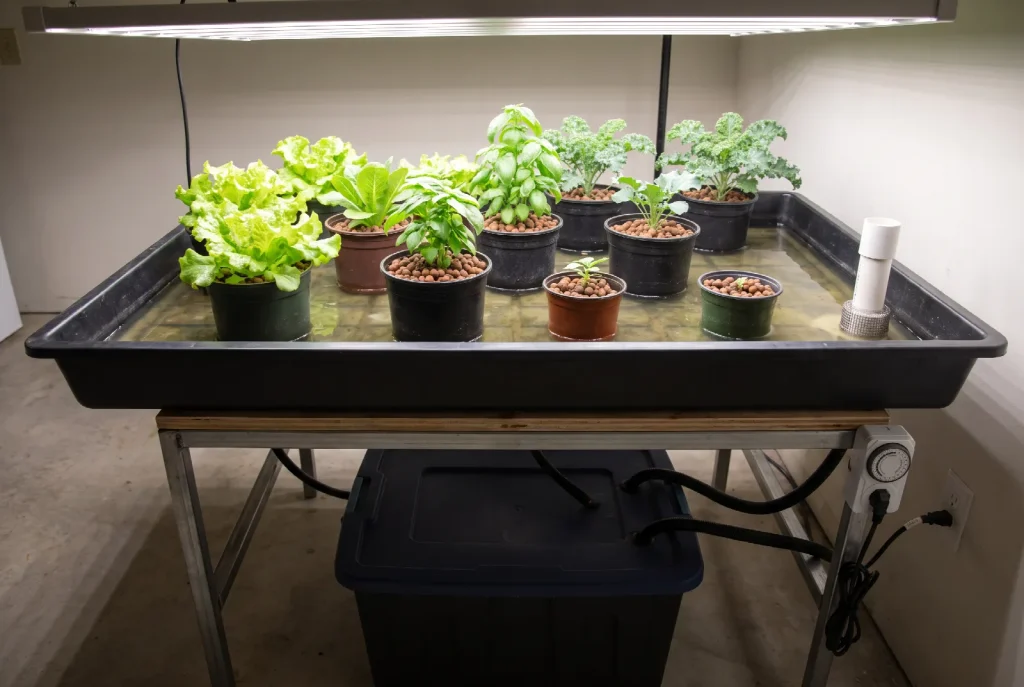
Ebb and flow separates the two things roots need in time rather than in space. For a few minutes the tray fills and the roots feed. Then it drains, and as the water falls away it pulls fresh air down into the growing medium behind it. Every other design on this site has to deliver water and oxygen at the same moment and compromise on one of them. This one takes turns.
What it is, and the names it goes by
Oregon State’s definition is as plain as it gets: a hydroponic system where plants are grown in trays that periodically flood with nutrient rich water and then drain back into a reservoir, made of flood trays, a nutrient reservoir, a pump and a timer. That is four components, and nothing else is required.
You will meet it under several names and they are the same thing. Flood and drain is the most descriptive. Ebb and flood is the usual term in commercial greenhouse work, where it describes benches rather than tabletop trays. Ebb and grow usually means a particular shape of the same idea, with buckets on a shared manifold instead of one open tray, and it gets its own section below.
What makes it unusual among hydroponic designs is that the plants sit in pots of inert medium rather than in open water. That is why a tray can hold a pepper in a six inch pot next to a tray of seedlings, and why the same build grows things that nutrient film technique and deep water culture cannot touch.
Why alternating beats a constant supply
Roots need water and they need oxygen, and in a reservoir those two compete, because water holds very little dissolved oxygen and warm water holds less. That competition is the mechanism behind most of the root rot on this site.
Flooding and draining sidesteps it. During the flood the medium takes up solution by capillary action from below, which is simply bottom watering. During the drain, the falling water acts like a piston: as it leaves the pot it draws air down into the spaces it vacates. Oregon State describes the effect as stimulating healthy root growth by pulling air into the growing media during the drainage phase. The medium is not a passive lump. It is the part doing the gas exchange.
Which is also why the medium matters more here than in any other design, and why the growing medium article is worth reading before you buy a sack of anything. A medium that holds too much water never drains enough to breathe. One that holds too little dries between floods.
How deep to flood, and when to flood again
Most guidance on this system is a schedule, which is the wrong shape of answer, because the right interval depends on your medium, your pot size, your plants and your room. Oregon State gives an observational rule instead, and it is the most useful thing on this page.
- Flood to about an inch below the top of the media. Not to the rim, and not a shallow puddle in the bottom of the tray.
- Drain once the media is fully soaked. The surface will be glistening. That is the signal, rather than a number of minutes.
- Flood again before the media begins to dry out and contract. If it has pulled away from the side of the pot, or the plant is wilting, you are already late.
Those three observations replace guesswork with something you can check by looking. The schedule that satisfies them is the one to set, and our build guide covers the timer side in detail, including the commercial contact time, a starting schedule for clay pebbles and the irrigation duration above which root disease becomes a genuine risk.
One thing worth absorbing early. When the medium is dry, the answer is more floods, not longer ones. A longer flood does not put more water into a medium that is already saturated. It only keeps the roots submerged for longer, which is the one thing this design exists to avoid.
The tray does more work than people expect
A flood tray looks like a box, and most of its design decisions are invisible until something goes wrong.
The floor should not be flat. Oregon State recommends a flood table with ridges or channels, so that residual solution is removed from the base of the growing media between cycles. A flat tray leaves a film under every pot, and the bottom inch of medium never gets its drain phase. Proper flood tables are moulded with a ribbed floor for exactly this reason, and it is the one feature worth paying for.
Media depth sets what you can grow. Deeper media allow longer flood cycles and support larger crops, because there is more root space and more buffer. A two inch tray of shallow pots is a seedling system. A tray carrying eight inch pots is a system for a bush tomato. The tray is the same. The pots decide.
And light reaching the solution grows algae, the same as everywhere else. The algae article covers the general fix, which is to keep light off the water. Ebb and flow has a specific trick available to it that nothing else on this site does: an algae trap, a small chamber designed to encourage algae to grow away from the production area, where it is easy to clean and where free floating algae tend to collect. It is a commercial technique rather than a home one, and it is a good illustration that this design has had a great deal more engineering attention than its hobby reputation suggests.
Two problems the cycle itself fixes
This is the part that almost no beginner guide mentions, and it is the strongest argument for the design.
Salt build up. Any system that waters from below concentrates salts near the surface of the medium as water evaporates from the top. Oregon State’s answer is two sided: shallow flood cycles help prevent salt accumulating near the base of the plants, and using pure water, distilled or reverse osmosis, for some of the flood cycles rinses the build up out of the media. That is a maintenance routine you can run on a timer, and it costs nothing but a tank of plain water. Nothing else on this site can flush its own root zone.
Pests. Flood depth and flood interval are levers on the moisture at the surface of the medium, and surface moisture is what fungus gnats breed in. Decreasing the flood depth or increasing the delay between cycles dries the substrate out and reduces the problem. The pest article argues the same point from the other end, that drying the surface is the control that actually works, and here it is something the timer does rather than something you have to do.
Trays, buckets, and what ebb and grow means
The principle scales in two directions and the choice matters more than the name on the box.
One open tray is the classic form. Everything floods together, every plant sees the same solution, and you can rearrange pots freely. It is the easiest to build and the easiest to inspect, because one look tells you whether the flood happened.
Buckets on a shared manifold is what is usually sold as ebb and grow. Each plant has its own container connected to a common fill and drain line, so the solution rises in every bucket at once and falls back to one reservoir. The advantage is real for large plants: a bucket gives far more root volume than a tray of the same footprint, and the plants can be spaced as widely as they need. The cost is that a blocked fitting starves one plant silently, which an open tray makes obvious.
Benches are the commercial version, and the reason the technique has a serious literature behind it. Ebb and flood benching is standard in nursery and bedding plant production, which is where the ridged floors, the algae traps and the irrigation duration research all come from. Oregon State calls the method ideal for seedling production, and at home that translates directly: a flood tray is the most practical nursery you can run alongside a succession rotation, because a tray of cells floods as happily as a tray of pots.
Does it work in aquaponics?
Better than anything else here, and for a reason worth knowing.
In aquaponics the fish provide the nutrients, but bacteria have to convert them into a form a plant can use, and those bacteria need surface area to live on. Arizona Cooperative Extension lists three system types for this and is explicit about what separates them: a media bed grows plants in gravel or expanded clay media that also acts as biofiltration. An ebb and flow tray full of pots of clay pebbles is a media bed. It is doing the biofiltration as a side effect of being what it is.
Compare that with nutrient film technique, where the channel provides almost no surface area and a separate biofilter has to be bought and plumbed in. Solids removal is still essential either way, because uneaten feed and fish waste have to come out before they reach the roots. But the biofilter, which is the component most likely to defeat a first attempt, comes free with the medium.
If aquaponics is where you are heading, this is the hydroponic half to learn first.
What to grow, and whether to build one
The crop list is the widest on this site. Oregon State names peppers, which benefit from the oxygenation the cycle provides, herbs including basil, cilantro and mint, radishes, which suit the temporary flooding well, and leafy greens including spinach, Swiss chard and arugula. Annual flowers such as marigolds, petunias, zinnias and pansies take to it too, which is worth knowing if the system is going to live somewhere people see it.
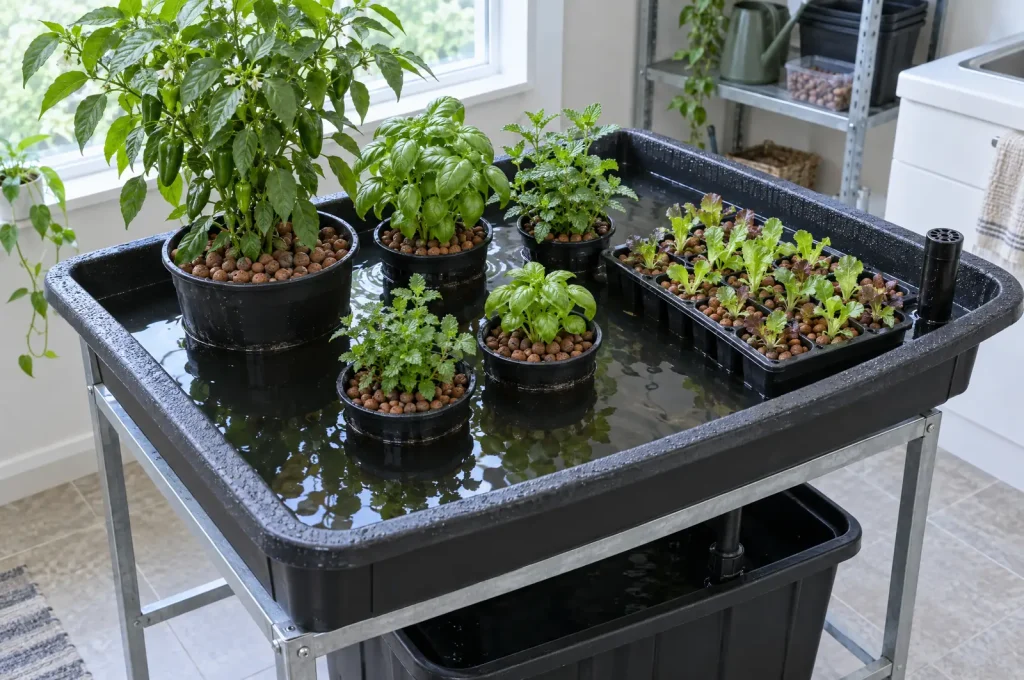
Radishes are the interesting one. A root crop is awkward in most hydroponic designs and perfectly ordinary here, because the plant is sitting in a pot of medium rather than hanging in water. That is the whole argument for this system in one example.
What it does well
- Handles mixed plantings and different pot sizes easily
- Strong root oxygenation on every drain cycle
- The medium holds moisture, so a brief pump failure is survivable
- Flushes its own salt build up on a timer
- Scales to large trays without redesigning anything
Where it struggles
- More parts, so more things to go wrong
- The tray has to be dead level or one end floods deeper every cycle
- Needs a lot more growing medium than water culture designs
- Overflow fittings clog with roots and debris
As a first system it is a reasonable choice and not the obvious one. It has more parts than a Kratky jar and more ways to be wrong than a bucket, and the levelling requirement catches people out. What it buys you is range. If you already know you want peppers and herbs and a tray of seedlings running at once, there is no other design here that does all three, and it is worth skipping straight to it.
If you are building rather than reading, the ebb and flow table plan has the parts list, the two fittings that do all the work, the levelling check and the reservoir arithmetic.
Not sure which system to build?
Compare all six side by side on cost, difficulty, and what they grow best.
Where this comes from
The definition and component list, the description of the drain phase pulling air into the media, the three step flood rule of an inch below the top of the media, draining when the media is glistening and flooding again before it contracts, the ridged or channelled table floor, the note that deeper media allow longer cycles and larger crops, the algae trap, the shallow floods and periodic pure water cycles for salt control, the flood depth and interval as pest levers, the description of the method as ideal for seedling production, and the crop list are all from Oregon State University Extension’s peer reviewed publication EM 9458, Hydro hints: Ebb and flow, by Mykl Nelson II, Gail Langellotto and Lloyd Nackley, published May 2025.
The aquaponics section is from University of Arizona Cooperative Extension’s peer reviewed publication az2215, Aquaponics Basics: How Fish, Plants, and Microbes Work Together, which states that solids removal and biofiltration are essential and that a media bed uses growing media which also acts as biofiltration. The levelling requirement, the irrigation duration threshold for root disease and the reservoir sizing figures are set out with their own sources in our build guide rather than repeated here. Costs are typical at the time of writing rather than quotes.
Answer five questions about your budget, space, experience and what you want to grow, and our system comparison tool ranks all six against your answers, with the reasoning shown, and an honest “nothing fits” when nothing does.