Can You Run a Grow Light 24 Hours a Day?
Three pages on this site tell you not to run a grow light round the clock. One of them explains why, and the explanation is wrong. Plants do not need darkness in order to respire. The rule those pages are defending is still worth keeping for most readers, but it is right for a completely different reason, and once you know which reason it is you can tell when it stops applying.
What we have been saying
Our lighting guide puts it like this. Plants need a dark period to respire properly, and running a light around the clock wastes electricity while stressing the plant. Our list of common beginner mistakes has it at number five, shortened to plants need a dark period. The beginners guide gets there from the other side and says that plants under a blazing grow light around the clock get light burn.
Both of the shorter pages point back at the lighting guide for the detail, so this is one rule stated three times rather than three findings that agree. That is worth knowing before taking it apart.
Respiration is not the reason
Respiration is what a plant does with the sugar it has made. It runs in the dark and it runs in the light, in the same mitochondria, and it does not pause and wait for the lamp to go off. There is no step in it that requires darkness. A plant in continuous light is respiring the entire time.
The giveaway is what a metabolic requirement would have to look like. If darkness were needed for respiration, every plant would suffer without it, in proportion to how long the light stayed on. That is not what happens. Some crops are damaged badly by continuous light, some are completely unaffected, and at least one is measurably better off. The work on the damage goes back to the 1920s and explains it in terms of sugar accumulation and signalling, not respiration.
What happens to lettuce
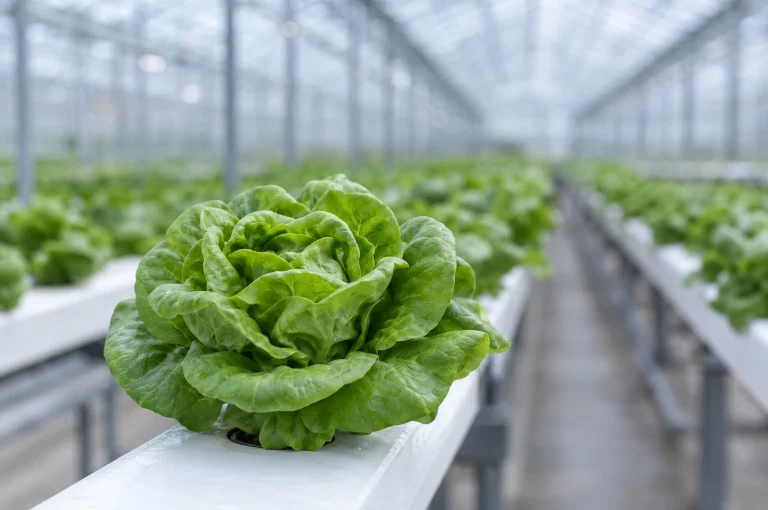
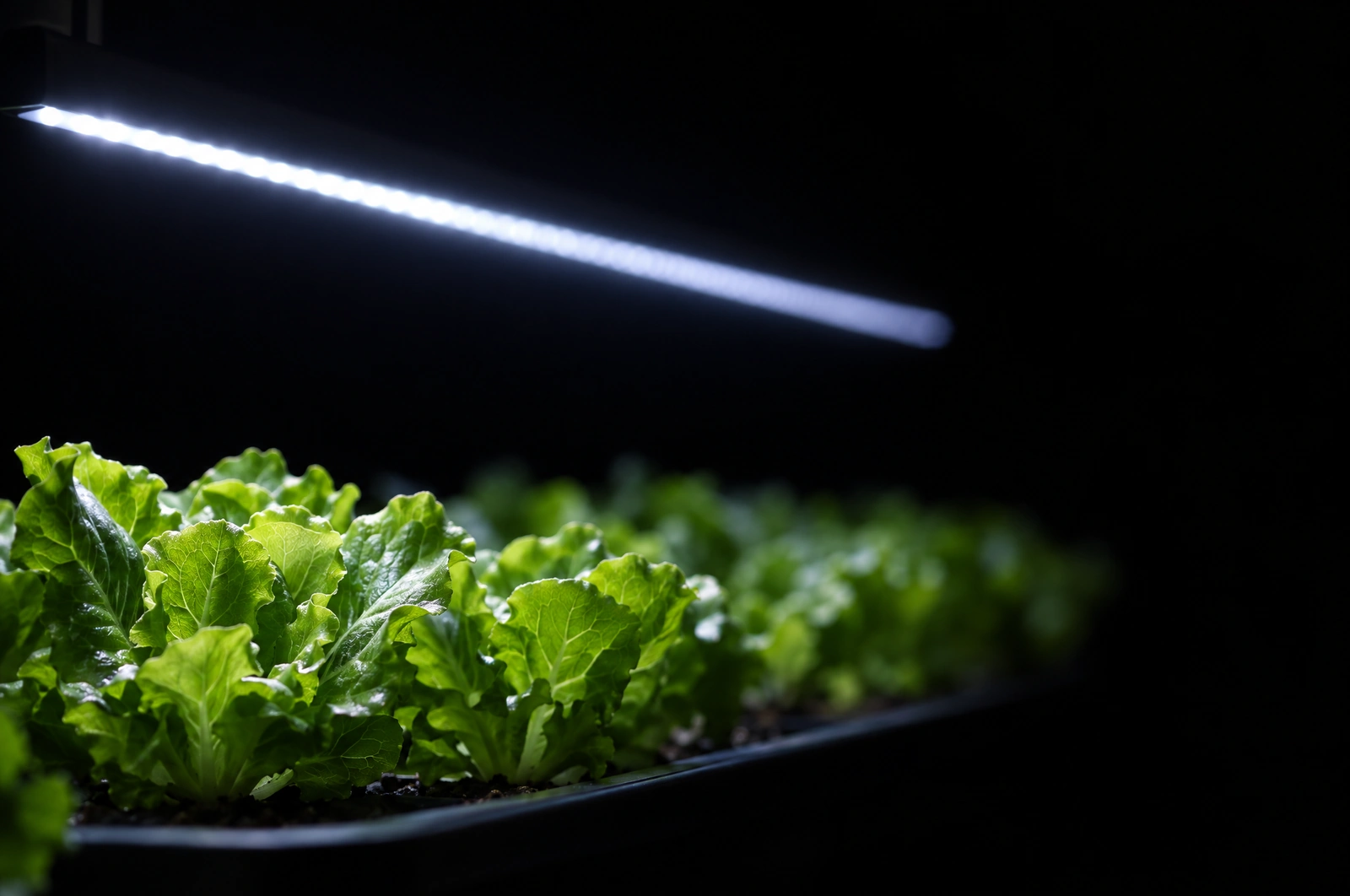
Two trials published this year both asked the same question of lettuce, and both were careful about the thing that matters most. They held the daily light total constant. Lengthening the day means lowering the intensity, so that the plant receives the same quantity of light either way and the only variable is whether the lamp ever goes off.
The first, from a group in Italy, ran two crisphead cultivars three ways: sixteen hours at one intensity, twelve hours at a higher one, and twenty four hours at a lower one, all adding up to the same daily total. Yield, plant shape, chlorophyll fluorescence and gas exchange did not differ between the three. Nothing measurable happened. The differences between the two cultivars were larger than the differences between the lighting regimes.
The second, from Wageningen, compared continuous light against eighteen hours at the same daily total on two more cultivars, and found something better than nothing. Jagger gained twenty three percent in both fresh and dry mass. Danstar gained six percent fresh and fourteen percent dry. The plants intercepted about ten percent more light because their leaf area grew faster, and they used the light they intercepted seven to eleven percent more efficiently. Sucrose fell and starch accumulated, which is the detail to remember for later.
Then the sentence that answers the objection anyone growing lettuce would raise. Visual quality was unaffected in both cultivars, with no signs of tipburn or bolting.
| What was grown | Under continuous light |
|---|---|
| Lettuce, two cultivars | Yield and physiology unchanged |
| Lettuce, two cultivars | 6 to 23 percent more mass |
| Potato, four cultivars | Two injured, two not |
| Tomato | Mottled chlorosis and necrosis |
What happened when the lights never went off. The two lettuce trials held the daily light total constant. The potato and tomato work did not.
Three days before you cut
There is a narrower version of this that is more interesting than the growth result, because it changes the thing you eat rather than the amount of it.
A 2023 study in the Journal of Agricultural and Food Chemistry took butterhead and red oak leaf lettuce in a greenhouse and, for one, two or three days before harvest, cut the nitrogen supply and ran the light continuously. Three days of both together lowered nitrate and lowered sesquiterpene lactones, while raising soluble sugar, soluble protein, anthocyanins and phenolic compounds, and it did all of that without costing any fresh weight. A simulated digestion put numbers on the eating end: significantly sweeter and significantly less bitter than the control.
Both of those compounds have appeared here before. Sesquiterpene lactones are the family that includes lactucopicrin, which is the bitterness our article on whether hydroponic lettuce tastes different is mostly about. Nitrate is the one leafy compound that is actually regulated, with the limits set out in our piece on whether hydroponic food is as nutritious, and those limits are higher in winter precisely because there is less light to convert it.
Earlier work points the same way. A 2015 trial on hydroponic purple lettuce applied short term continuous lighting before harvest across six different nitrogen regimes and raised shoot dry mass by at least thirty five percent in every one of them, while cutting leaf nitrate by at least twenty three percent and lifting ascorbic acid, soluble sugar and soluble protein.
The crop that genuinely cannot
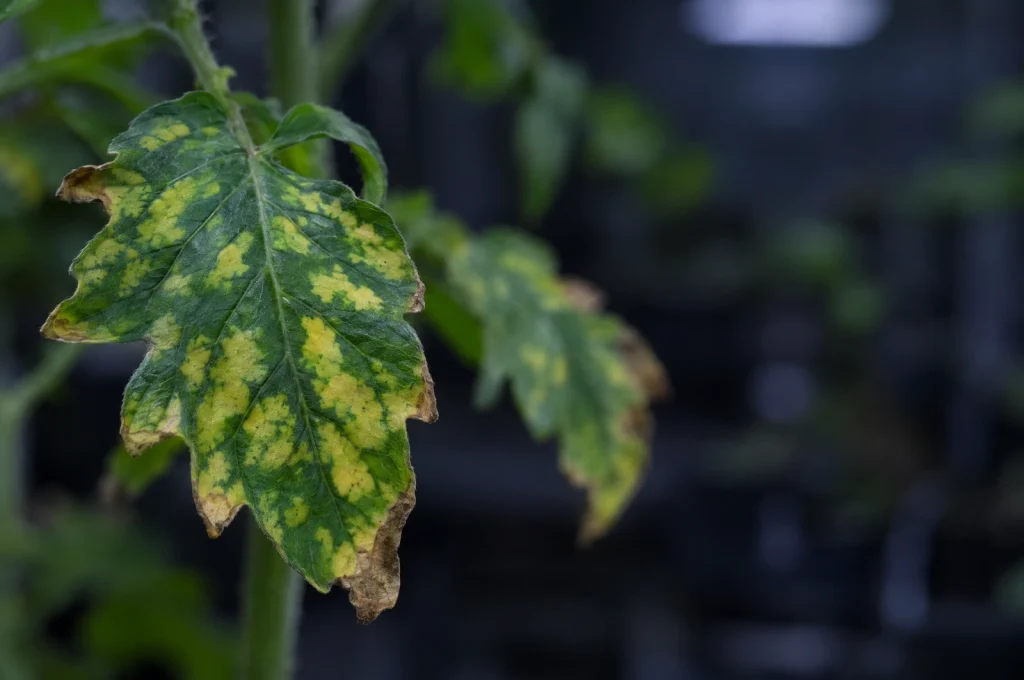
Tomato is the opposite case, and it has been known since the 1920s. Grown under continuous light, a tomato plant develops mottled chlorosis and necrosis, which is a blotchy yellowing that goes on to kill the tissue it appears in. It is not a deficiency and no feeding change fixes it. The researchers who work on it describe light in unnaturally long photoperiods as harmful and even lethal.
The mechanism is still argued over, but the strongest evidence points at sugar. A 2017 study measured sucrose and starch in tolerant and sensitive tomato lines across several abnormal light and dark cycles, and found a strong negative correlation between how much of both had piled up and how well photosystem two was working. The plant makes sugar faster than it can move or use it, and photosynthesis is turned down in response. That is the same accumulation the Wageningen lettuce showed, which raises an obvious question about why one crop copes and the other does not.
Part of the answer is genetic, and specific. In 2014 a group reported a dominant locus on chromosome seven of wild tomato species that confers tolerance to continuous light, and traced it to a light harvesting chlorophyll binding protein. Breeding that one locus into modern hybrid lines produced up to twenty percent more yield, because those plants can then be grown under light that never stops. The paper describes it as overcoming a limit on crop productivity that exists only because plants adapted to a terrestrial twenty four hour day.
Potato sits between the two. A 1998 study grew four cultivars under constant light and found Kennebec and Superior injured while Norland and Denali were not, with ethylene implicated in the damage. So the honest unit here is not plants, and often not even the crop. It is the variety.
The catch that saves the rule
Every lettuce result above holds the daily light total constant. The researchers turned the intensity down when they turned the hours up. That is the whole experiment, and at home it is the part you cannot do.
Most small panels have no dimmer, and even on the ones that do, nobody switching from fourteen hours to twenty four thinks to drop the output. What actually happens is that the dose goes up by about seventy percent. Our winter article puts lettuce at roughly fifteen to twenty moles per square metre per day, so the same lamp left on round the clock lands somewhere between twenty six and thirty four.
That is well past the point where the crop stops being happy about it. Our page on lettuce tipburn records seventeen as the daily total above which tipburn appeared in Cornell’s trial, and notes that for some cultivars the ceiling is fifteen or lower. Seventeen is also the figure behind the 150 gram head in our count of what a small system actually yields. Doubling it does not get you a double sized lettuce. It gets you a lettuce with brown dead margins hidden in the middle of the head.
So the rule holds, and the reason is the dose rather than the dark. It is also the reason our environmental piece called the Arizona model’s twenty four hour photoperiod an aggressive assumption. Lighting round the clock is a decision about how much light to buy, not about whether plants are allowed to sleep.
What to do with this
Keep the timer. Hours are the thing you pay for, and our running cost calculator will tell you exactly what ten extra hours a day costs over a year. For almost everybody reading this, a fixed output panel left on permanently is a way of spending more money to grow a worse lettuce.
If your panel dims, the experiment is open to you, and the rule is to hold the daily total. Work out what the lamp is delivering now over its current hours, then drop the intensity by the same proportion you stretch the day. On the published evidence lettuce will be no worse and may be a little better. Dimmable panels are the only hardware this needs.
The pre-harvest window is the cheap version and the one most worth trying. Three days of continuous light before you cut, on a lettuce already most of the way to harvest, is a timer change and nothing else. The published downside at that length is none, and the published upside is sweeter leaves with less nitrate in them.
Do not do any of it to tomatoes or peppers. The crop table in our lighting guide puts fruiting crops at fourteen to eighteen hours and leafy greens at ten to fourteen, which has it backwards in one respect worth fixing: lettuce is the crop that could go to twenty four, and tomato is the one that must not. That guide is being corrected, starting with the sentence about respiration.
Where this comes from
The three way photoperiod trial at constant daily light total is Onofrio Davide Palmitessa and colleagues, Continuous lighting at low PPFD improves energy efficiency while preserving growth and quality of lettuce in vertical farming systems, Frontiers in Plant Science, 2026. The twenty three percent growth result, the light interception and light use efficiency figures and the absence of tipburn and bolting are from Daniela Núñez Ocaña and colleagues, Continuous light at fixed daily light integral enhances lettuce growth due to improved light interception and light use efficiency, Frontiers in Plant Science, 2026. The pre-harvest quality work is Xiaoyan Yang and colleagues in the Journal of Agricultural and Food Chemistry, 2023, and the purple lettuce figures are Yu, Yang and Liu in the Chinese Journal of Applied Ecology, 2015. The tomato disorder, the chromosome seven locus and the twenty percent yield increase are from Aarón Vélez-Ramírez and colleagues, A single locus confers tolerance to continuous light and allows substantial yield increase in tomato, Nature Communications, 2014, with the carbohydrate measurements from the same group in Plant and Cell Physiology, 2017. The potato cultivars and the ethylene result are Cushman and Tibbitts in the Journal of the American Society for Horticultural Science, 1998. The tipburn ceiling and the lettuce daily light figures are ours, cited in full on the pages linked above.
Found this useful? Tell Google to show you more of it.
Add to Preferred Sources