Is Hydroponic Food as Nutritious, and How Would We Know
Somebody will tell you that hydroponic food is watery and empty. Somebody else will tell you that studies prove it is more nutritious than anything grown in soil. Both are quoting real published research, which is the first clue that something is wrong with the question. The comparisons that get quoted were mostly not built to answer it, and the one that was built properly returns an answer that sounds like a contradiction until you look at how it was measured.
The part that is not in doubt
Our article on hydroponics against soil declines to settle this in a single sentence, which is the correct answer but an unsatisfying one. So here is the long version. Start with the half of it that is settled, because it is larger than people expect.
A plant cannot contain an element nobody gave it. In soil those elements come from whatever that particular soil happens to hold, which varies by field, by season and by how long the ground has been cropped. In hydroponics they come from a bottle formulated to supply the full set, which is why our nutrient guide opens with the list of seventeen rather than the three on the front of a garden fertiliser box.
For minerals, a correctly mixed reservoir is not a thin diet. It is a known one. Calcium, magnesium, iron and the rest are present because somebody put them there in a measured ratio. That is the opposite of the usual accusation.
The argument was never really about minerals. It is about vitamin C, vitamin E, the pigments and the phenolic compounds, and those are different in kind, because the plant manufactures them itself in response to the conditions it is growing in. Change the light, the temperature, the variety or the age at harvest and you change them. That is where every comparison falls apart.
The study where everything else was held still
There is one comparison that did the obvious thing and grew both sides itself. Chunli Lei’s 2021 doctoral work at the University of Illinois took a single cultivar, Giant Caesar lettuce, and grew it for thirty five days in laboratory built hydroponic and soil systems standing side by side.
Above ground the plants came out the same. There were no significant differences in plant size, biomass or leaf features, although the hydroponic roots were longer and heavier. Then the measurements get interesting, and they appear to disagree with each other.
Freeze dried and compared on dry matter, there was no significant difference in ascorbic acid, chlorophyll, beta carotene or total phenolics. Compared on fresh weight, every one of those compounds was significantly higher in the soil grown lettuce. The paper also records the fact that explains it: the hydroponic lettuce had higher moisture and lower ash content.
Per gram of leaf, or per gram of leaf solids
Those two results are not in conflict. They are one lettuce measured against two denominators, and the difference between them is water.
A leaf holding more water has less of everything else per gram without having made any less of it. Dry the two samples down and the chemistry matches. Weigh them wet and the wetter one looks poorer, because part of what you weighed was water. So “soil lettuce has more vitamin C” and “there is no difference” can both be true statements about the same two lettuces.
Which basis is the honest one depends on what you are asking. You eat leaves rather than dry matter, so fresh weight is the right number for a plate of salad. But it is measuring hydration as much as nutrition, and a lettuce that is slightly wetter is not a lettuce that failed at something.
One result in that study does not fit the explanation. Antioxidant capacity was lower in the hydroponic lettuce on both the dry and the wet basis, so dilution does not account for all of it. That is worth sitting with rather than explaining away. It is also one cultivar, in one laboratory, over one thirty five day crop, which is exactly as much as it is.
The study everybody quotes for the other side
The figures that travel in the opposite direction almost all come from one open access paper, published by Buchanan and Omaye in Food and Nutrition Sciences in 2013. It compared four lettuce varieties and found three of them substantially higher in the hydroponic samples: tocopherol greater by 229, 497 and 492 percent, and ascorbic acid greater by 93, 171 and 216 percent.
Those numbers are quoted everywhere. The methods section is quoted nowhere, and it is the part that decides what they mean.
Three of the four pairs came from a Montessori school in Reno, the hydroponic samples from the school greenhouse and the soil samples from pots of school ground soil. The fourth pair was shopping: the hydroponic Butterleaf was bought at a Costco and the soil grown Butterleaf from a community food co-op, each from a different commercial grower. That fourth pair, the only one where both sides came from working farms, showed no significant difference in either vitamin.
This is not a hidden flaw. The authors describe their sourcing plainly and it is what was available to them. It does mean that the samples differ in grower, site, soil, season, variety handling and time since cutting as well as in growing method, and a difference of 492 percent between two lettuces from two different places is not evidence about hydroponics. The paper also reports two of its own figures differently in the abstract and in the results tables, which is a reasonable prompt to read the tables.
The one difference real enough to be regulated
There is a compositional difference in leafy greens that nobody disputes, and it has nothing to do with soil. Leafy vegetables take up nitrate and use light to convert it into the amino acids they are built from. When light is short the nitrate arrives anyway and sits in the leaf unconverted.
It matters enough that the European Union sets legal maximum levels, and the shape of those limits is the most useful thing on this page.
| Grown | Oct to Mar | Apr to Sep |
|---|---|---|
| Under cover | 5,000 | 4,000 |
| Open air | 4,000 | 3,000 |
Maximum nitrate permitted in fresh lettuce, in milligrams per kilogram, from Commission Regulation (EU) 2023/915. Iceberg types are held to lower figures again.
Read that table twice. A regulator has written daylight into law. Lettuce grown under cover is permitted more nitrate than lettuce grown outdoors, and lettuce harvested in the dark half of the year is permitted more than lettuce harvested in summer. Nobody granted that allowance out of generosity. They granted it because the plant cannot do the conversion without light, and holding winter greenhouse lettuce to a summer figure would make an ordinary crop illegal.
Note what the categories actually are. Under cover means a greenhouse or similar structure, not hydroponics specifically, and the regulation says nothing about growing method. Low light is the variable, and a windowsill in January is a low light situation whatever the roots are sitting in. The winter light gap article puts actual numbers on how large that shortfall is indoors, and the lighting guide covers closing it. Supply is the other half of the same sum, which is one more reason to mix at the strength the PPM and EC chart gives rather than above it.
What you actually control
Almost everything that moves these numbers is a setting rather than a method.
- Light. It drives the nitrate conversion above, and it drives the pigments and phenolics that the whole argument is about. It is also the thing most home setups are short of.
- Variety. Look again at the paper above. Its four lettuce varieties did not behave alike, and three different multiples came out of the same experiment on the same measurement, with the fourth showing no significant difference at all. Whatever that study measured, variety was moving it. The lettuce page covers choosing one on the grounds you can actually act on.
- Age at harvest. A plant left standing past its point is not the same food as one cut on time, which is the subject of the harvest timing article.
There is one piece of common advice worth flagging rather than repeating. Because leaf nitrate follows a daily cycle, you will see it suggested that cutting later in the day lowers it. The evidence for that specific instruction is thin and old, and it pulls against the better supported advice to cut in the morning while the leaves are turgid. Give the plants enough light across the whole crop and the hour you cut stops being the lever.
The effect that is larger than the argument
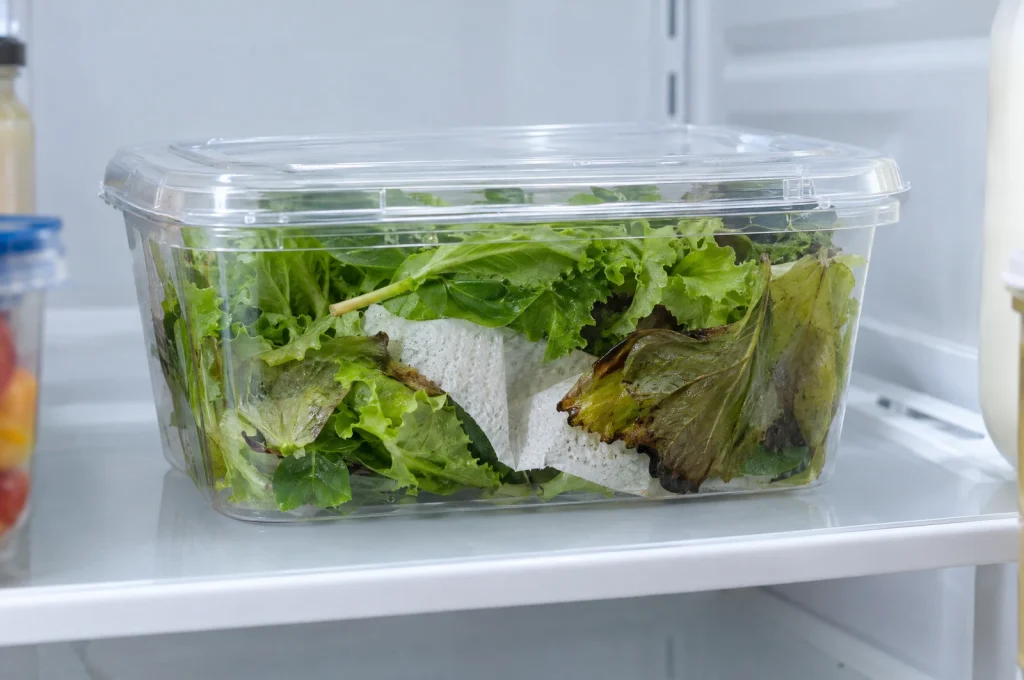
While two camps argue over a difference that needs a laboratory to detect, and argue separately about whether any of it counts as organic, something larger is happening in the fridge.
Dewhirst and colleagues, publishing in Food Chemistry in 2017, stored salad leaves in the dark at 39F (4C) and measured what happened to their ascorbate. Across the leaf types tested the loss over ten days ran from 35 to 86 percent, averaging 59 percent, with baby iceberg lettuce at the bad end and wild rocket holding on best. Lettuce showed the greatest percentage loss of any leaf they tested. Our lettuce page already tells you not to bother with iceberg, on the grounds that it is slow and fussy to grow. It turns out to keep worst as well.
Put that beside everything above. A bag of leaves can lose more than half its vitamin C sitting correctly refrigerated in the dark, which is a larger movement than any soil against solution comparison has produced. The same study found that washing the leaves in water increased the loss, and that agitating them while washing made it worse, while simply submerging them did not.
That last finding is the reason the harvest article tells you to put leaves away dry and unwashed and to wash them at the moment you eat them. It is also the honest answer to the question this article started with. Your advantage over a shop is not the growing method. It is that the leaf was attached to a living plant twenty minutes ago. Nothing in the published comparisons comes close to being worth as much as that, and it is the one variable a home grower wins outright.
Where this comes from
The side by side lettuce comparison is from “Differential responses of hydroponically grown and soil-grown lettuce to the stress of microplastics”, a 2021 doctoral dissertation by Chunli Lei in Food Science and Human Nutrition at the University of Illinois at Urbana-Champaign. Everything quoted here comes from the first part of that work, which is a product quality comparison. The rest of the dissertation is about microplastics and is not drawn on.
The vitamin figures on the other side are from “Comparative Study of Ascorbic Acid and Tocopherol Concentrations in Hydroponic- and Soil-Grown Lettuces” by Buchanan and Omaye, Food and Nutrition Sciences volume 4, 2013, which is open access. How the four pairs of samples were obtained, and the non significant result for the shop bought pair, are read from its materials and results sections rather than from commentary about it.
The nitrate limits are quoted from Annex I, section 6.1 of Commission Regulation (EU) 2023/915 on maximum levels for certain contaminants in food, which repealed and replaced the earlier Regulation 1881/2006. Fresh spinach sits at 3,500 milligrams per kilogram and rocket at 7,000 in winter, the highest figure in the section.
The storage losses are from “Novel insights into ascorbate retention and degradation during the washing and post-harvest storage of spinach and other salad leaves” by Dewhirst, Clarkson, Rothwell and Fry, Food Chemistry volume 233, 2017. The daily nitrate cycle is real and reported in the literature, but the specific advice to harvest later in the day rests on older trial work that we have not been able to read in full, which is why it is flagged above rather than recommended.
Found this useful? Tell Google to show you more of it.
Add to Preferred Sources