A Seedling That Stalls After Transplanting Is Not in Shock
You moved the seedling into the system four days ago and it has done nothing since. It is not dead, it is not wilting, it is simply the same size it was on the day you planted it, and the internet has one word for this. Transplant shock. The trouble with that answer is that a hydroponic transplant done properly does not damage a single root, so whatever is holding the plant up, it is not an injury. Four other things changed at that moment, all of them at once, and each has a different timescale.
A cube transplant does not injure anything
Start with what did not happen, because it rules out the usual explanation.
In soil, transplant shock is mostly mechanical. Lifting a seedling tears the fine root hairs that do nearly all the water uptake, and the plant then has a full canopy demanding water and a damaged system trying to supply it. That gap is the shock, and it is why soil growers talk about recovery.
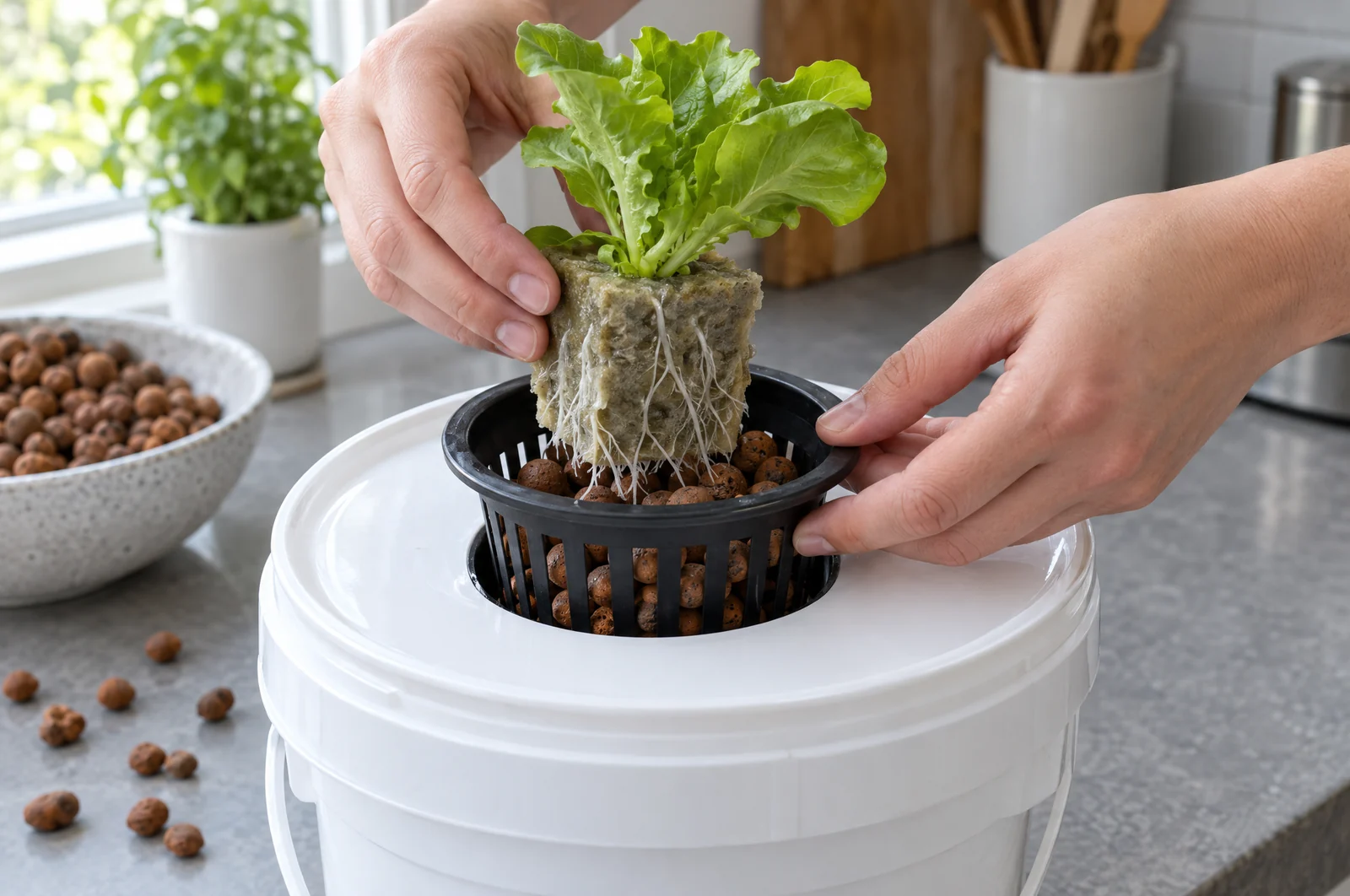
Hydroponics sidesteps it. The whole point of starting seeds in a cube is that the cube is what you move. Roots stay in the medium they grew in, nothing is pulled, nothing is torn, and the plant arrives in the system with its water supply intact. If you moved the cube and not the plant, there is no injury to recover from.
So the pause is real and the usual diagnosis is wrong. What actually happened is that a plant raised in carefully ideal conditions was moved, in one step, into conditions that are merely good.
Four things changed at the same moment
Nebraska Extension makes the point about outdoor transplants in a sentence that travels perfectly indoors: during propagation, transplants are given ideal conditions for growth including water whenever they need it. Everything that follows is a step down from that.
Outdoors the step down is cold, wind and strong sun, which is what hardening off exists to soften. Indoors there is no wind and no weather, so people assume there is nothing to harden off against. There is. Four things change the moment the cube goes into the net pot, and the plant has to adjust to all of them at once.
| What changes | How long |
|---|---|
| Humidity falls | Hours |
| Light goes up | Days |
| Root zone wets | Days |
| Feed arrives | Days |
Roughly how long each adjustment takes. The first is the one you see, the rest are the ones that hold the plant up.
The humidity drop is the one you notice
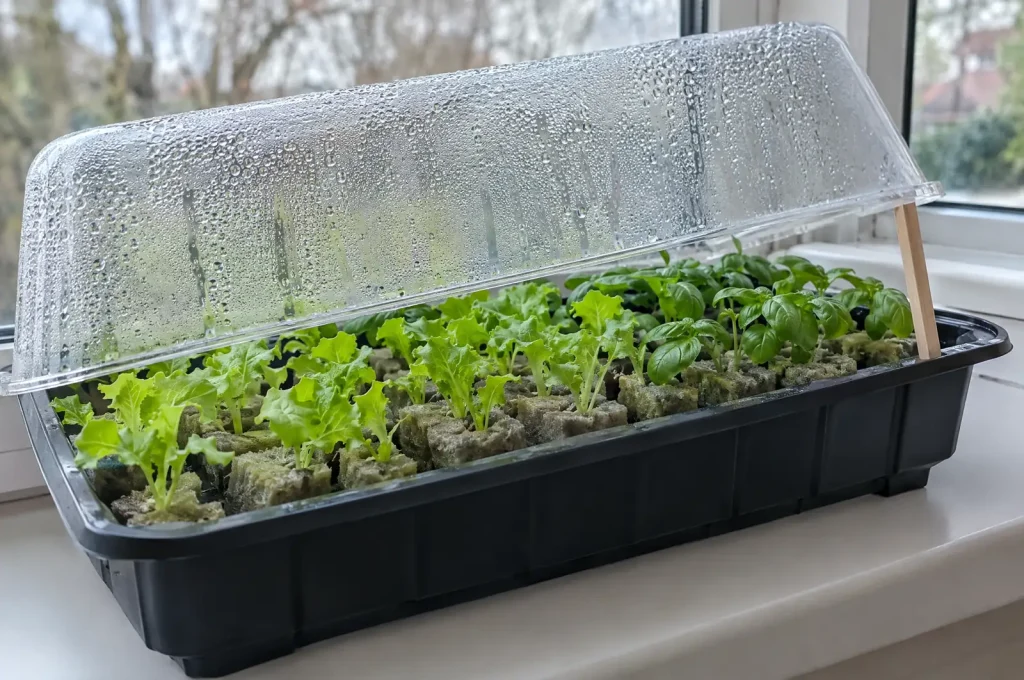
A propagator lid holds the air close to saturated. A seedling raised under one has never needed to defend itself against dry air, and it has built itself accordingly. Nebraska’s description of what hardening does is the clue: the natural waxes on leaf surfaces thicken on exposure, which reduces the rate of water loss. A seedling straight out of a dome has thin wax, because thin wax was enough.
Take the lid off and the air around those leaves goes from almost saturated to whatever your room is, which in winter with the heating on can be very dry indeed. Water now leaves the leaf faster than it did yesterday, and the plant responds by closing stomata, which also closes off the carbon dioxide it needs to grow. A plant with shut stomata is not growing, and from the outside that looks exactly like nothing happening.
The fix costs nothing. Lift the lid in stages over two or three days rather than removing it, propping it open a little wider each time. If the dome is already off and the plant is sulking, a clear bag or an upturned jar over it for a day or two, with a gap for air, buys the leaf time to thicken its own defences.
This is the same relationship the article on tipburn works through from the other end, where too little transpiration rather than too much is the problem. Humidity is not a comfort setting. It decides how fast water moves through the plant.
The light step up takes days, not hours
A propagator usually sits somewhere gentle. The system usually sits under the grow light. That is often a large jump, and a leaf built for low light cannot simply start using high light on the day it arrives.
There is good evidence for how long this takes. A 2023 study moved shade grown soybean seedlings into high light and measured them at zero, two, four, seven and ten days. In the shade intolerant variety, photoinhibition was still present ten days after the move, and the net photosynthetic rate had not fully recovered to the level of plants grown in high light throughout. The shade tolerant variety managed the change far better.
That is soybean in a greenhouse rather than lettuce under an LED panel, so treat the number as the shape of the thing rather than a figure for your windowsill. The shape is what matters here: adjusting to brighter light is a process measured in days, it is not uniform between varieties, and pushing a plant through it faster is not an option available to you.
So ramp it. Start the light higher above the canopy than its final position, or run fewer hours for the first few days, then bring it to where the lighting guide says it should sit. If your panel dims, that is what the dimmer is for.
The root zone goes from damp to wet
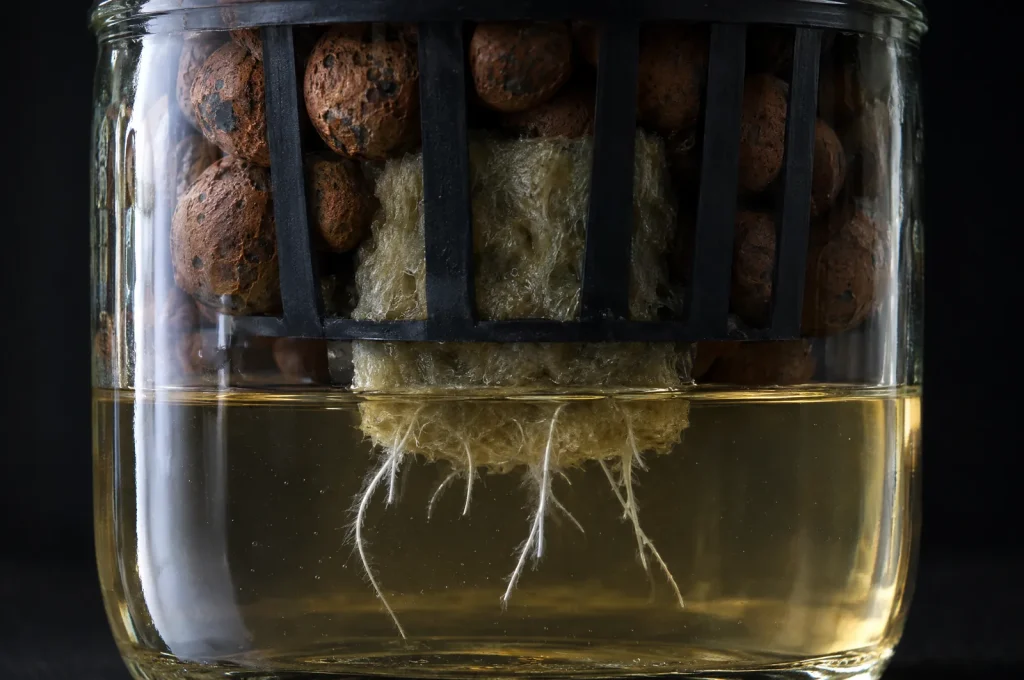
A propagated cube is damp and full of air. Drop it into a system and the bottom of it is now in contact with standing solution, which is a different environment entirely, and the roots have to grow into it rather than simply continue.
There is a version of this that the growing medium article flags and that is worth repeating, because it is the one that turns a pause into a loss. A cube can dry out while the reservoir underneath it is completely full. Rockwool wicks well, but only across a contact point, and a cube sitting a centimetre above the solution with dry pebbles around it is on its own. The plant wilts, the grower looks at a full tank, and the conclusion is that something mysterious is wrong.
So check contact rather than level. At planting the base of the cube should be touching the surface of the solution, and the pebbles packed around it should be damp to the touch, not dry. In a bucket system you top up to keep that contact until roots are visibly down in the water. In a Kratky jar the level touches the cube on planting day and then falls away on purpose, which is the whole design, and the roots chase it down.
The food arrives all at once
Seeds come with their own packed lunch and need nothing from you until the first true leaves. Most propagation therefore happens on plain water or something very weak. Then the cube goes into a reservoir mixed at label strength, and the step is larger than people realise.
Seedlings have small root systems and very little buffer, which is why our PPM and EC chart gives them their own band at the bottom of the range rather than the figure for a mature plant. Going in at full strength will not usually kill a healthy seedling, but it is one more adjustment stacked on top of three others, and it is the easiest of the four to avoid.
Affiliate disclosure: some links below are affiliate links. We may earn a commission if you buy through one, at no extra cost to you. As an Amazon Associate I earn from qualifying purchases. Full disclosure.
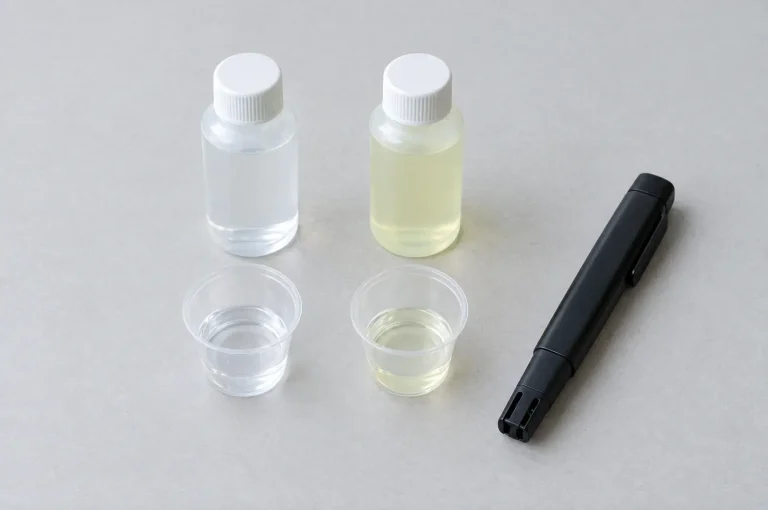
Mix the first reservoir at roughly half the label rate and bring it up over the first week or two. The only way to know what the plant is actually getting is to measure it, so use a pH and EC meter rather than trusting the arithmetic on the bottle, and check pH at the same time, because a seedling in the wrong pH band cannot take up what is there however carefully you mixed it.
What normal looks like
Most of the worry here comes from not knowing what a settled seedling is supposed to do, so here is the shape of it.
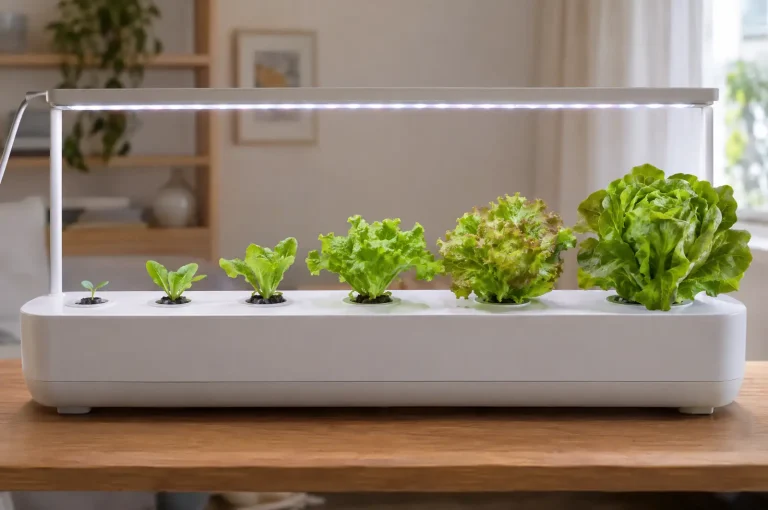
- Days one to three. Little or no visible growth. The plant is adjusting rather than producing. Leaves should stay turgid and the colour should not change.
- Days three to five. Roots appear below the net pot before the top does anything interesting. That is the right order and it is the signal worth waiting for.
- Day five onwards. New growth at the centre. From here the plant accelerates rather than creeps, and the pause ends as abruptly as it started.
A week of no top growth after a transplant is unremarkable. It feels much longer when you are checking twice a day, which everybody does, and the succession planting habit of always having something else at a different stage is the real cure for watching one plant too closely.
When it is not settling
Four signs mean something other than adjustment, and all four want action rather than patience.
- Wilting that is still there in the morning. A seedling that droops under the light and recovers overnight is transpiring faster than it can drink, which is the humidity problem above. One that is still limp after a dark period is not getting water at all, and the cube contact is the first thing to check.
- Pale new growth rather than no growth. That is a feeding or pH problem rather than a settling one, and the article on reading deficiency symptoms covers which is which.
- Browning at the base of the stem. Not settling. That is damping off, it moves quickly, and the seed starting article explains why nothing cures it once it has started.
- Two weeks with nothing at all. Lift the net pot and look. White roots mean the plant is fine and the conditions are not. Brown or absent roots mean the cube never made proper contact, or it did and then sat waterlogged.
The lifting is worth doing sooner than feels polite. Nothing in a net pot is harmed by being picked up and looked at, and the roots answer the question that the leaves cannot.
Where this comes from
The description of what hardening off does, that natural waxes on leaf surfaces thicken on exposure and reduce the rate of water loss, that stored carbohydrate increases, and that propagation gives transplants ideal conditions including water whenever they need it, is from Nebraska Extension in Lancaster County’s guidance on hardening off transplants. It is written for plants going outdoors, where cold, wind and strong sun are the stresses, and it is quoted here for the mechanism rather than the setting.
The light acclimation timescale is from “Photosynthetic Acclimation of Shade-Grown Soybean Seedlings to a High-Light Environment”, published in Plants in 2023, which grew two soybean varieties of differing shade tolerance at full and at forty percent sunlight, moved half the low light plants into high light, and measured them at zero, two, four, seven and ten days. The shade intolerant variety showed photoinhibition ten days after transfer with net photosynthetic rate not fully recovered, while the shade tolerant one adjusted considerably better. Soybean in a greenhouse is not lettuce under a panel, which is why it is used here for the timescale and the variability rather than as a number to apply.
The cube contact problem, the seedling strength band and the damping off material are our own, set out with their own sources on the growing medium, PPM and EC, and seed starting pages. The day by day shape of a settling seedling is practice rather than measurement, which is why it is given as a pattern to compare against rather than a schedule.
Found this useful? Tell Google to show you more of it.
Add to Preferred Sources