
Deep water culture: the beginner’s best friend
Roots suspended in a reservoir of oxygenated solution. Simple to build, fast to grow, and forgiving of the mistakes everyone makes early on.
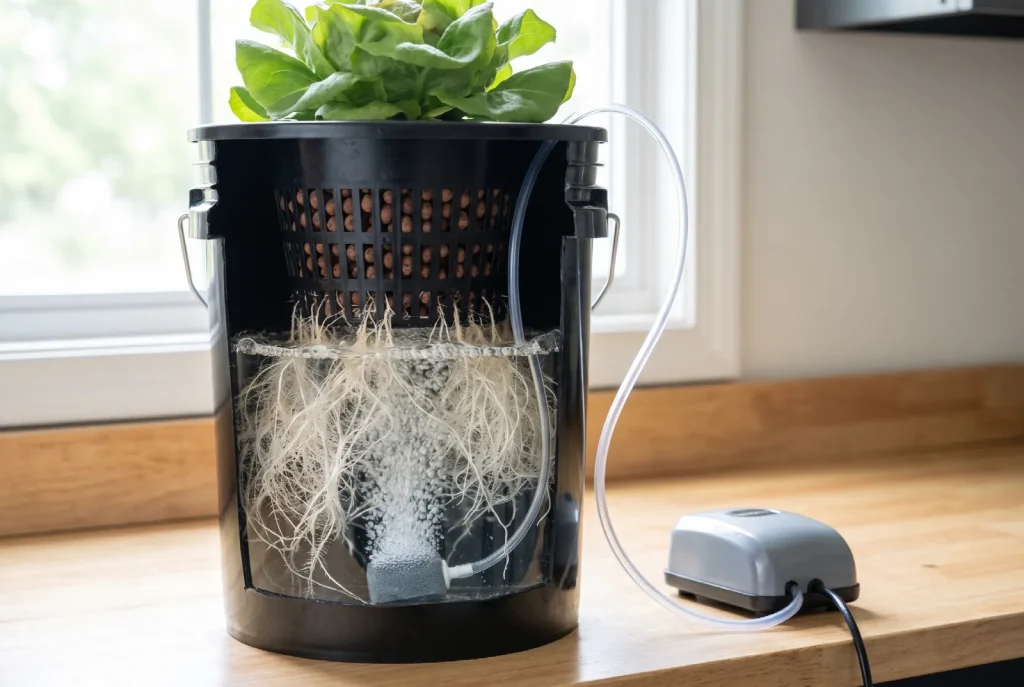
DWC is Kratky with a pump. Roots hang permanently in nutrient solution, and an air stone keeps that solution saturated with oxygen. Because the roots never run short of either water or air, growth is noticeably faster than in a passive system.
How it works
A reservoir holds four or five gallons of solution. Net pots sit in the lid with their bases in the water. An aquarium air pump feeds an air stone on the bottom of the reservoir, and the rising bubbles both oxygenate the water and keep the nutrients evenly mixed.
Unlike Kratky, you keep the reservoir topped up. The pump supplies the oxygen, so there is no need for an air gap.
What it does well
- Fast growth thanks to constant oxygen at the root zone
- Cheap to build from a bucket and an aquarium pump
- Very forgiving of small nutrient and pH errors
- Easy to inspect, because lifting the lid shows you everything
Where it struggles
- Needs mains power, and a long outage causes real stress
- Warm solution invites root rot, so summer needs attention
- Reservoir needs a full change every two to three weeks
- Air stones clog and need occasional cleaning
Keeping root rot away
Root rot is the one problem DWC growers actually face, and it has three causes: solution above roughly 75F (24C), a stalled or blocked air stone, and light leaking into the reservoir. Healthy roots are white or cream and slightly fuzzy. Brown, slimy roots with a swampy smell mean you have it.
What to grow
Lettuce, chard, kale, spinach, basil, mint, and cilantro all do extremely well. A single cherry tomato or pepper plant in its own bucket also works nicely once you have some experience, though it will need staking and heavier feeding.
Build one
Our $30 bucket DWC plan covers the whole build, including the hole spacing and the pump placement detail that stops water siphoning back during a power cut.
Not sure which system to build?
Compare all six side by side on cost, difficulty, and what they grow best.
Answer five questions about your budget, space, experience and what you want to grow, and our system comparison tool ranks all six against your answers — with the reasoning shown, and an honest “nothing fits” when nothing does.