
What is hydroponics? The complete beginner explanation
Hydroponics explained in plain English. How soil-free growing works, why it is easier than you think, and how to start your first system this weekend.
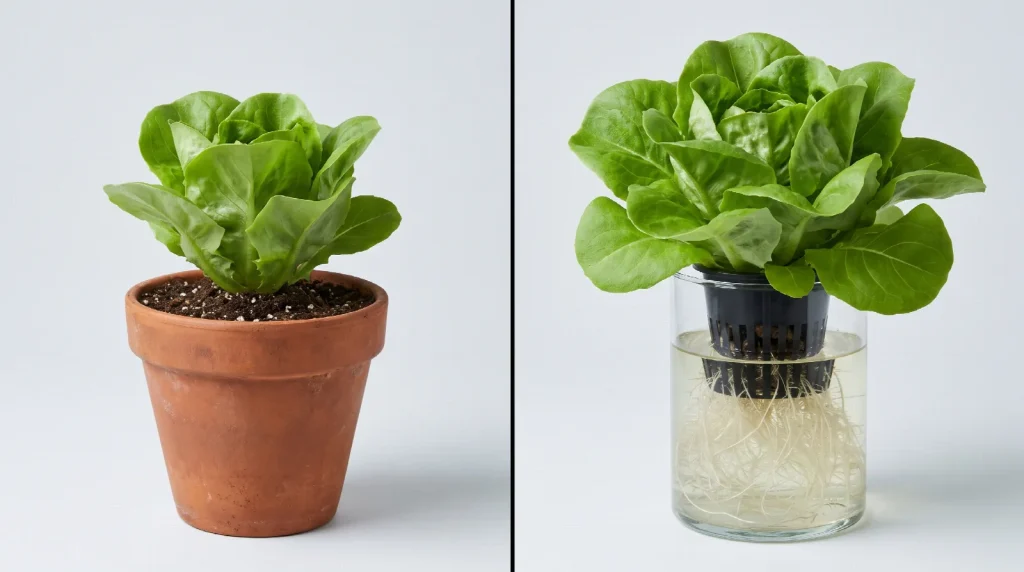
At its simplest, hydroponics is growing plants without soil. Instead of roots digging through dirt for nutrients, they sit in water that already has everything they need mixed in. That is it. No soil, no weeding, no guesswork about whether your plants are getting fed.
Here is the part that surprises most beginners: plants do not actually need soil. They need water, nutrients, light, and carbon dioxide. Soil was just the delivery system. Hydroponics replaces soil with a smarter delivery system, one that gives plants exactly what they need, exactly when they need it.
What is hydroponics, really?
The word “hydroponics” comes from Greek: hydro (water) plus ponos (work). Literally, “water working.” It has existed in some form for thousands of years, but the modern version took shape in the 1920s when scientists began studying plant nutrition in earnest.
Here is what hydroponics looks like in practice: a container of water with dissolved nutrients. Plants sit in that water, or have their roots regularly exposed to it, and grow. The water gets refreshed or recirculated. The plants get everything they need. You get fresh food.
That container could be a mason jar on your windowsill. It could be a PVC pipe system on your balcony. It could be a commercial greenhouse. The principle is the same: give roots direct access to water and nutrients, and plants will thrive.
What hydroponics is not
- Aquaponics. That is fish plus plants in a shared system. Hydroponics uses only nutrient solution, no fish involved.
- Aeroponics. That is misting roots with nutrient spray. Related, but different.
- Just plants in water. You cannot stick a cutting in tap water and call it hydroponics. The nutrients matter.
- Genetically modified. Hydroponic plants are regular plants. The growing method changes, not the plant.
- Only for experts. This is the biggest myth, and we bust it thoroughly below.
How hydroponics works (the simple version)
To understand hydroponics, it helps to understand what plants actually need. Forget everything you learned in school about roots searching through soil. Here is the real process.
What plants actually need
- Water. For transporting nutrients and maintaining structure.
- Nutrients. Nitrogen, phosphorus, potassium, and a dozen micronutrients.
- Light. For photosynthesis, turning light into energy.
- Carbon dioxide. From the air, for photosynthesis.
- Oxygen. For root respiration. Yes, roots breathe.
- Support. Something to hold them upright: soil, rock, or just the container.
Soil provides nutrients, water retention, support, and some oxygen to roots. But soil does all of these imperfectly. Nutrients get washed away. Water drains unevenly. Roots can be oxygen-starved in compacted dirt.
Hydroponics controls each factor precisely:
- Nutrients: mixed into water at exact concentrations, so plants get a perfect diet.
- Water: delivered directly to roots. No drought stress, no overwatering.
- Oxygen: added through air pumps, water movement, or system design.
- Support: provided by inert media like clay pebbles or rock wool.
- Light and CO2: same as any plant. Sunlight or grow lights, ambient air.
The nutrient solution: the heart of hydroponics
The nutrient solution is just water with plant food dissolved in it. Think of it as a balanced meal for plants: everything they need in one drink.
Commercial hydroponic nutrients come as liquid concentrates or powders. You mix them with water following the label instructions. The solution contains:
- Macronutrients (needed in large amounts): nitrogen, phosphorus, potassium, calcium, magnesium, sulfur.
- Micronutrients (needed in trace amounts): iron, manganese, zinc, copper, boron, molybdenum, chlorine.
A very brief history of hydroponics
Hydroponics is not new. Not even close.
Ancient beginnings. The Hanging Gardens of Babylon may have used early hydroponic techniques. Egyptian hieroglyphs show plants growing in water. Chinese rice farmers have grown plants in water-filled paddies for millennia.
The term is born. In the 1920s and 1930s, Dr William Frederick Gericke at the University of California proved that plants could grow to full size with their roots in nutrient solutions. He coined the term “hydroponics.”
Feeding troops in WWII. The US military used hydroponics to grow fresh vegetables for soldiers stationed on Pacific islands where soil was poor. This proved the method at scale.
NASA and space. In the 1990s NASA began researching hydroponics for long-duration space missions. If humans ever live on Mars, they will likely grow food hydroponically.
Today. Hydroponics powers commercial greenhouses, urban vertical farms, and millions of home kitchens. The global market exceeds $6 billion and is growing at over 10% per year.
The 6 main types of hydroponic systems
Not all hydroponic systems work the same way. Here are the six main types, ranked from simplest to most complex.
| System | Cost to build | Electricity | Best for |
|---|---|---|---|
| Kratky method | $5 to $15 | None | Absolute beginners, herbs, leafy greens |
| Deep water culture | $25 to $60 | Air pump | Beginners, lettuce, herbs, tomatoes |
| Nutrient film technique | $50 to $200 | Water pump | Leafy greens, small commercial setups |
| Ebb and flow | $75 to $300 | Pump and timer | Larger plants, scalable home gardens |
| Drip systems | $50 to $250 | Pump and timer | Tomatoes, peppers, fruiting crops |
| Aeroponics | $150 to $500+ | Pump and timer | Experienced growers, maximum yield per square foot |
1. The Kratky method (passive, no electricity)
The simplest hydroponic system ever invented. A container of nutrient solution. A plant in a net pot. As the plant drinks, the water level drops, exposing roots to air. No pump. No timer. No electricity. Perfect for beginners.
Read our full Kratky method guide
2. Deep water culture (DWC)
Plants sit in net pots suspended above a reservoir of nutrient solution. An air pump bubbles oxygen through the water around the clock. Roots grow down into the water and drink constantly. Simple, effective, and forgiving.
3. Nutrient film technique (NFT)
A thin film of nutrient solution flows continuously through channels or pipes. Plant roots sit in the channel, partially submerged in the flowing water. Very efficient, but it requires a pump and some precision.
4. Ebb and flow (flood and drain)
A growing tray is periodically flooded with nutrient solution, then drained. A timer controls the pump. Roots get water and nutrients during floods, oxygen during drains. Flexible and scalable.
5. Drip systems
Nutrient solution drips onto the base of each plant from small tubes. Excess drains back to the reservoir or runs off. Common in commercial agriculture and adaptable for home use.
6. Aeroponics
Roots hang in the air and are misted with nutrient solution at intervals. Maximum oxygen exposure and the fastest growth rates, but also the most technically demanding and expensive.
Why people choose hydroponics
Hydroponics has moved from laboratory curiosity to mainstream growing method for good reason. Here is what draws people in.
Grow up to 30% faster
Because nutrients are delivered directly to roots, plants do not waste energy searching through soil. They grow faster and reach harvest sooner. Lettuce that takes 60 days in soil can be ready in 30 to 40 days hydroponically.
Use up to 90% less water
This sounds backwards. You are growing in water, so how can you use less? In soil gardening most water drains away or evaporates. In hydroponics water is recirculated, so the same water feeds plants over and over. The only loss is what plants absorb and what evaporates.
No weeding, ever
No soil means no soil-borne weeds. No digging up dandelions. No mulching. No herbicides. The only plants in your system are the ones you put there.
Year-round harvests
Indoor hydroponics is not bound by seasons. Grow lettuce in January. Harvest basil in December. Your kitchen becomes a perpetual garden regardless of the weather outside.
Perfect for small spaces
A single mason jar fits on a windowsill. A 4-bucket system takes one square foot of floor space. Vertical systems grow upward, not outward. Apartment dwellers, renters, and tiny-home owners can all grow meaningful amounts of food.
Predictable results
Soil varies. One garden bed might be great, another clay-heavy and nutrient-poor. Hydroponics gives you control: same nutrients, same pH, same conditions every time. Consistent harvests, predictable growth.
Read the full benefits breakdown
Common myths, and the truth
Let us address the fears that stop people from starting.
How to start your first hydroponic system
Here is the exact path we recommend for every beginner.
Start small and free
Build our $10 mason jar Kratky system. Grow one basil or lettuce plant. Learn the basics without risk. Prove to yourself that this works.
Scale to four plants
Build a $30 bucket DWC system. Grow lettuce, basil, cilantro, and one experiment. See how different plants behave.
Learn the science
Read our Nutrients 101 guide and pH basics. Understanding why things work makes troubleshooting far easier.
Expand what you grow
Try tomatoes, peppers, or strawberries. Each teaches you something new. Our plant guides walk you through each one.
Optimise and share
By now you are producing more than you can eat. Share with friends. Consider a larger system or a vertical setup. You are no longer a beginner, you are a grower.
Frequently asked questions
What can I grow hydroponically?
Almost anything, but beginners should start with leafy greens (lettuce, spinach, kale), herbs (basil, mint, cilantro, parsley), and cherry tomatoes. Root vegetables like carrots and potatoes are harder and better attempted once you have mastered the basics.
How much does it cost to start hydroponics?
Between $10 and $50 for a first system. A mason jar Kratky setup costs about $10. A 4-plant bucket DWC system costs $30 to $50. After the initial build, ongoing costs are just nutrients (roughly $15 to $30 per year) and replacement seeds.
Do I need special lights?
If you have a sunny windowsill with six or more hours of direct light, no. For indoor spaces without good natural light, a basic LED grow light costs $20 to $40 and makes a large difference. We compare the best budget options in our grow light guide.
Is hydroponics organic?
Hydroponics can be organic if you use organic-certified nutrients. Most beginners start with standard synthetic nutrients, which are perfectly safe and often more predictable. You control exactly what goes into your plants, which is the point.
How often do I need to check on my system?
Kratky systems need a check every one to two weeks. DWC systems benefit from a quick look every few days. Neither requires daily babysitting. Most beginners spend 10 to 15 minutes per week on maintenance.
Can hydroponics be done outdoors?
Yes, but outdoor systems need protection from rain (which dilutes nutrients), extreme heat, and pests. Most beginners start indoors where conditions are controlled. Outdoor hydroponics works well for greenhouses and covered patios.
How long until I can harvest?
Leafy greens: three to five weeks. Herbs: two to four weeks. Cherry tomatoes: 8 to 12 weeks to first harvest, then continuous for months. Peppers: 10 to 14 weeks.
Ready to go deeper?
If you understand what hydroponics is and how it works, the next step is building your first system.