
Hydroponic pH: the complete beginner guide
pH decides whether your plants can actually reach the food you gave them. Here is the number to aim for, why it drifts, and how to fix it with things you already own.
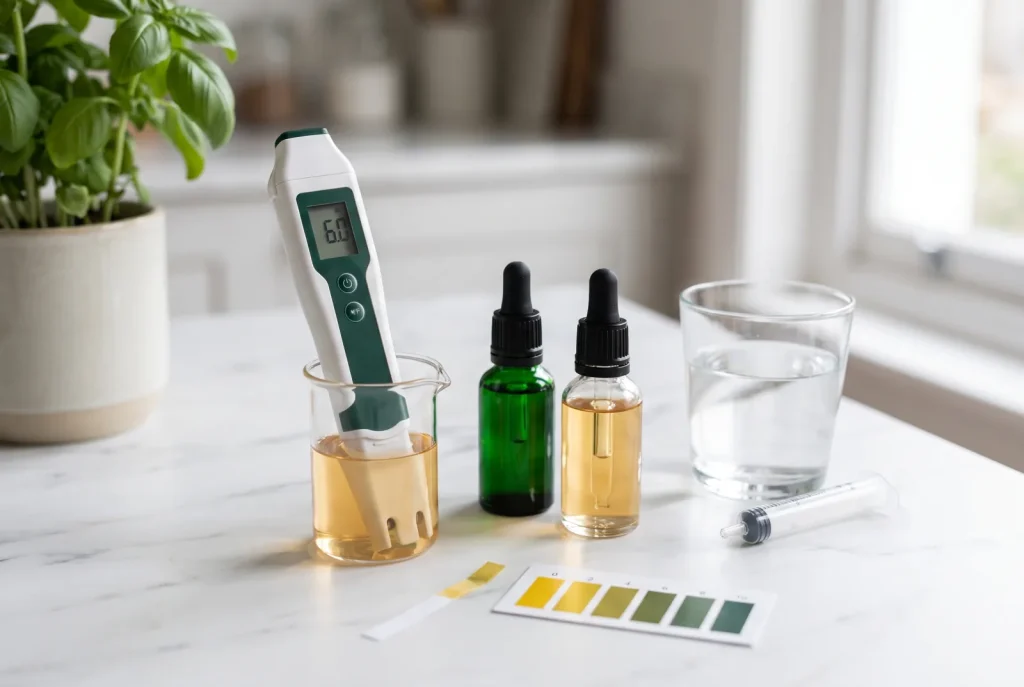
If you only ever measure one thing in hydroponics, measure pH. It is the single most common reason a plant sits starving in a reservoir full of nutrients, and it is the cheapest problem on this site to fix.
What pH actually is
pH is a measure of how acidic or alkaline a liquid is, on a scale from 0 to 14. Seven is neutral, lower is acidic, higher is alkaline. Lemon juice is about 2, tap water is usually somewhere between 6.5 and 8.5, and bleach is around 13.
The part that catches people out is that the scale is logarithmic. Each whole number is a tenfold change, so pH 5.0 is ten times more acidic than 6.0 and a hundred times more acidic than 7.0. That is why a reading of 7.5 is not “slightly off” when you are aiming for 6.0, and why adjusters work in drops rather than capfuls.
The number to aim for
| Crop | Target pH | Notes |
|---|---|---|
| Lettuce and leafy greens | 5.5 to 6.5 | Genuinely forgiving. Anywhere in this band is fine. |
| Herbs (basil, mint, cilantro) | 5.5 to 6.5 | As above. Basil is happy at the higher end. |
| Kale, chard, bok choy | 6.0 to 6.5 | Heavier calcium users, so avoid the bottom of the range. |
| Strawberries | 5.5 to 6.2 | Narrower. Iron problems show up quickly above 6.5. |
| Tomatoes and peppers | 5.8 to 6.3 | Narrowest of the common crops. |
| Seedlings and cuttings | 5.8 to 6.2 | Small root systems have no buffer against a bad reading. |
Note that soil advice is different and does not transfer. Most garden vegetables want 6.0 to 7.0 in soil, because soil holds and releases nutrients differently. Following a soil chart in a hydroponic reservoir is a common and expensive mistake.
Why pH decides what the plant can reach
Nutrients only stay dissolved and absorbable within certain pH ranges. Push the water outside those ranges and elements do not disappear, they become chemically unavailable. The technical word is lockout, and it produces the classic beginner situation: a full, correctly mixed reservoir and a plant with yellowing leaves. Nothing is missing. The plant simply cannot reach it.
Two things fall out of that chart, and they explain almost every pH problem a beginner has.
- Iron locks out first, and it locks out high. Above about 6.5 iron uptake drops off sharply, and iron is what new growth needs most. That is why the earliest visible sign of a high pH is yellowing between the veins of the newest leaves while the veins stay green.
- Calcium and magnesium go the other way. They fall away below about 6.0, so chasing a very low pH to protect iron creates a different deficiency instead.
- There is no perfect number. The 5.5 to 6.5 band is simply where the fewest things are compromised at once.
Why pH drifts in a hydroponic system
People often assume that once they have set pH the job is done. It is not, and understanding why it moves saves a lot of pointless adjusting.
| Cause | Which way it moves | What to do |
|---|---|---|
| The plant feeding | Usually up, sometimes down | Normal and unavoidable. Roots swap hydrogen ions for the nutrients they absorb, so the solution shifts as the plant eats. Just re-check weekly. |
| Water evaporating | Up | Water leaves, dissolved salts stay, so the solution concentrates. Top up with plain water rather than more nutrient. |
| Weak buffering in soft or RO water | Swings wildly either way | Very pure water has little to resist change, so tiny additions cause big swings. Add adjuster in smaller amounts and expect to re-check more often. |
| Hard tap water | Creeps back up | Dissolved carbonates actively resist your adjustment and pull pH back. Let water stand overnight before mixing, and expect to re-adjust. |
| Algae or root rot | Erratic, often up | Biological activity changes the chemistry. If pH will not hold steady and the reservoir smells bad, treat the rot rather than the pH. |
| A fresh nutrient mix | Settles over a few hours | Some formulations keep reacting after mixing. Check, then re-check the next day before deciding it has drifted. |
How often to check
| System | Check pH | Why |
|---|---|---|
| Kratky jar or bottle | At mixing, then rarely | A passive system is mixed once and finishes before drift matters much. Check if the plant looks unhappy. |
| Bucket DWC | Weekly | Shared reservoir, active feeding, so it moves steadily. |
| NFT or drip | Every 3 to 4 days | Small solution volume relative to plant demand, so it drifts faster. |
| Any system, first two weeks | Every 2 to 3 days | You are still learning what your water does. Frequency can drop once you know the pattern. |
| After any top-up or change | Immediately | You have just changed the chemistry. |
How to test pH
| Method | Cost | Accuracy | Verdict |
|---|---|---|---|
| Test strips | $5 | About ±0.5 | Fine for a first grow, and better than not testing. Colour matching is genuinely hard under kitchen lighting. |
| Liquid drop kit | $8 to $12 | About ±0.2 | The best value for a beginner. A few drops in a sample of solution, compared against a colour card. Lasts for hundreds of tests. |
| Digital pH pen | $15 to $25 | ±0.1 or better | Worth it once you run more than one system, or the moment colour matching starts annoying you. Needs calibrating. |
If you buy a pen, calibrate it
A digital pen is only accurate if it is calibrated, and an uncalibrated pen is worse than strips because it reports a precise number confidently and wrongly. Calibration sachets cost a couple of dollars and take two minutes.
- Calibrate when new, then monthly with normal use
- Use two-point calibration (pH 4.0 and 7.0) if the pen supports it
- Rinse the probe with plain water between readings, never wipe it dry
- Store the probe wet, in storage solution rather than tap water, or it will die within months
How to raise and lower pH
| Problem | Household fix | Commercial fix |
|---|---|---|
| pH too high, above 6.5 | A few drops of white vinegar or lemon juice | pH Down, usually phosphoric acid |
| pH too low, below 5.5 | A small pinch of baking soda | pH Up, usually potassium hydroxide |
For a jar or a single bucket, the household versions are completely adequate and cost almost nothing. Their one weakness is that they do not hold as long: vinegar is consumed over a few days, so a system corrected with vinegar tends to creep back up faster than one corrected with phosphoric acid. If you find yourself re-adjusting constantly, that is the reason to switch.
The routine that avoids overshooting
Mix the nutrients first, and stir properly
Measure only once everything is dissolved. An unmixed reservoir gives you a reading from whichever layer your probe happens to be in.
Add a very small amount
For a five-gallon reservoir, start with about a quarter teaspoon of vinegar or a few drops of commercial pH Down. For a jar, start with two or three drops.
Stir, then wait a full minute
This is the step everyone skips, and it is why people overshoot. The reading has not finished moving when you take it.
Re-test and repeat
Creep up on the target. Two small additions are always better than one large one.
Write down what worked
Once you know that your bucket takes half a teaspoon of vinegar, the job becomes ten seconds rather than a procedure.
Handling adjusters safely
Household vinegar and baking soda need no special care. Commercial pH Up and pH Down are a different matter: they are concentrated acid and concentrated alkali, and they will burn skin and eyes.
- Wear eye protection when handling concentrated pH adjusters, every time
- Add adjuster to water, never water to adjuster
- Keep both bottles capped, upright and out of reach of children and pets
- Never store them in an unlabelled container, and never in a drinks bottle
- Rinse any splash off skin immediately with plenty of water
- Keep pH Up and pH Down apart, because together they react vigorously
Your water source changes everything
Two growers can follow identical instructions and get different results because their water is different. It is worth knowing which situation you are in.
| Water | Typical pH | Behaviour | What it means for you |
|---|---|---|---|
| Hard tap water | 7.0 to 8.5 | Heavily buffered by carbonates | Resists your adjustment and drifts back up. Let it stand overnight, and expect to re-adjust. You are unlikely to need cal-mag. |
| Soft tap water | 6.5 to 7.5 | Lightly buffered | Adjusts easily and holds reasonably well. The easiest starting point. |
| Reverse osmosis or distilled | 5.5 to 7.0, unstable | Almost no buffering | Swings dramatically on tiny additions. Add adjuster a drop at a time. You will very likely need a cal-mag supplement. |
| Well water | Varies widely | Can be very hard, sometimes high in iron or sulfur | Worth a one-off water test. It can be excellent or genuinely difficult. |
| Rainwater | 5.0 to 6.5 | Soft and lightly acidic | Behaves like RO water. Filter out debris first. |
Diagnosing pH problems
| What you see | Likely pH story | Fix |
|---|---|---|
| Yellow between the veins of the newest leaves, veins still green | pH too high, iron locked out | Bring pH down into 5.8 to 6.2. New growth greens up within about a week. |
| Yellow between the veins of older leaves | Magnesium short, often pH too low or soft water | Check pH is not under 5.5, and consider cal-mag. |
| Brown, crisping leaf edges with pH in range | Not pH. Solution too strong. | Dilute with plain water and mix weaker next time. |
| Growth simply stalls, leaves dull | pH drifted out of range some time ago | Test, correct, and judge success by new growth rather than existing leaves. |
| pH will not hold no matter what you do | Root rot, algae, or unbuffered water | Inspect the roots first. Fix the biology before the chemistry. |
For everything that is not a pH problem, work through the full troubleshooting guide
pH is not PPM
These two get confused constantly, and they answer different questions. pH tells you whether the food is reachable. PPM or EC tells you how much food is in there. A reservoir can be perfectly dosed and completely locked out, or perfectly balanced at pH 6.0 and far too weak.
| Stage or crop | EC (mS/cm) | PPM (500 scale) |
|---|---|---|
| Seedlings and cuttings | 0.4 to 0.8 | 200 to 400 |
| Lettuce and leafy greens | 0.8 to 1.2 | 400 to 600 |
| Herbs | 1.0 to 1.6 | 500 to 800 |
| Strawberries | 1.4 to 2.0 | 700 to 1000 |
| Tomatoes and peppers, fruiting | 2.0 to 3.5 | 1000 to 1750 |
You do not need a PPM meter to start. For the first few grows, mixing at the label rate and watching pH is enough. Our nutrient dosing calculator handles the mixing side.
Frequently asked questions
What is the best pH for hydroponics?
Aim for 5.8 to 6.2, and treat anything between 5.5 and 6.5 as acceptable. Leafy greens and herbs are forgiving across that whole band. Tomatoes, peppers and strawberries prefer the narrower 5.8 to 6.3 part of it.
Why does my hydroponic pH keep rising?
Usually the plants feeding, because roots release hydrogen ions as they take nutrients up, plus water evaporating and leaving salts behind. Hard tap water also pulls pH back up because dissolved carbonates resist your adjustment. A drift of a few tenths a week is normal.
How often should I check pH?
Weekly for a bucket DWC, every three or four days for NFT or drip, and every two or three days for the first fortnight while you learn what your water does. A passive Kratky jar is mixed once and rarely needs checking at all.
Can I use vinegar to lower pH in hydroponics?
Yes, and for a jar or a single bucket it works perfectly well. Add a few drops, stir, wait a minute, then retest. Its one weakness is that it does not hold as long as phosphoric acid, so the pH creeps back up sooner.
What happens if hydroponic pH is too high?
Iron becomes unavailable first, which shows as yellowing between the veins of the newest leaves while the veins stay green. Manganese, boron and zinc follow. Nothing is missing from the reservoir, the plant just cannot absorb it.
Should I check pH before or after adding nutrients?
After, always. Nutrients change the pH of water, sometimes by a full point, so a reading taken beforehand tells you nothing useful. Mix everything, stir until dissolved, then measure.
Do I need a digital pH meter?
Not to start. A liquid drop kit at around $10 is accurate to about 0.2 and is plenty for a first grow. A digital pen becomes worth it once you run several systems, but only if you calibrate it, because an uncalibrated pen is worse than strips.
Why is soil pH advice different?
Soil holds and releases nutrients differently, so most garden vegetables want 6.0 to 7.0 in the ground. Applying a soil chart to a hydroponic reservoir will push you too high and lock out iron. Use hydroponic figures for hydroponic systems.
Get the dose right too
pH decides whether the food is reachable. The dosing calculator makes sure the right amount is in there in the first place.