
6 types of hydroponic systems: a side-by-side comparison
DWC, NFT, Kratky, ebb and flow, aeroponics, and drip. Compared honestly so you can pick the one that fits your budget, space, and patience.
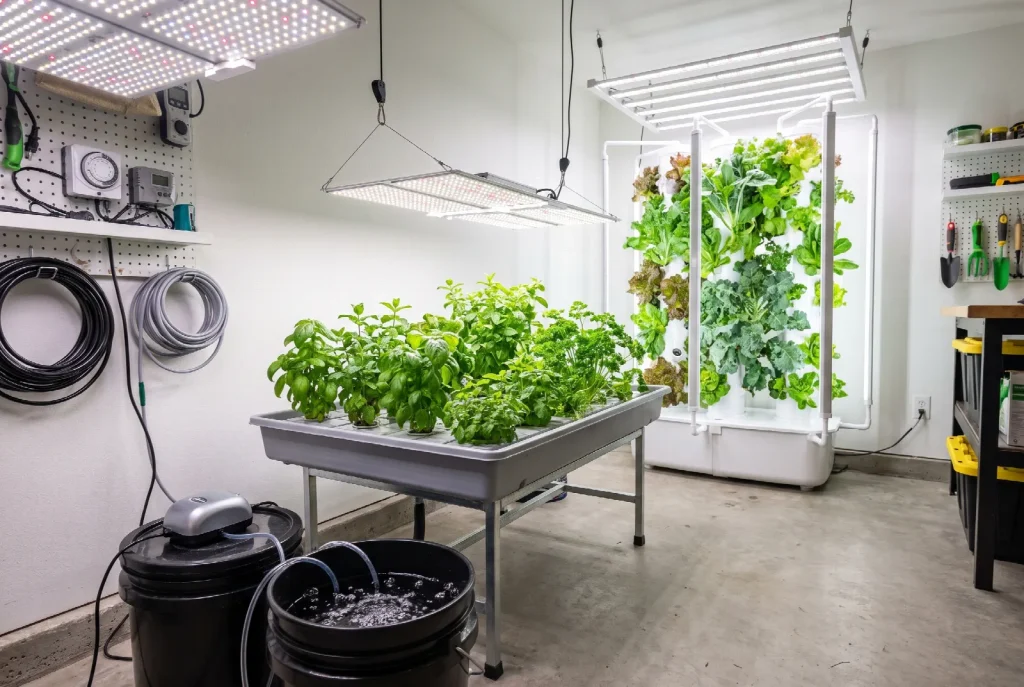
Every hydroponic system exists to answer one question: how do you keep roots wet and breathing at the same time? The six designs below are simply six different answers, ranked here from simplest to most demanding.
| System | Cost | Power needed | Difficulty | Best for |
|---|---|---|---|---|
| Kratky | $5 to $15 | None | Very easy | First-timers, herbs, leafy greens |
| Deep water culture | $25 to $60 | Air pump | Easy | Lettuce, herbs, a single tomato |
| Nutrient film technique | $50 to $200 | Water pump | Moderate | Lots of leafy greens in a small footprint |
| Ebb and flow | $75 to $300 | Pump and timer | Moderate | Mixed crops, larger plants |
| Drip | $50 to $250 | Pump and timer | Moderate | Tomatoes, peppers, fruiting crops |
| Aeroponics | $150 to $500+ | Pump and timer | Hard | Experienced growers chasing maximum yield |
Kratky method
Passive, no electricity, no moving parts. The simplest hydroponic system ever devised.
Read the guideDeep water culture
Roots suspended in an oxygenated reservoir. Simple, fast, and very forgiving.
Read the guideNutrient film technique
A thin film of solution flows past the roots continuously. Efficient and compact.
Read the guideEbb and flow
A tray floods and drains on a timer, alternating feeding with oxygenation.
Read the guideDrip systems
Solution drips to each plant individually. The workhorse of commercial growing.
Read the guideAeroponics
Roots hang in air and are misted at intervals. Fastest growth, least forgiving.
Read the guideAnswer five questions about your budget, space, experience and what you want to grow, and our system comparison tool ranks all six against your answers — with the reasoning shown, and an honest “nothing fits” when nothing does.